
Best for
- User asks to generate images with Stable Diffusion, SDXL, Flux, SD3, etc.
- User wants to run a specific ComfyUI workflow file
- User wants to chain generative steps (txt2img → upscale → face restore)
NousResearch/hermes-agent/skills/creative/comfyui/SKILL.md
Generate images, video, and audio via diffusion workflows.
Decision brief
Generate images, video, audio, and 3D content through ComfyUI using the official comfy-cli for setup/lifecycle and direct REST/WebSocket API for workflow execution.
In this controlled same-task single run, enabling comfyui changed the output from 2909 non-whitespace characters and 10 headings to 2496 characters and 9 headings. Matches among 8 signals extracted from the pinned source changed from 0 to 0. Both actual outputs are shown; this is a structural observation, not a quality score or a universal performance claim.
Create a test strategy and representative test cases for a JSON API schema comparison feature. Include failure cases and a clear verification procedure. The deliverable must specifically reflect this user intent: Generate images, video, and audio via diffusion workflows.
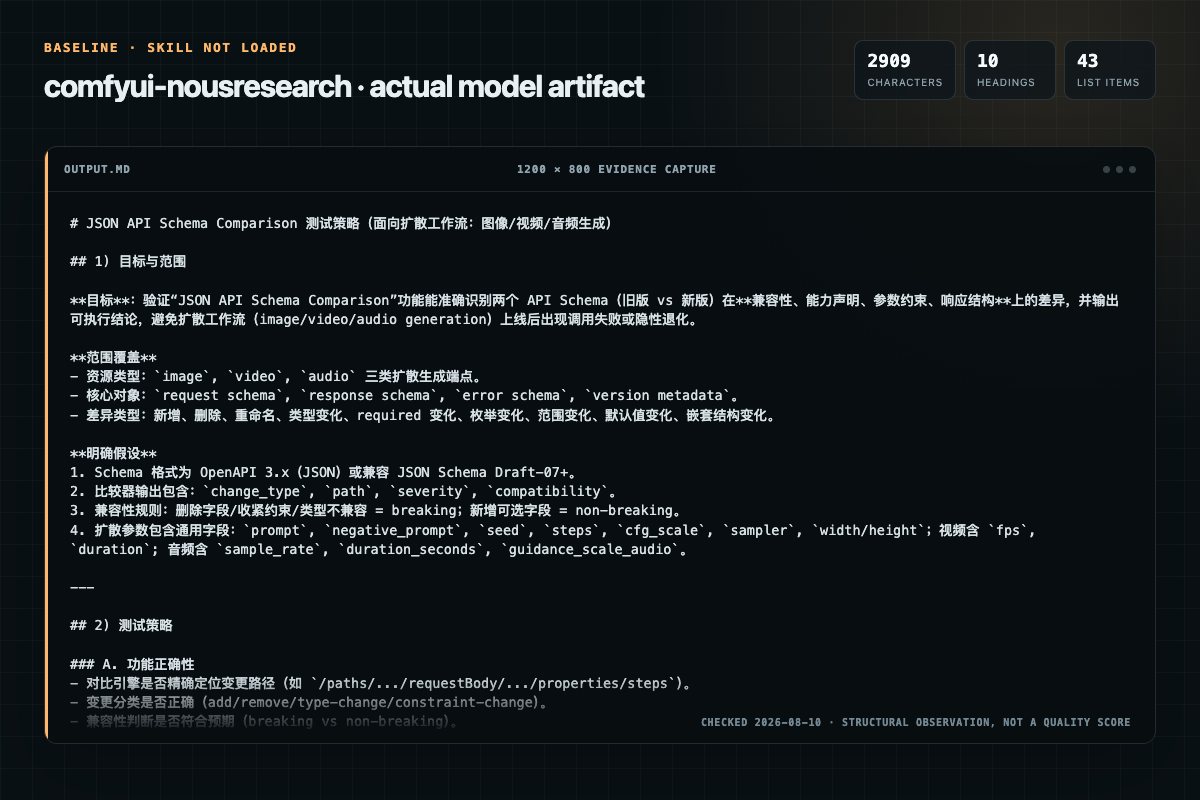
Baseline: 2909 non-whitespace characters, 10 headings, and 43 list items.
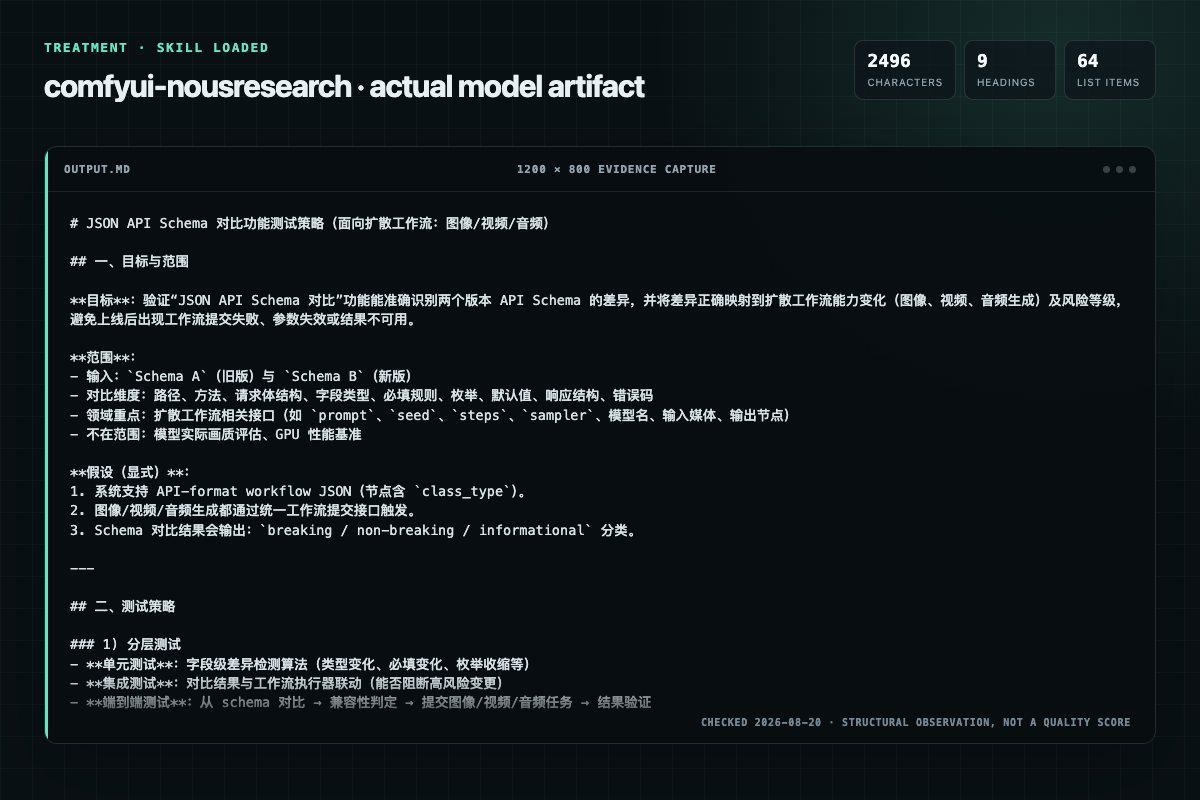
With Skill: 2496 non-whitespace characters, 9 headings, and 64 list items.
| Observation | Without Skill | With Skill |
|---|---|---|
| Source-signal coverage | 0/8: none | 0/8: none |
| Output structure | 2909 chars · 10 headings · 43 list items · 0 code blocks | 2496 chars · 9 headings · 64 list items · 0 code blocks |
| Verification and caution signals | 13 verification signals · 5 risk/limitation signals | 33 verification signals · 10 risk/limitation signals |
Use the comfyui Skill pinned at 6851841112e9 for my task. Follow its source-specific constraints around `comfyui`, `architecture`, `layers`, `quick`, then return the finished deliverable with explicit assumptions, verification, failure conditions, and limits. Do not treat the Skill text as a factual source or claim that a single demonstration proves universal performance.
Compatibility matrix
| Platform | Status | Evidence | What to check |
|---|---|---|---|
| Codex | Not declared | No explicit evidence | Portability before use |
| Claude Code | Not declared | No explicit evidence | Portability before use |
| Cursor | Not declared | No explicit evidence | Portability before use |
| Gemini CLI | Not declared | No explicit evidence | Portability before use |
Installation
The source command is displayed only when detected. A safe inspection prompt is always available so your agent can explain every action before execution.
npx skills add https://github.com/NousResearch/hermes-agent --skill "skills/creative/comfyui"Inspect the Agent Skill "comfyui" from https://github.com/NousResearch/hermes-agent/blob/64a6f42cb38def7ad6524bdfe640a16997c88760/skills/creative/comfyui/SKILL.md at commit 64a6f42cb38def7ad6524bdfe640a16997c88760. List every install step, command, network request, credential, file read/write, external action, and rollback step. Explain whether it fits my task. Do not install or execute anything until I approve.
Workflow
Review the “Quick Start” section in the pinned source before continuing.
Workflows must be in API format (each node has classtype). They come from:
Workflows must be in API format (each node has classtype). They come from:
bash python scripts/extractschema.py workflowapi.json --summary-only
Review the “Step 3: Run with parameters” section in the pinned source before continuing.
Permission review
The documentation includes network, browsing, or remote request actions.
curl -s http://127.0.0.1:8188/system_stats 2>/dev/null && echo "server: running"The documentation asks the agent to run terminal commands or scripts.
python scripts/hardware_check.pyThe documentation asks the agent to run terminal commands or scripts.
python scripts/health_check.pyThe documentation includes network, browsing, or remote request actions.
# Local (defaults to http://127.0.0.1:8188)The documentation includes sending, uploading, or posting data to a remote service.
| "cancel that" | REST | `curl -X POST http://HOST:8188/interrupt` |The documentation includes sending, uploading, or posting data to a remote service.
| "free GPU memory" | REST | `curl -X POST http://HOST:8188/free` |Evidence record
| Signal | Value | Evidence type | Meaning |
|---|---|---|---|
| Quality score | 93/100 | Computed | Documentation, specificity, maintenance, and trust rules |
| Repository stars | 235,927 | Source | Repository attention, not individual Skill quality |
| Compatibility | 0 platforms | Source | Declared in the catalog source record |
| Usage guide | tested outcome page | Tested | Generated or reviewed according to the visible evidence level |
Pinned source
Generate images, video, audio, and 3D content through ComfyUI using the
official comfy-cli for setup/lifecycle and direct REST/WebSocket API
for workflow execution.
Reference docs (references/):
official-cli.md — every comfy ... command, with flagsrest-api.md — REST + WebSocket endpoints (local + cloud), payload schemasworkflow-format.md — API-format JSON, common node types, param mappingtemplate-integrity.md — converting comfyui-workflow-templates from
editor format to API format: Reroute bypass, dotted dynamic-input keys
(values.a, resize_type.width), Cloud quirks (302 redirect, 1 concurrent
free-tier job, 1080p VRAM ceiling), Discord-compatible ffmpeg stitch.
Authored by @purzbeats. Load this whenever
you're starting from an official template.Scripts (scripts/):
| Script | Purpose |
|---|---|
_common.py | Shared HTTP, cloud routing, node catalogs (don't run directly) |
hardware_check.py | Probe GPU/VRAM/disk → recommend local vs Comfy Cloud |
comfyui_setup.sh | Hardware check + comfy-cli + ComfyUI install + launch + verify |
extract_schema.py | Read a workflow → list controllable params + model deps |
check_deps.py | Check workflow against running server → list missing nodes/models |
auto_fix_deps.py | Run check_deps then comfy node install / comfy model download |
run_workflow.py | Inject params, submit, monitor, download outputs (HTTP or WS) |
run_batch.py | Submit a workflow N times with sweeps, parallel up to your tier |
ws_monitor.py | Real-time WebSocket viewer for executing jobs (live progress) |
health_check.py | Verification checklist runner — comfy-cli + server + models + smoke test |
fetch_logs.py | Pull traceback / status messages for a given prompt_id |
Example workflows (workflows/): SD 1.5, SDXL, Flux Dev, SDXL img2img,
SDXL inpaint, ESRGAN upscale, AnimateDiff video, Wan T2V. See
workflows/README.md.
┌─────────────────────────────────────────────────────┐
│ Layer 1: comfy-cli (official lifecycle tool)        │
│   Setup, server lifecycle, custom nodes, models     │
│   → comfy install / launch / stop / node / model    │
└─────────────────────────┬───────────────────────────┘
                          │
┌─────────────────────────▼───────────────────────────┐
│ Layer 2: REST/WebSocket API + skill scripts         │
│   Workflow execution, param injection, monitoring   │
│   POST /api/prompt, GET /api/view, WS /ws           │
│   → run_workflow.py, run_batch.py, ws_monitor.py    │
└─────────────────────────────────────────────────────┘
Why two layers? The official CLI is excellent for installation and server management but has minimal workflow execution support. The REST/WS API fills that gap — the scripts handle param injection, execution monitoring, and output download that the CLI doesn't do.
# What's available?
command -v comfy >/dev/null 2>&1 && echo "comfy-cli: installed"
curl -s http://127.0.0.1:8188/system_stats 2>/dev/null && echo "server: running"

# Can this machine run ComfyUI locally? (GPU/VRAM/disk check)
python scripts/hardware_check.py
If nothing is installed, see Setup & Onboarding below — but always run the hardware check first.
python scripts/health_check.py
# → JSON: comfy_cli on PATH? server reachable? at least one checkpoint? smoke-test passes?
Workflows must be in API format (each node has class_type). They come from:
workflows/ directory (ready-to-run examples)Editor format (top-level nodes and links arrays) is not directly
executable. The scripts detect this and tell you to re-export.
python scripts/extract_schema.py workflow_api.json --summary-only
# → {"parameter_count": 12, "has_negative_prompt": true, "has_seed": true, ...}

python scripts/extract_schema.py workflow_api.json
# → full schema with parameters, model deps, embedding refs
# Local (defaults to http://127.0.0.1:8188)
python scripts/run_workflow.py \
  --workflow workflow_api.json \
  --args '{"prompt": "a beautiful sunset over mountains", "seed": -1, "steps": 30}' \
  --output-dir ./outputs

# Cloud (export API key once; uses correct /api routing automatically)
export COMFY_CLOUD_API_KEY="comfyui-..."
python scripts/run_workflow.py \
  --workflow workflow_api.json \
  --args '{"prompt": "..."}' \
  --host https://cloud.comfy.org \
  --output-dir ./outputs

# Real-time progress via WebSocket (requires `pip install websocket-client`)
python scripts/run_workflow.py \
  --workflow flux_dev.json \
  --args '{"prompt": "..."}' \
  --ws

# img2img / inpaint: pass --input-image to upload + reference automatically
python scripts/run_workflow.py \
  --workflow sdxl_img2img.json \
  --input-image image=./photo.png \
  --args '{"prompt": "make it watercolor", "denoise": 0.6}'

# Batch / sweep: 8 random seeds, parallel up to cloud tier limit
python scripts/run_batch.py \
  --workflow sdxl.json \
  --args '{"prompt": "abstract"}' \
  --count 8 --randomize-seed --parallel 3 \
  --output-dir ./outputs/batch
-1 for seed (or omitting it with --randomize-seed) generates a fresh
random seed per run.
The scripts emit JSON to stdout describing every output file:
{
  "status": "success",
  "prompt_id": "abc-123",
  "outputs": [
    {"file": "./outputs/sdxl_00001_.png", "node_id": "9",
     "type": "image", "filename": "sdxl_00001_.png"}
  ]
}
| User says | Tool | Command |
|---|---|---|
| Lifecycle (use comfy-cli) | ||
| "install ComfyUI" | comfy-cli | bash scripts/comfyui_setup.sh |
| "start ComfyUI" | comfy-cli | comfy launch --background |
| "stop ComfyUI" | comfy-cli | comfy stop |
| "install X node" | comfy-cli | comfy node install <name> |
| "download X model" | comfy-cli | comfy model download --url <url> --relative-path models/checkpoints |
| "list installed models" | comfy-cli | comfy model list |
| "list installed nodes" | comfy-cli | comfy node show installed |
| Execution (use scripts) | ||
| "is everything ready?" | script | health_check.py (optionally with --workflow X --smoke-test) |
| "what can I change in this workflow?" | script | extract_schema.py W.json |
| "check if W's deps are met" | script | check_deps.py W.json |
| "fix missing deps" | script | auto_fix_deps.py W.json |
| "generate an image" | script | run_workflow.py --workflow W --args '{...}' |
| "use this image" (img2img) | script | run_workflow.py --input-image image=./x.png ... |
| "8 variations with random seeds" | script | run_batch.py --count 8 --randomize-seed ... |
| "show me live progress" | script | ws_monitor.py --prompt-id <id> |
| "fetch the error from job X" | script | fetch_logs.py <prompt_id> |
| Direct REST | ||
| "what's in the queue?" | REST | curl http://HOST:8188/queue (local) or --host https://cloud.comfy.org |
| "cancel that" | REST | curl -X POST http://HOST:8188/interrupt |
| "free GPU memory" | REST | curl -X POST http://HOST:8188/free |
When a user asks to set up ComfyUI, the FIRST thing to do is ask whether they want Comfy Cloud (hosted, zero install, API key) or Local (install ComfyUI on their machine). Don't start running install commands or hardware checks until they've answered.
Official docs: https://docs.comfy.org/installation CLI docs: https://docs.comfy.org/comfy-cli/getting-started Cloud docs: https://docs.comfy.org/get_started/cloud Cloud API: https://docs.comfy.org/development/cloud/overview
Suggested script:
"Do you want to run ComfyUI locally on your machine, or use Comfy Cloud?
- Comfy Cloud — hosted on RTX 6000 Pro GPUs, all common models pre-installed, zero setup. Requires an API key (paid subscription required to actually run workflows; free tier is read-only). Best if you don't have a capable GPU.
- Local — free, but your machine MUST meet the hardware requirements:
- NVIDIA GPU with ≥6 GB VRAM (≥8 GB for SDXL, ≥12 GB for Flux/video), OR
- AMD GPU with ROCm support (Linux), OR
- Apple Silicon Mac (M1+) with ≥16 GB unified memory (≥32 GB recommended).
- Intel Macs and machines with no GPU will NOT work — use Cloud instead.
Which would you like?"
Routing:
python scripts/hardware_check.py --json
# Optional: also probe `torch` for actual CUDA/MPS:
python scripts/hardware_check.py --json --check-pytorch
| Verdict | Meaning | Action |
|---|---|---|
ok | ≥8 GB VRAM (discrete) OR ≥32 GB unified (Apple Silicon) | Local install — use comfy_cli_flag from report |
marginal | SD1.5 works; SDXL tight; Flux/video unlikely | Local OK for light workflows, else Path A (Cloud) |
cloud | No usable GPU, <6 GB VRAM, <16 GB Apple unified, Intel Mac, Rosetta Python | Switch to Cloud unless user explicitly forces local |
The script also surfaces wsl: true (WSL2 with NVIDIA passthrough) and
rosetta: true (x86_64 Python on Apple Silicon — must reinstall as ARM64).
If verdict is cloud but the user wants local, do not proceed silently.
Show the notes array verbatim and ask whether they want to (a) switch to
Cloud or (b) force a local install (will OOM or be unusably slow on modern models).
Use the hardware check first. The table below is the fallback for when the user has already told you their hardware:
| Situation | Recommended Path |
|---|---|
verdict: cloud from hardware check | Path A: Comfy Cloud |
| No GPU / want to try without commitment | Path A: Comfy Cloud |
| Windows + NVIDIA + non-technical | Path B: ComfyUI Desktop |
| Windows + NVIDIA + technical | Path C: Portable or Path D: comfy-cli |
| Linux + any GPU | Path D: comfy-cli (easiest) |
| macOS + Apple Silicon | Path B: Desktop or Path D: comfy-cli |
| Headless / server / CI / agents | Path D: comfy-cli |
For the fully automated path (hardware check → install → launch → verify):
bash scripts/comfyui_setup.sh
# Or with overrides:
bash scripts/comfyui_setup.sh --m-series --port=8190 --workspace=/data/comfy
It runs hardware_check.py internally, refuses to install locally when the
verdict is cloud (unless --force-cloud-override), picks the right
comfy-cli flag, and prefers pipx/uvx over global pip to avoid polluting
system Python.
For users without a capable GPU or who want zero setup. Hosted on RTX 6000 Pro.
Docs: https://docs.comfy.org/get_started/cloud
export COMFY_CLOUD_API_KEY="your-comfyui-key"
python scripts/run_workflow.py \
  --workflow workflows/flux_dev_txt2img.json \
  --args '{"prompt": "..."}' \
  --host https://cloud.comfy.org \
  --output-dir ./outputs
Pricing: https://www.comfy.org/cloud/pricing
Concurrent jobs: Free/Standard 1, Creator 3, Pro 5. Free tier
cannot run workflows via API — only browse models. Paid subscription
required for /api/prompt, /api/upload/*, /api/view, etc.
One-click installer for non-technical users. Currently Beta.
Docs: https://docs.comfy.org/installation/desktop
Linux is not supported for Desktop — use Path D.
Docs: https://docs.comfy.org/installation/comfyui_portable_windows
Download from https://github.com/comfyanonymous/ComfyUI/releases, extract,
run run_nvidia_gpu.bat. Update via update/update_comfyui_stable.bat.
The official CLI is the best path for headless/automated setups.
Docs: https://docs.comfy.org/comfy-cli/getting-started
# Recommended:
pipx install comfy-cli
# Or use uvx without installing:
uvx --from comfy-cli comfy --help
# Or (if pipx/uvx unavailable):
pip install --user comfy-cli
Disable analytics non-interactively:
comfy --skip-prompt tracking disable
comfy --skip-prompt install --nvidia              # NVIDIA (CUDA)
comfy --skip-prompt install --amd                 # AMD (ROCm, Linux)
comfy --skip-prompt install --m-series            # Apple Silicon (MPS)
comfy --skip-prompt install --cpu                 # CPU only (slow)
comfy --skip-prompt install --nvidia --fast-deps  # uv-based dep resolution
Default location: ~/comfy/ComfyUI (Linux), ~/Documents/comfy/ComfyUI
(macOS/Win). Override with comfy --workspace /custom/path install.
comfy launch --background                       # background daemon on :8188
comfy launch -- --listen 0.0.0.0 --port 8190    # LAN-accessible custom port
curl -s http://127.0.0.1:8188/system_stats      # health check
For Ascend NPU, Cambricon MLU, Intel Arc, or other unsupported hardware.
Docs: https://docs.comfy.org/installation/manual_install
git clone https://github.com/comfyanonymous/ComfyUI.git
cd ComfyUI
pip install torch torchvision torchaudio --extra-index-url https://download.pytorch.org/whl/cu130
pip install -r requirements.txt
python main.py
# SDXL (general purpose, ~6.5 GB)
comfy model download \
  --url "https://huggingface.co/stabilityai/stable-diffusion-xl-base-1.0/resolve/main/sd_xl_base_1.0.safetensors" \
  --relative-path models/checkpoints

# SD 1.5 (lighter, ~4 GB, good for 6 GB cards)
comfy model download \
  --url "https://huggingface.co/stable-diffusion-v1-5/stable-diffusion-v1-5/resolve/main/v1-5-pruned-emaonly.safetensors" \
  --relative-path models/checkpoints

# Flux Dev fp8 (smaller variant, ~12 GB)
comfy model download \
  --url "https://huggingface.co/Comfy-Org/flux1-dev/resolve/main/flux1-dev-fp8.safetensors" \
  --relative-path models/checkpoints

# CivitAI (set token first):
comfy model download \
  --url "https://civitai.com/api/download/models/128713" \
  --relative-path models/checkpoints \
  --set-civitai-api-token "YOUR_TOKEN"
List installed: comfy model list.
comfy node install comfyui-impact-pack             # popular utility pack
comfy node install comfyui-animatediff-evolved     # video generation
comfy node install comfyui-controlnet-aux          # ControlNet preprocessors
comfy node install comfyui-essentials              # common helpers
comfy node update all
comfy node install-deps --workflow=workflow.json   # install everything a workflow needs
python scripts/health_check.py
# → comfy_cli on PATH? server reachable? checkpoints? smoke test?

python scripts/check_deps.py my_workflow.json
# → are this workflow's nodes/models/embeddings installed?

python scripts/run_workflow.py \
  --workflow workflows/sd15_txt2img.json \
  --args '{"prompt": "test", "steps": 4}' \
  --output-dir ./test-outputs
The simplest way is to use --input-image with run_workflow.py:
python scripts/run_workflow.py \
  --workflow workflows/sdxl_img2img.json \
  --input-image image=./photo.png \
  --args '{"prompt": "make it cyberpunk", "denoise": 0.6}'
The flag uploads photo.png, then injects its server-side filename into
whatever schema parameter is named image. For inpainting, pass both:
python scripts/run_workflow.py \
  --workflow workflows/sdxl_inpaint.json \
  --input-image image=./photo.png \
  --input-image mask_image=./mask.png \
  --args '{"prompt": "fill with flowers"}'
Manual upload via REST:
curl -X POST "http://127.0.0.1:8188/upload/image" \
  -F "[email protected]" -F "type=input" -F "overwrite=true"
# Returns: {"name": "photo.png", "subfolder": "", "type": "input"}

# Cloud equivalent:
curl -X POST "https://cloud.comfy.org/api/upload/image" \
  -H "X-API-Key: $COMFY_CLOUD_API_KEY" \
  -F "[email protected]" -F "type=input" -F "overwrite=true"
https://cloud.comfy.orgX-API-Key header (or ?token=KEY for WebSocket)$COMFY_CLOUD_API_KEY once and the scripts pick it up automatically/api/view returns a 302 to a signed URL; the scripts
follow it and strip X-API-Key before fetching from the storage backend
(don't leak the API key to S3/CloudFront)./api/object_info, /api/queue, /api/userdata — 403 on free tier;
paid only./history is renamed to /history_v2 on cloud (the scripts route
automatically)./models/<folder> is renamed to /experiment/models/<folder> on cloud
(the scripts route automatically).clientId in WebSocket is currently ignored — all connections for a
user receive the same broadcast. Filter by prompt_id client-side.subfolder is accepted on uploads but ignored — cloud has a flat namespace.run_batch.py --parallel N to saturate your tier.# Local
curl -s http://127.0.0.1:8188/queue | python -m json.tool
curl -X POST http://127.0.0.1:8188/queue -d '{"clear": true}' # cancel pending
curl -X POST http://127.0.0.1:8188/interrupt # cancel running
curl -X POST http://127.0.0.1:8188/free \
-H "Content-Type: application/json" \
-d '{"unload_models": true, "free_memory": true}'
# Cloud — same paths under /api/, plus:
python scripts/fetch_logs.py --tail-queue --host https://cloud.comfy.org
API format required — every script and the /api/prompt endpoint expect
API-format workflow JSON. The scripts detect editor format (top-level
nodes and links arrays) and tell you to re-export via
"Workflow → Export (API)" (newer UI) or "Save (API Format)" (older UI).
Server must be running — all execution requires a live server.
comfy launch --background starts one. Verify with
curl http://127.0.0.1:8188/system_stats.
Model names are exact — case-sensitive, includes file extension.
check_deps.py does fuzzy matching (with/without extension and folder
prefix), but the workflow itself must use the canonical name. Use
comfy model list to discover what's installed.
Missing custom nodes — "class_type not found" means a required node
isn't installed. check_deps.py reports which package to install;
auto_fix_deps.py runs the install for you.
Working directory — comfy-cli auto-detects the ComfyUI workspace.
If commands fail with "no workspace found", use
comfy --workspace /path/to/ComfyUI <command> or
comfy set-default /path/to/ComfyUI.
Cloud free-tier API limits — /api/prompt, /api/view, /api/upload/*,
/api/object_info all return 403 on free accounts. health_check.py and
check_deps.py handle this gracefully and surface a clear message.
Timeout for video/audio workflows — auto-detected when an output node
is VHS_VideoCombine, SaveVideo, etc.; the default jumps from 300 s to
900 s. Override explicitly with --timeout 1800.
Path traversal in output filenames — server-supplied filenames are
passed through safe_path_join to refuse anything escaping --output-dir.
Keep this protection on — workflows with custom save nodes can produce
arbitrary paths.
Workflow JSON is arbitrary code — custom nodes run Python, so
submitting an unknown workflow has the same trust profile as eval.
Inspect workflows from untrusted sources before running.
Auto-randomized seed — pass seed: -1 in --args (or use
--randomize-seed and omit the seed) to get a fresh seed per run.
The actual seed is logged to stderr.
tracking prompt — first run of comfy may prompt for analytics.
Use comfy --skip-prompt tracking disable to skip non-interactively.
comfyui_setup.sh does this for you.
Use python scripts/health_check.py to run the whole list at once. Manual:
hardware_check.py verdict is ok OR the user explicitly chose Comfy Cloudcomfy --version works (or uvx --from comfy-cli comfy --help)curl http://HOST:PORT/system_stats returns JSONcomfy model list shows at least one checkpoint (local) OR
/api/experiment/models/checkpoints returns models (cloud)check_deps.py reports is_ready: true (or only node_check_skipped
on cloud free tier)--output-dirFrequently asked questions
Generate images, video, audio, and 3D content through ComfyUI using the official comfy-cli for setup/lifecycle and direct REST/WebSocket API for workflow execution.
The source record exposes this install command: npx skills add https://github.com/NousResearch/hermes-agent --skill "skills/creative/comfyui". Inspect the command and pinned source before running it.
Static rules flagged network, exec-script, send-data in the source; the page lists the matching lines and excerpts.
Alternatives
garrytan/gbrain
End-to-end discipline for turning any large data source (audio libraries, email takeouts, document corpora, chat exports, API dumps) into brain pages at scale. The lifecycle spine: SCHEMA → ACCESS → TRIAL → EVALUATE → IMPROVE → CODIFY → TEST → SKILLIFY → BULK → MONITOR. State is tracked in a durable JSON manifest (see MANIFEST-PATTERN.md) so any crash, session boundary, or subagent fan-out resumes from ground truth instead of memory.
alirezarezvani/claude-skills
App Store Optimization (ASO) toolkit for researching keywords, analyzing competitor rankings, generating metadata suggestions, and improving app visibility on Apple App Store and Google Play Store. Use when the user asks about ASO, app store rankings, app metadata, app titles and descriptions, app store listings, app visibility, or mobile app marketing on iOS or Android. Supports keyword research and scoring, competitor keyword analysis, metadata optimization, A/B test planning, launch checklist
dotnet/skills
Migrates .NET test projects from VSTest to Microsoft.Testing.Platform (MTP). Use when user asks to "migrate to MTP", "switch from VSTest", "enable Microsoft.Testing.Platform", "use MTP runner", set OutputType=Exe only for test projects in Directory.Build.props, or mentions EnableMSTestRunner, EnableNUnitRunner, or UseMicrosoftTestingPlatformRunner. USE FOR: MTP behavioral differences vs VSTest (exit code 8, zero tests discovered, --ignore-exit-code, TESTINGPLATFORM_EXITCODE_IGNORE); centralizing
vipshop/cache-dit
High-level guide for integrating a new DiT model into cache-dit: Cache (BlockAdapter/ForwardPattern), Context Parallelism, Tensor Parallelism, Text Encoder Parallelism (TE-P), VAE Parallelism (VAE-P), generate CLI, installation, testing workflow, and detailed references. Use when adding support for a new diffusion transformer model in cache-dit.