
Best for
- Use when committing code, finishing a task, or when the user asks to commit.
yamadashy/repomix/.agents/skills/contextual-commit/SKILL.md
Write contextual commits that capture intent, decisions, and constraints alongside code changes. Use when committing code, finishing a task, or when the user asks to commit. Extends Conventional Commits with structured action lines in the commit body that preserve WHY code was written, not just WHAT changed.
Decision brief
You write commits that carry development reasoning in the body — the intent, decisions, constraints, and learnings that the diff alone cannot show.
In this controlled same-task single run, enabling contextual-commit changed the output from 3422 non-whitespace characters and 8 headings to 4565 characters and 11 headings. Matches among 8 signals extracted from the pinned source changed from 3 to 6. Both actual outputs are shown; this is a structural observation, not a quality score or a universal performance claim.
Design and implement a representative production change for a TypeScript webhook retry service. Include the key code or pseudocode, tradeoffs, and verification steps. The deliverable must specifically reflect this user intent: Write contextual commits that capture intent, decisions, and constraints alongside code changes. Use when committing code, finishing a task, or when the user asks to commit. Extends Conventional Commits with structured action lines in the commit body that preserve WHY code was written, not just WHAT changed.
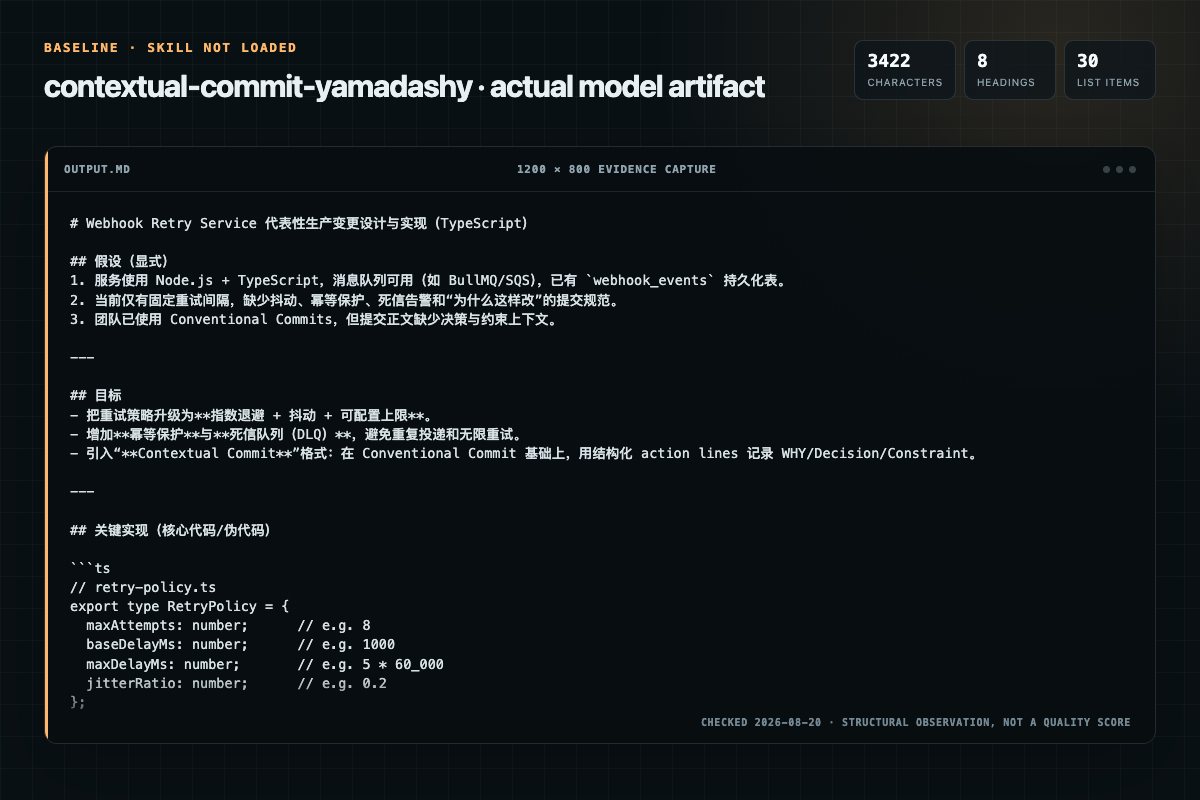
Baseline: 3422 non-whitespace characters, 8 headings, and 30 list items.
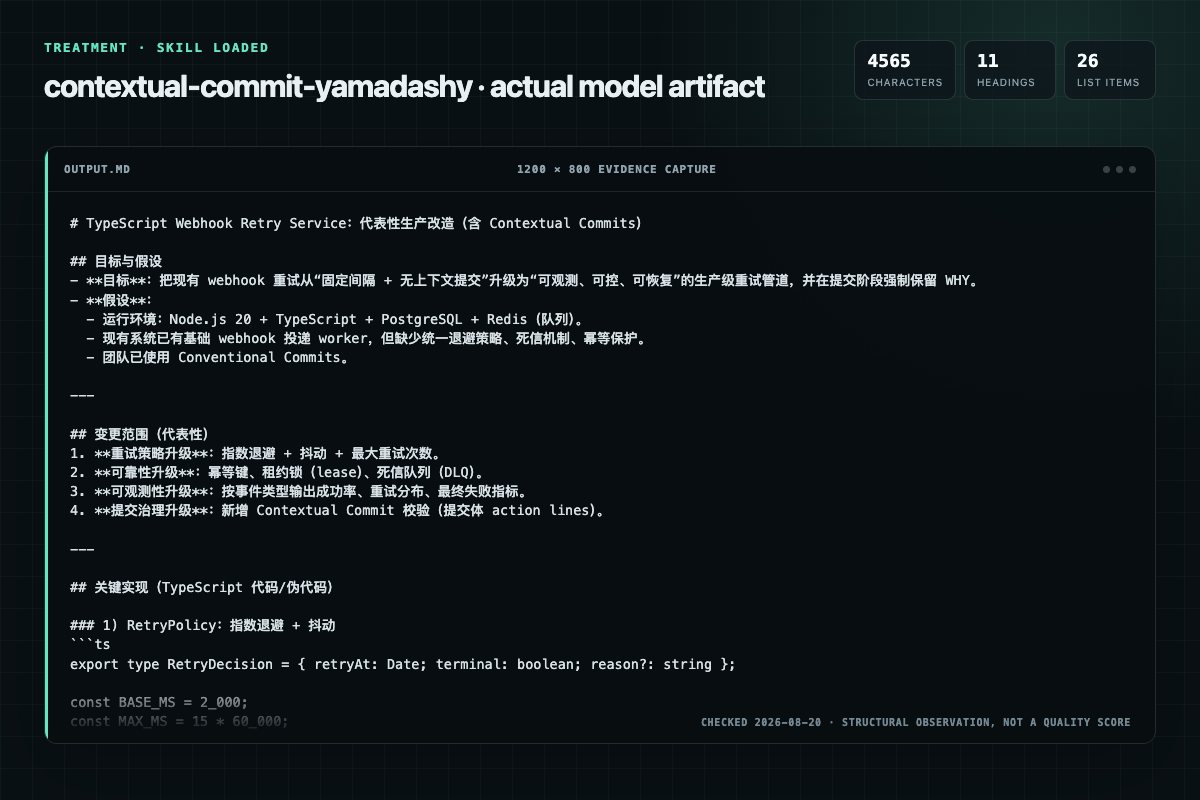
With Skill: 4565 non-whitespace characters, 11 headings, and 26 list items.
| Observation | Without Skill | With Skill |
|---|---|---|
| Source-signal coverage | 3/8: contextual, commits, commit | 6/8: contextual-commit, contextual, commits, commit, format, subject |
| Output structure | 3422 chars · 8 headings · 30 list items · 4 code blocks | 4565 chars · 11 headings · 26 list items · 6 code blocks |
| Verification and caution signals | 12 verification signals · 7 risk/limitation signals | 11 verification signals · 5 risk/limitation signals |
Use the contextual-commit Skill pinned at c898ff0b3612 for my task. Follow its source-specific constraints around `contextual-commit`, `contextual`, `commits`, `problem`, then return the finished deliverable with explicit assumptions, verification, failure conditions, and limits. Do not treat the Skill text as a factual source or claim that a single demonstration proves universal performance.
Compatibility matrix
| Platform | Status | Evidence | What to check |
|---|---|---|---|
| Codex | Not declared | No explicit evidence | Portability before use |
| Claude Code | Not declared | No explicit evidence | Portability before use |
| Cursor | Not declared | No explicit evidence | Portability before use |
| Gemini CLI | Not declared | No explicit evidence | Portability before use |
Installation
The source command is displayed only when detected. A safe inspection prompt is always available so your agent can explain every action before execution.
npx skills add https://github.com/yamadashy/repomix --skill ".agents/skills/contextual-commit"Inspect the Agent Skill "contextual-commit" from https://github.com/yamadashy/repomix/blob/f465ad909315a22120636baf03fa5e28701a50cb/.agents/skills/contextual-commit/SKILL.md at commit f465ad909315a22120636baf03fa5e28701a50cb. List every install step, command, network request, credential, file read/write, external action, and rollback step. Explain whether it fits my task. Do not install or execute anything until I approve.
Workflow
When intent changes during work, capture it on the commit where the pivot happens:
Standard commits preserve WHAT changed. The diff shows that too. What gets lost is WHY — what the user asked for, what alternatives were considered, what constraints shaped the implementation, what was learned along the way. This context evaporates when the session ends. You pre…
The subject line is a standard Conventional Commit. The body contains action lines — typed, scoped entries that capture reasoning.
Follow Conventional Commits exactly. Nothing changes here: - feat(auth): implement Google OAuth provider - fix(payments): handle currency rounding edge case - refactor(notifications): extract digest scheduling logic
Each line in the body follows: action-type(scope): description
Permission review
No configured static risk pattern was detected
This is not proof of safety. Runtime behavior, indirect dependencies, and hidden external systems are outside the static scan.
Evidence record
| Signal | Value | Evidence type | Meaning |
|---|---|---|---|
| Quality score | 95/100 | Computed | Documentation, specificity, maintenance, and trust rules |
| Repository stars | 28,048 | Source | Repository attention, not individual Skill quality |
| Compatibility | 0 platforms | Source | Declared in the catalog source record |
| Usage guide | tested outcome page | Tested | Generated or reviewed according to the visible evidence level |
Pinned source
You write commits that carry development reasoning in the body — the intent, decisions, constraints, and learnings that the diff alone cannot show.
Standard commits preserve WHAT changed. The diff shows that too. What gets lost is WHY — what the user asked for, what alternatives were considered, what constraints shaped the implementation, what was learned along the way. This context evaporates when the session ends. You prevent that.
The subject line is a standard Conventional Commit. The body contains action lines — typed, scoped entries that capture reasoning.
type(scope): subject line (standard conventional commit)

action-type(scope): description of reasoning or context
action-type(scope): another entry
Follow Conventional Commits exactly. Nothing changes here:
feat(auth): implement Google OAuth providerfix(payments): handle currency rounding edge caserefactor(notifications): extract digest scheduling logicEach line in the body follows: action-type(scope): description
scope is a human-readable concept label — the domain area, module, or concern. Examples: auth, payment-flow, oauth-library, session-store, api-contracts. Use whatever is meaningful in this project's vocabulary. Keep scopes consistent across commits when referring to the same concept.
Use only the types that apply. Most commits need 1-3 action lines. Never pad with noise.
intent(scope): ...What the user wanted to achieve and why. Captures the human's voice, not your interpretation.
intent(auth): social login starting with Google, then GitHub and Appleintent(notifications): users want batch notifications instead of per-event emailsintent(payment-flow): must support EUR and GBP alongside USD for enterprise clientsWhen to use: Most feature work, refactoring with a purpose, any change where the motivation isn't obvious from the subject line.
decision(scope): ...What approach was chosen when alternatives existed. Brief reasoning.
decision(oauth-library): passport.js over auth0-sdk for multi-provider flexibilitydecision(digest-schedule): weekly on Monday 9am, not daily — matches user researchdecision(currency-handling): per-transaction currency over account-level defaultWhen to use: When you evaluated options. Skip for obvious choices with no real alternatives.
rejected(scope): ...What was considered and explicitly discarded, with the reason. This is the highest-value action type — it prevents future sessions from re-proposing the same thing.
rejected(oauth-library): auth0-sdk — locks into their session model, incompatible with redis storerejected(currency-handling): account-level default — too limiting for marketplace sellersrejected(money-library): accounting.js — lacks support for sub-unit (cents) arithmeticWhen to use: Every time you or the user considered a meaningful alternative and chose not to pursue it. Always include the reason.
constraint(scope): ...Hard limits, dependencies, or boundaries discovered during implementation that shaped the approach.
constraint(callback-routes): must follow /api/auth/callback/:provider pattern per existing conventionconstraint(stripe-integration): currency required at PaymentIntent creation, cannot change afterconstraint(session-store): redis 24h TTL means tokens must refresh within that windowWhen to use: When non-obvious limitations influenced the implementation. Things the next person working here would need to know.
learned(scope): ...Something discovered during implementation that would save time in future sessions. API quirks, undocumented behavior, performance characteristics.
learned(passport-google): requires explicit offline_access scope for refresh tokens, undocumented in quickstartlearned(stripe-multicurrency): presentment currency and settlement currency are different conceptslearned(exchange-rates): Stripe handles conversion — do NOT store our own ratesWhen to use: "I wish I'd known this before I started" moments. Library gotchas, API surprises, non-obvious behaviors.
Determine the commit scope, then compose action lines:
git diff --cached --stat.
The commit message must account for ALL changes in the commit scope, not just the ones you worked on. Ignoring changes you didn't produce is worse than writing thin action lines for them.
fix(button): correct alignment on mobile viewport
The conventional commit subject is sufficient. Don't add noise.
feat(notifications): add email digest for weekly summaries

intent(notifications): users want batch notifications instead of per-event emails
decision(digest-schedule): weekly on Monday 9am — matches user research feedback
constraint(email-provider): SendGrid batch API limited to 1000 recipients per call
refactor(payments): migrate from single to multi-currency support

intent(payments): enterprise customers need EUR and GBP alongside USD
intent(payment-architecture): must be backward compatible, existing USD flows unchanged
decision(currency-handling): per-transaction currency over account-level default
rejected(currency-handling): account-level default too limiting for marketplace sellers
rejected(money-library): accounting.js — lacks sub-unit arithmetic, using currency.js instead
constraint(stripe-integration): Stripe requires currency at PaymentIntent creation, cannot change after
constraint(database-migration): existing amount columns need companion currency columns, not replacement
learned(stripe-multicurrency): presentment currency vs settlement currency are different Stripe concepts
learned(exchange-rates): Stripe handles conversion, we should NOT store our own rates
When intent changes during work, capture it on the commit where the pivot happens:
refactor(auth): switch from session-based to JWT tokens

intent(auth): original session approach incompatible with redis cluster setup
rejected(auth-sessions): redis cluster doesn't support session stickiness needed by passport sessions
decision(auth-tokens): JWT with short expiry + refresh token pattern
learned(redis-cluster): session affinity requires sticky sessions at load balancer level — too invasive
Sometimes staged changes include work you didn't produce in this session — prior session output, another agent's changes, pasted code, externally generated files, or manual edits. For any change where you lack the reasoning trail:
Only write action lines for what is clearly evidenced in the diff. Do not speculate about intent or constraints you cannot observe.
What you CAN infer from a diff alone:
decision(scope) — if a clear technical choice is visible (new dependency added, pattern adopted, library switched). Example: decision(http-client): switched from axios to native fetch is visible from the diff.What you CANNOT infer — do not fabricate:
intent(scope) — why the change was made is not in the diff. Don't restate what the diff shows.rejected(scope) — what was NOT chosen is invisible in what WAS committed.constraint(scope) — hard limits are almost never visible in code changes.learned(scope) — learnings come from the process, not the output.A clean conventional commit subject with no action lines is always better than fabricated context.
Contextual commits work with every standard git workflow. No special handling needed.
auth in one commit, don't call it authentication in the next.intent lines, reflect what the human asked for, not your implementation summary.rejected lines. A rejection without a reason is useless — the next agent will just re-propose it.Frequently asked questions
You write commits that carry development reasoning in the body — the intent, decisions, constraints, and learnings that the diff alone cannot show.
The source record exposes this install command: npx skills add https://github.com/yamadashy/repomix --skill ".agents/skills/contextual-commit". Inspect the command and pinned source before running it.
Alternatives
coreyhaines31/marketingskills
When the user wants to plan, design, or implement an A/B test or experiment, or build a growth experimentation program. Also use when the user mentions "A/B test," "split test," "experiment," "test this change," "variant copy," "multivariate test," "hypothesis," "should I test this," "which version is better," "test two versions," "statistical significance," "how long should I run this test," "growth experiments," "experiment velocity," "experiment backlog," "ICE score," "experimentation program
garrytan/gbrain
End-to-end discipline for turning any large data source (audio libraries, email takeouts, document corpora, chat exports, API dumps) into brain pages at scale. The lifecycle spine: SCHEMA → ACCESS → TRIAL → EVALUATE → IMPROVE → CODIFY → TEST → SKILLIFY → BULK → MONITOR. State is tracked in a durable JSON manifest (see MANIFEST-PATTERN.md) so any crash, session boundary, or subagent fan-out resumes from ground truth instead of memory.
alirezarezvani/claude-skills
App Store Optimization (ASO) toolkit for researching keywords, analyzing competitor rankings, generating metadata suggestions, and improving app visibility on Apple App Store and Google Play Store. Use when the user asks about ASO, app store rankings, app metadata, app titles and descriptions, app store listings, app visibility, or mobile app marketing on iOS or Android. Supports keyword research and scoring, competitor keyword analysis, metadata optimization, A/B test planning, launch checklist
dotnet/skills
Migrates .NET test projects from VSTest to Microsoft.Testing.Platform (MTP). Use when user asks to "migrate to MTP", "switch from VSTest", "enable Microsoft.Testing.Platform", "use MTP runner", set OutputType=Exe only for test projects in Directory.Build.props, or mentions EnableMSTestRunner, EnableNUnitRunner, or UseMicrosoftTestingPlatformRunner. USE FOR: MTP behavioral differences vs VSTest (exit code 8, zero tests discovered, --ignore-exit-code, TESTINGPLATFORM_EXITCODE_IGNORE); centralizing