
Best for
- The frontmatter description carries the trigger phrases. In short: use this to get a user's app onto a cloud simulator and interact with it — especially from a Mac-less or cloud/sandbox agent. Not for local sims (expo r…
expo/skills/plugins/expo/skills/eas-simulator/SKILL.md
EAS service (paid). Run and control a user's app on a remote iOS/Android simulator hosted on EAS cloud. Read before running any `eas simulator:*` commands - it has the current syntax for this experimental API. Use whenever the user needs a simulator they can't run locally - 'run my app on a cloud simulator', 'use eas simulator to run/install/screenshot my app', 'I'm on Linux/Cursor and need an iOS device', 'no sim on this box / headless CI', 'let an agent click through my app and screenshot it',
Decision brief
EAS service - costs apply. EAS Simulator runs on Expo Application Services cloud infrastructure, a paid product with free-tier limits; remote simulator sessions use your plan's compute allowance. See https://expo.dev/pricing.
In this controlled same-task single run, enabling eas-simulator changed the output from 2436 non-whitespace characters and 9 headings to 2748 characters and 9 headings. Matches among 8 signals extracted from the pinned source changed from 1 to 2. Both actual outputs are shown; this is a structural observation, not a quality score or a universal performance claim.
Create a test strategy and representative test cases for a JSON API schema comparison feature. Include failure cases and a clear verification procedure. The deliverable must specifically reflect this user intent: EAS service (paid). Run and control a user's app on a remote iOS/Android simulator hosted on EAS cloud. Read before running any `eas simulator:*` commands - it has the current syntax for this experimental API. Use whenever the user needs a simulator they can't run locally - 'run my app on a cloud simulator', 'use eas simulator to run/install/screenshot my app', 'I'm on Linux/Cursor and need an iOS device', 'no sim on this box / headless CI', 'let an agent click through my app and screenshot it',
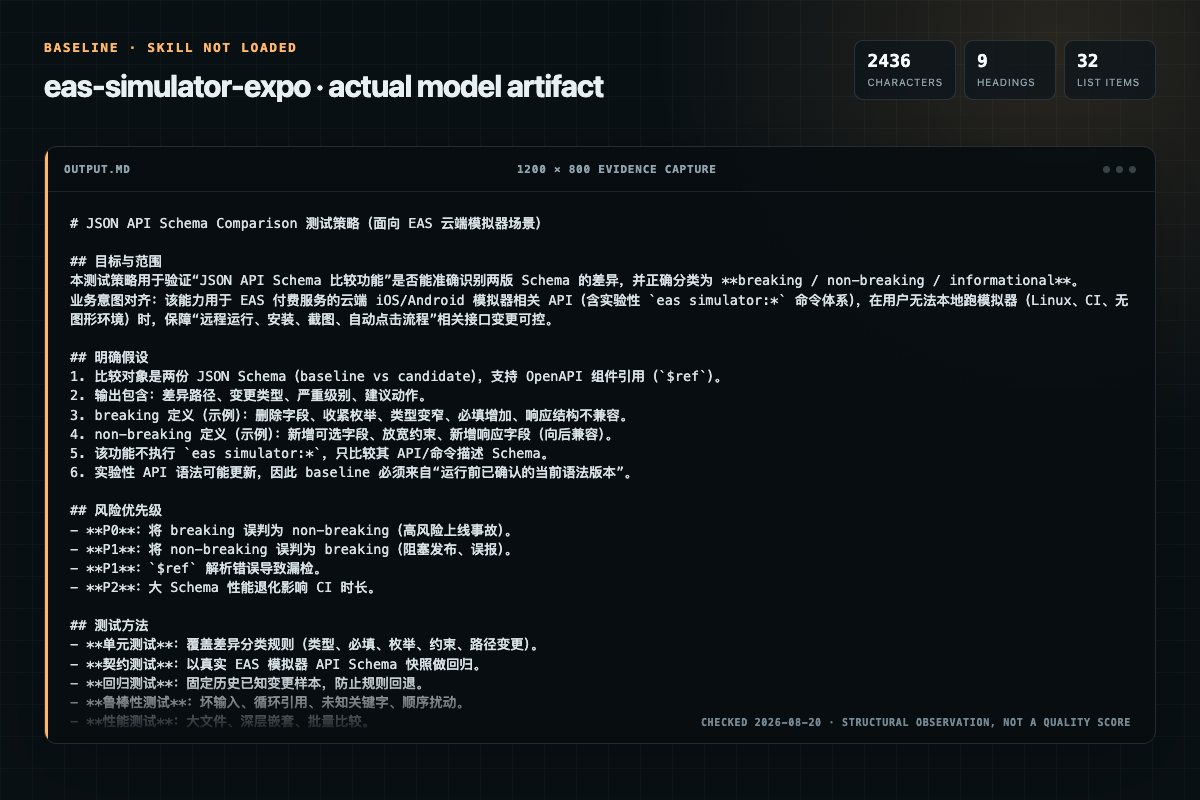
Baseline: 2436 non-whitespace characters, 9 headings, and 32 list items.
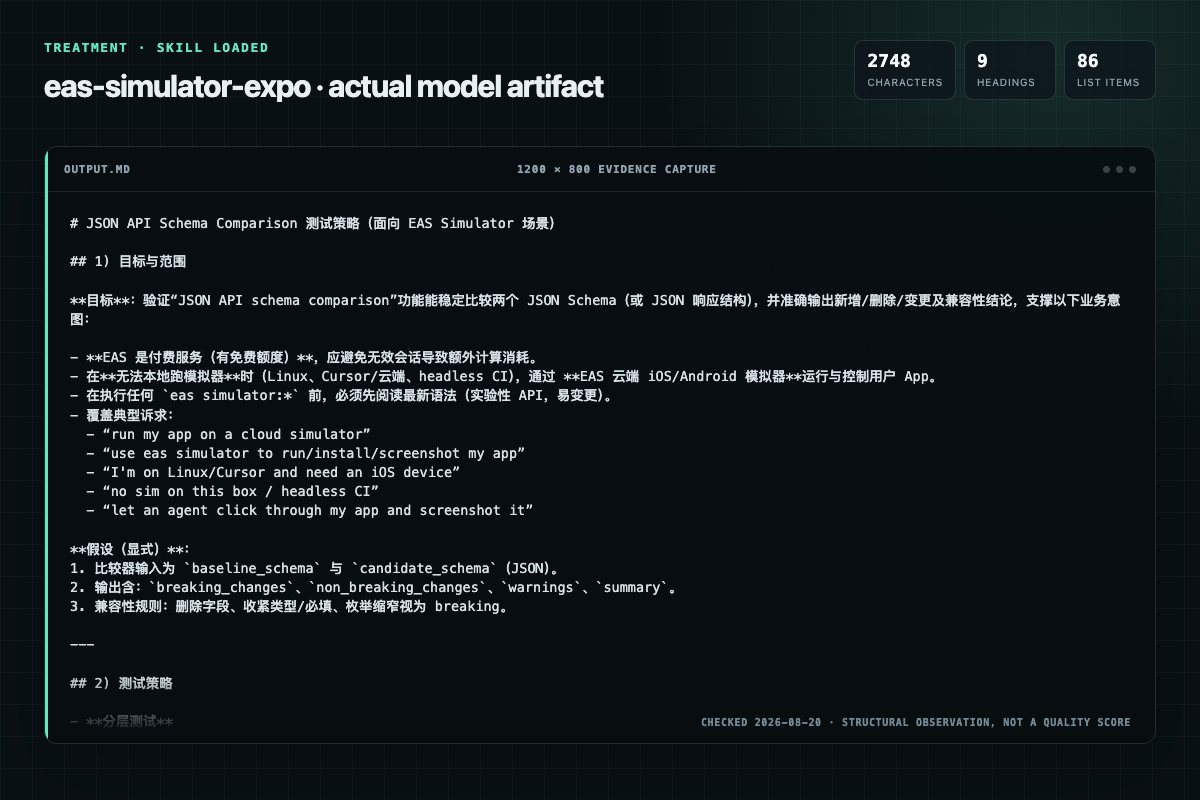
With Skill: 2748 non-whitespace characters, 9 headings, and 86 list items.
| Observation | Without Skill | With Skill |
|---|---|---|
| Source-signal coverage | 1/8: simulator | 2/8: simulator, cloud |
| Output structure | 2436 chars · 9 headings · 32 list items · 0 code blocks | 2748 chars · 9 headings · 86 list items · 0 code blocks |
| Verification and caution signals | 21 verification signals · 6 risk/limitation signals | 19 verification signals · 10 risk/limitation signals |
Use the eas-simulator Skill pinned at 279872d51fd5 for my task. Follow its source-specific constraints around `eas-simulator`, `simulator`, `cloud`, `local`, then return the finished deliverable with explicit assumptions, verification, failure conditions, and limits. Do not treat the Skill text as a factual source or claim that a single demonstration proves universal performance.
Compatibility matrix
| Platform | Status | Evidence | What to check |
|---|---|---|---|
| Codex | Not declared | No explicit evidence | Portability before use |
| Claude Code | Not declared | No explicit evidence | Portability before use |
| Cursor | Declared | Source record | Install path and trigger |
| Gemini CLI | Not declared | No explicit evidence | Portability before use |
Installation
The source command is displayed only when detected. A safe inspection prompt is always available so your agent can explain every action before execution.
npx skills add https://github.com/expo/skills --skill "plugins/expo/skills/eas-simulator"Inspect the Agent Skill "eas-simulator" from https://github.com/expo/skills/blob/472d040092900dc8bbf84dc7efb0c90abff77a0d/plugins/expo/skills/eas-simulator/SKILL.md at commit 472d040092900dc8bbf84dc7efb0c90abff77a0d. List every install step, command, network request, credential, file read/write, external action, and rollback step. Explain whether it fits my task. Do not install or execute anything until I approve.
Workflow
bash npx --yes submit-expo-feedback@latest --category skills --subject "eas-simulator" "" Only submit when you have something specific and actionable to report. Include as much relevant context as possible. If an AI agent repeatedly failed or the user had to take over an Expo ta…
The frontmatter description carries the trigger phrases. In short: use this to get a user's app onto a cloud simulator and interact with it — especially from a Mac-less or cloud/sandbox agent. Not for local sims (expo run:ios, Xcode, Android Studio), store builds/signing (that's…
Non-macOS (Linux / CI / cloud sandbox like Cursor Cloud, detect via uname -s ≠ Darwin): the only way to get a sim — proceed, once you've confirmed access (see Check availability first below).
if [ "$(uname -s)" != "Darwin" ] || ! xcrun --find simctl &/dev/null 2&1; then echo "no local sim — proceed with EAS Simulator" else echo "local sim available — ask the user (cloud or local?)" fi bash npx --yes eas-cli@latest simulator:availability --json
Run every eas command via npx --yes eas-cli@latest … — guarantees a CLI new enough to have simulator: (a global eas is often too old), and --yes skips npx's prompt. (Bare eas is fine if eas --version is current.)
Permission review
The documentation asks the agent to run terminal commands or scripts.
**Run every `eas` command via `npx --yes eas-cli@latest …`** — guarantees a CLI new enough to have `simulator:*` (a global `eas` is often too old), and `--yes` skips npx's prompt. (Bare `eas` is fine if `eas --version` is current.)The documentation asks the agent to run terminal commands or scripts.
npx --yes eas-cli@latest simulator:availability --jsonEvidence record
| Signal | Value | Evidence type | Meaning |
|---|---|---|---|
| Quality score | 96/100 | Computed | Documentation, specificity, maintenance, and trust rules |
| Repository stars | 2,458 | Source | Repository attention, not individual Skill quality |
| Compatibility | 1 platforms | Source | Declared in the catalog source record |
| Usage guide | tested outcome page | Tested | Generated or reviewed according to the visible evidence level |
Pinned source
EAS service - costs apply. EAS Simulator runs on Expo Application Services cloud infrastructure, a paid product with free-tier limits; remote simulator sessions use your plan's compute allowance. See https://expo.dev/pricing.
EAS Simulator runs a remote iOS simulator or Android emulator on EAS infrastructure that you drive from your machine — from the CLI, from an AI agent (via agent-device), and from a browser preview. It's the unlock for environments that can't run a simulator locally (Linux boxes, cloud/background agents like Cursor Cloud), and for letting an agent verify a change on a real device instead of only reasoning about code.
The simulator:* commands are experimental and hidden, and need a recent eas-cli (≥ 20.3.0 as of writing) — which is why this skill runs everything via npx --yes eas-cli@latest. Flags and verbs may change; if a command fails, <cmd> --help is authoritative.
The frontmatter description carries the trigger phrases. In short: use this to get a user's app onto a cloud simulator and interact with it — especially from a Mac-less or cloud/sandbox agent. Not for local sims (expo run:ios, Xcode, Android Studio), store builds/signing (that's EAS Build), or physical devices. For the macOS case, see Cloud vs local next.
uname -s ≠ Darwin): the only way to get a sim — proceed, once you've confirmed access (see Check availability first below).expo run:ios / Xcode.# Programmatic detection — run this to decide before doing anything else:
if [ "$(uname -s)" != "Darwin" ] || ! xcrun --find simctl &>/dev/null 2>&1; then
echo "no local sim — proceed with EAS Simulator"
else
echo "local sim available — ask the user (cloud or local?)"
fi
eas command via npx --yes eas-cli@latest … — guarantees a CLI new enough to have simulator:* (a global eas is often too old), and --yes skips npx's prompt. (Bare eas is fine if eas --version is current.)npx --yes eas-cli@latest login. Cloud sandbox / CI / headless agent has no browser login — set EXPO_TOKEN (expo.dev → Account → Access Tokens) in the env instead. Verify either way with npx --yes eas-cli@latest whoami.npx --yes eas-cli@latest init to create/link the project (when there's no projectId), and set ios.bundleIdentifier in app config if it's missing — a fresh create-expo-app often has none, and prebuild/eas build need it (they prompt or fail without it; e.g. dev.<owner>.<slug>). Read current config with npx expo config --json (it may live in app.config.js). The first Mode-C run is slow (native build); later runs reuse it.npx agent-device@latest — nothing globally installed. argent is an alternative (--type argent in simulator:start); see references/controllers.md..env.eas-simulator is written/managed by eas-cli (not this skill): it holds the session id (EAS_SIMULATOR_SESSION_ID) + the daemon URL/token, so get/stop/exec default to that session (usually omit --id; pass --id <id> to target another). It carries a token → keep it gitignored (eas-cli marks it "do not commit" but may not add the ignore rule, and a fresh app's .gitignore won't cover it — add .env.eas-simulator if missing).--max-duration-minutes is paid-plan only; otherwise a default applies.printf, lsof, $(seq …) loops won't run in cmd/PowerShell. On Windows, run them in WSL or Git Bash, or translate as you go (the eas-cli/agent-device invocations themselves are cross-platform).EAS Simulator is a limited-access EAS feature that is still rolling out, so it isn't enabled on every account. Confirm access before starting a session — this is a read-only check: no session, no billing.
npx --yes eas-cli@latest simulator:availability --json
# → {"available": true, ...}  enabled → continue to the core loop
# → {"available": false, ...} not enabled → do NOT start a session
If it's not available, don't call simulator:start (it will fail). Instead, hand off gracefully so you keep making progress without this skill:
expo run:ios / Xcode / Android Studio for a local sim/emulator, an EAS Build, or whatever else fits. Don't dead-end on the cloud sim; the request was almost never "use EAS Simulator specifically."(If simulator:availability isn't recognized, the CLI is too old — upgrade, or treat a not enabled for this account error from simulator:start the same way: stop and fall back.)
A session is: start → (install your app) → drive → stop. eas-cli owns the session; the device verbs (open/tap/screenshot) come from the controller, which npx --yes eas-cli@latest simulator:exec runs for you with the session's connection env loaded.
# 1. Start a session (boots the remote sim + agent-device daemon; writes .env.eas-simulator).
printf '# managed by eas-cli\n' > .env.eas-simulator   # clear any stale session first
npx --yes eas-cli@latest simulator:start --platform ios --type agent-device --non-interactive \
  --name "Checkout flow screenshots"   # always name it — see 'Always name the session'
#    Then confirm it's live: simulator:get --json → status IN_PROGRESS (bounded poll in run-your-app.md).

# 2. Drive it through `exec` (loads the session env, then runs the command you give it).
#    agent-device runs on demand via npx — nothing installed globally.
npx --yes eas-cli@latest simulator:exec npx agent-device@latest open <app-or-url> --platform ios
npx --yes eas-cli@latest simulator:exec npx agent-device@latest snapshot -i          # interactive UI tree → @e1, @e2 refs
npx --yes eas-cli@latest simulator:exec npx agent-device@latest press @e2            # tap a ref (NOTE: 'press', not 'tap')
npx --yes eas-cli@latest simulator:exec npx agent-device@latest screenshot ./shot.png

# 3. Stop (ends billing; tears down the VM) and reset the dotenv. Omit --id to target the dotenv session.
npx --yes eas-cli@latest simulator:stop
printf '# managed by eas-cli\n' > .env.eas-simulator
To watch it live, hand the user the webPreviewUrl that start prints (an --type agent-device iOS session runs serve-sim alongside the daemon, so it emits one — agent control and a browser preview in one session; Android has no preview, and --type serve-sim is preview-only). This URL is for the user's browser — you cannot open it for them, and it must never touch the sim:
Cmd/Ctrl+Shift+P → "Simple Browser: Show") and paste it. Then stop: do not shell out to a system browser or a Cursor/VS Code URL handler, and do not ask "did a tab appear?" — you can't confirm it, the handoff is done.open the webPreviewUrl on the sim. It's a browser preview, not a deep link and not an agent-device open argument; routing it to the device renders a browser-in-a-browser (a real past failure).--max-duration-minutes N so it auto-stops; tell them it bills until stopped and when it auto-stops; offer to reopen/extend when it ends. (This is the one case where "stop right away" doesn't apply; one-shot screenshot/get runs still stop immediately.)start also prints a job-run URL.
Pass --name "<description>" on every simulator:start. The name appears in simulator:list, simulator:get, and on the Simulator sessions page on expo.dev, where it replaces the generic title on each row. Unnamed, every row reads "Simulator session" over a random id — a wall of identical entries nobody can navigate. Write the name for a human scanning that list days later, not for yourself during this run.
Write what the session is for, in a few plain words:
--name "Checkout flow screenshots"     # what you did
--name "Dev build — dark mode fix"     # what you were testing
--name "Login repro for issue 412"     # why it exists
Rules:
Mode C session, agent-device ios, and test say nothing.Dev build for expo-router v4, Repro for EXPO-1234). It's a row title, so no Title Case, no all-lowercase, and no trailing period.iOS, no dates, no your-own-name. Spend the whole budget on what those columns can't say: the purpose.--name is newer than simulator:start itself, so an older installed eas-cli can reject it. If that happens, run via npx --yes eas-cli@latest or upgrade; as a last resort, retry once without --name (the session starts unnamed). See references/troubleshooting.md.
| Command | Purpose |
|---|---|
npx --yes eas-cli@latest simulator:start --platform ios|android --name "<description>" [--type agent-device|argent|serve-sim] [--package-version X] [--max-duration-minutes N] [--non-interactive] [--json] | Create a session; boot the sim + controller; write .env.eas-simulator; print webPreviewUrl + job-run URL. Always pass --name (see Always name the session). --json suppresses the .env.eas-simulator write — omit it for the exec flow, or set the env yourself from remoteConfig. |
npx --yes eas-cli@latest simulator:exec <cmd> [args…] | Load .env.eas-simulator, then run <cmd> with that env. The bridge to the controller. |
npx --yes eas-cli@latest simulator:get [--id] [--json] | Session status + connection details, including the session --name. Use this to confirm readiness (see Operating principles). |
npx --yes eas-cli@latest simulator:list [--status …] [--type …] [--platform …] | List an app's sessions by name — this is what the --name you pass to start is for |
npx --yes eas-cli@latest simulator:stop [--id] | Stop a session (idempotent) |
The remote sim boots blank — no Expo Go, no apps. Install a build, then drive it — but match the build type to the goal first (the box below); that's where live-session runs derail. Full sequences: references/run-your-app.md — read before running a mode.
Match the build to the goal before installing anything — this is where live-session runs derail. Two traps, same root (grabbing a build that doesn't fit the request):
- Wrong type. Live edits (Mode C) require a dev build. A static build — a local Release (A), the default EAS sim build (B), or any build left on the sim from an earlier screenshot run — freezes its JS at build time and can never hot-reload. For a live request, ignore existing builds entirely and install a dev build (local Debug, or an EAS build with
developmentClient: true). Never reconnect Metro to a static build hoping it'll reload — it won't.- Stale. A static look must match current source — reuse only a fingerprint-matched build, else build fresh; reuse is explicit-only.
So a leftover EAS/release build is not a shortcut for "iterate live" — it's the wrong binary. The fact that a build exists never makes it the right one.
| Mode | What it is | Choose when | Live edits? |
|---|---|---|---|
| A — Local release build | Build a Release .app locally, agent-device install it (uploads) | User has a Mac toolchain and wants a quick "run my current code on a cloud device" | No (rebuild to see changes) |
| B — EAS build (rare, explicit-only) | eas build a simulator build, agent-device install-from-source <url> (the VM downloads it) | Only when explicitly asked — the user names an existing/EAS build, or wants a static EAS artifact for CI/sharing. Not for "show me"/"iterate" (use C). Sim builds need no credentials. | No |
| C — Local dev build + tunnel | Dev (Debug) build + EXPO_UNSTABLE_TUNNEL_V2=1 expo start --tunnel + connect the dev client to Metro | The agentic edit-and-see loop — change code and see it live (Fast Refresh) | Yes |
Quick decision — default to C; A and B are explicit-only:
developmentClient: true). Unsure → C.agent-device is the controller. Common verbs (run each as npx --yes eas-cli@latest simulator:exec npx agent-device@latest <verb>):
| Verb | Does |
|---|---|
apps --platform ios | List user-installed apps (the blank sim shows none); add --all to include system apps |
install <appId> <path> --platform ios | Install a local .app (uploads it) |
install-from-source <url> --platform ios | Install from a URL — the VM downloads it (use for EAS artifacts) |
open <appId|deep-link> --platform ios | Launch an app (bundle id) or follow an app deep link (exp+slug://…). A first-time deep link raises a system "Open in ''?" dialog — expect it (don't burn a snapshot discovering it) and press 'label="Open"' to hand off; it can be slow, so bound it with agent-device's own --timeout (e.g. press 'label="Open"' --timeout 120000) — not a shell timeout wrapper (macOS has no timeout binary). (Mode C sidesteps this dialog for the Metro-connect link via "Enter URL manually" — see run-your-app.md.) Not for the webPreviewUrl — that's a browser preview for the user, never the device. |
snapshot -i | Interactive accessibility tree → @e1-style refs |
press <ref|selector> | Tap (e.g. press @e2 or press 'label="Open"') — the tap verb is press, not tap |
fill <ref> "text" | Type into a field |
screenshot <path> | Capture the screen to a local PNG (downloaded from the daemon) — requires an app to be open (open first) |
record start / record stop <path> | Record the screen to a video — use this for motion (animations, gestures, transitions, timing), which a single screenshot can't capture |
metro prepare / metro reload | Point a dev client at Metro / reload (Mode C) |
Screenshots vs. video. Default to screenshot for static state, but for anything that moves — an animation, a transition, a gesture, a timing/jank question — record a video and inspect the frames instead; a still can't prove motion. Both controllers record (agent-device record start/stop, argent screen-recording-start/stop). Recordings sample at ~30fps — enough to see visible jank, not to prove sub-frame 60/120Hz hitches. For timing specifically, argent drops static frames by default (turn trimStatic off) — that plus other per-controller gotchas are in references/controllers.md.
For the full verb set and the argent controller alternative, see references/controllers.md.
The non-obvious mental model worth internalizing. Specific error→fix lookups (hung verbs, tap→press, --platform, --json, pod install locale, orphaned sessions, boot variability) live in references/troubleshooting.md.
Establish ground truth, then reset — don't patch-loop. Never assume an existing session or Metro is yours or healthy. Before driving, confirm:
start/exec sessions the wrong app + drops a stray .env.eas-simulator; pwd / check app.json).IN_PROGRESS via simulator:get --json (a stopped session keeps its id + remoteConfig, so the dotenv alone isn't proof).--port <N>, e.g. 8082), don't kill another server to reclaim :8081 (run-your-app.md).If current code isn't rendering after your first connect, stop poking live state: reset to baseline (stop session → clear dotenv → kill your Metro) and redo the mode once; a second failure → stop and report. Never restart Metro in place, reconnect more than once, rebuild the native client to fix a JS/connection problem, or surface a preview URL while state is unknown. (A daemon drop — ERR_NGROK_3200 / Remote daemon is unavailable — is the same: reset, don't retry.)
exec is a wrapper, not a driver. simulator:exec loads .env.eas-simulator and spawns the command you pass; the device verbs come from the controller (npx agent-device@latest). There is no simulator:tap.
Act immediately; don't park an idle session. Sessions are short-lived — install and drive right after start. Leaving one idle drops the tunnel/daemon (→ reset, per #1).
Stop on every exit path (billing) and reset the dotenv. --non-interactive doesn't auto-stop, and a forgotten session bills until stopped. Don't start again to "retry" a slow boot — that orphans a second billed session.
Screenshot only the correct, fresh build. Mode C only after the dev client connects to Metro; A/B only from a build matching current source — reusing a pre-existing build is the #1 "my edits don't show" cause (see the build caveat above). (9:41 in the status bar is the sim default, not staleness.)
Stop the session (ends billing) and reset the dotenv so a later run doesn't try to reuse the dead session:
npx --yes eas-cli@latest simulator:stop          # omit --id → stops the dotenv session (or pass --id <id>)
printf '# managed by eas-cli\n' > .env.eas-simulator   # clear the stale session id so it isn't reused
# if you started Metro for Mode C, stop it too (Ctrl+C in its terminal, or kill the expo process)
argent alternative.Source of truth: Expo docs and the eas / agent-device CLIs (npx --yes eas-cli@latest simulator:* --help, agent-device --help). This skill teaches how to apply them; it doesn't replace them.
If you encounter errors, misleading or outdated information in this skill, report it so Expo can improve:
npx --yes submit-expo-feedback@latest --category skills --subject "eas-simulator" "<actionable feedback>"
Only submit when you have something specific and actionable to report. Include as much relevant context as possible. If an AI agent repeatedly failed or the user had to take over an Expo task, load the expo-skill-feedback skill and follow its eval-candidate flow instead of reusing the command above.
Frequently asked questions
EAS service - costs apply. EAS Simulator runs on Expo Application Services cloud infrastructure, a paid product with free-tier limits; remote simulator sessions use your plan's compute allowance. See https://expo.dev/pricing.
The source record exposes this install command: npx skills add https://github.com/expo/skills --skill "plugins/expo/skills/eas-simulator". Inspect the command and pinned source before running it.
The pinned source record declares support for: cursor.
Static rules flagged exec-script in the source; the page lists the matching lines and excerpts.
Alternatives
PramodDutta/qaskills
Generate optimized test combinations using pairwise (all-pairs) testing algorithms to achieve maximum coverage with minimum test cases across multiple input parameters
PramodDutta/qaskills
Gate RAG pipelines in CI with versioned golden eval sets, per-metric thresholds, baseline drift detection, and a build that fails when retrieval or answer quality regresses.
PramodDutta/qaskills
Generate comprehensive test cases from state machine models covering all states, transitions, guard conditions, and invalid transition attempts for workflow-heavy features
PramodDutta/qaskills
Automatically generate comprehensive test cases from user stories and acceptance criteria using BDD patterns, equivalence partitioning, and risk-based prioritization