
Tested demoQuality 99/100
indranilbanerjee/digital-marketing-pro/skills/four-core-documents/SKILL.md
four-core-documents
Produce Part 3 of the 12-Part engagement: the four strategic-spine documents across 61 steps — 3.1 Business & SBU Analysis, 3.2 Segmentation Framework, 3.3 Brand Positioning & Communications, 3.4 DMFlow — with --doc single-document runs, --view v2 re-runs, and a --combined executive stitch. Triggers on "/digital-marketing-pro:four-core-documents", "produce the four core documents", "run part 3 of the engagement", "generate the strategic spine", "re-run positioning as v2". Requires an initialised
- Source repository stars
- 768
- Declared platforms
- 0
- Static risk flags
- 2
- Last source update
- 2026-08-17
- Source checked
- 2026-08-25
Decision brief
What it does: where it fits
This skill produces Part 3 of the engagement methodology: the four documents that together define the brand at strategic depth. Every channel strategy, every creative brief, every piece of copy reads back to these.
Not for
- Tasks that require unconfirmed production actions or broad system permissions.
- Environments where the pinned source and install steps cannot be inspected.
Controlled single-run demoChecked 2026-08-20
What changed when the Skill was used
In this controlled same-task single run, enabling four-core-documents changed the output from 2366 non-whitespace characters and 8 headings to 2969 characters and 9 headings. Matches among 8 signals extracted from the pinned source changed from 0 to 1. Both actual outputs are shown; this is a structural observation, not a quality score or a universal performance claim.
Same test task
Create a launch deliverable for a privacy-first team collaboration product aimed at small engineering teams. Make it specific, usable, and ready for review. The deliverable must specifically reflect this user intent: Produce the Four Core Documents at strategic depth (61 total steps): Business & SBU Analysis, Segmentation Framework, Brand Positioning, DMFlow. Use when running Part 3 of the engagement methodology.
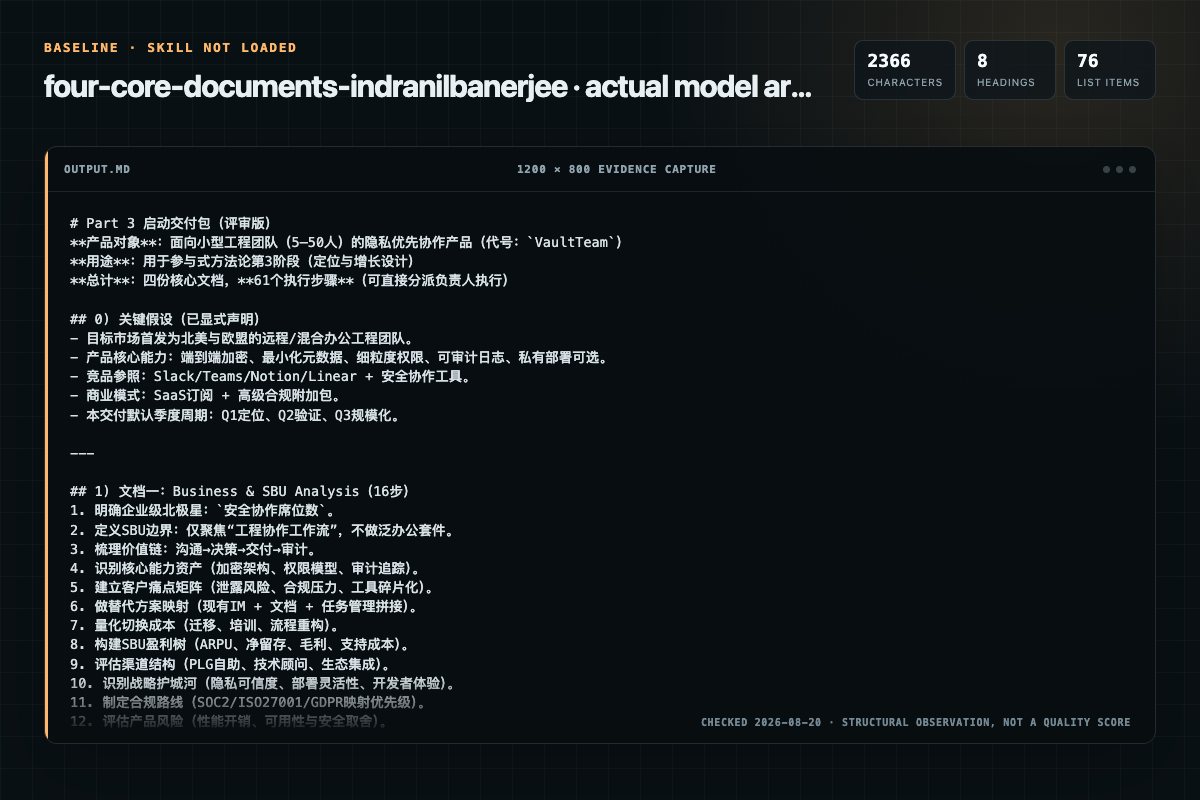
Baseline: 2366 non-whitespace characters, 8 headings, and 76 list items.
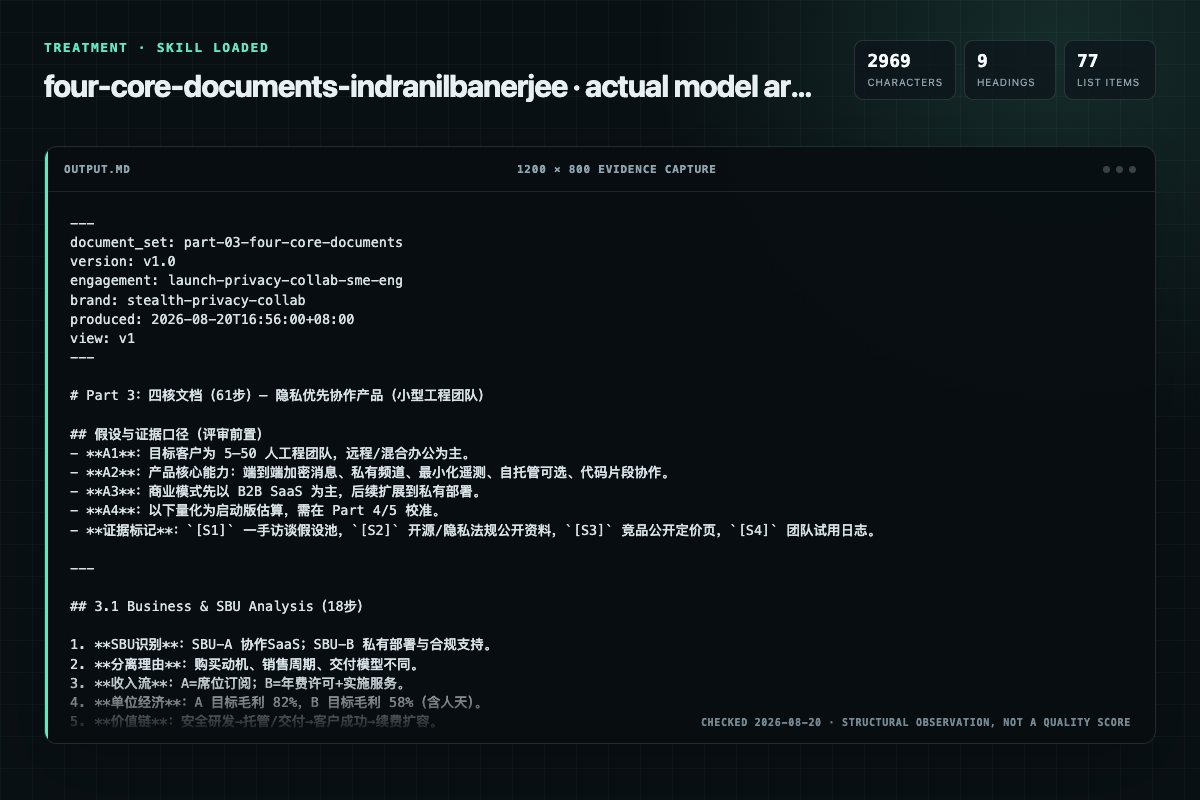
With Skill: 2969 non-whitespace characters, 9 headings, and 77 list items.
| Observation | Without Skill | With Skill |
|---|---|---|
| Source-signal coverage | 0/8: none | 1/8: four-core-documents |
| Output structure | 2366 chars · 8 headings · 76 list items · 0 code blocks | 2969 chars · 9 headings · 77 list items · 0 code blocks |
| Verification and caution signals | 4 verification signals · 5 risk/limitation signals | 9 verification signals · 9 risk/limitation signals |
A prompt you can use
Use the four-core-documents Skill pinned at fa4ccd0a4afc for my task. Follow its source-specific constraints around `four-core-documents`, `digital-marketing-pro`, `strategic`, `spine`, then return the finished deliverable with explicit assumptions, verification, failure conditions, and limits. Do not treat the Skill text as a factual source or claim that a single demonstration proves universal performance.
Method and limitationsExpandCollapse
Test method
- Baseline and treatment used the same task, model (gpt-5.3-codex-low), and runner; the only planned difference was whether the complete target Skill text was injected.
- The treatment used snapshot 028b4ca7cde0eab99d7941b873f8933277c6bade; the current source commit fa4ccd0a4afc1b902ef8de8d297b180aa148d46a was verified against content hash 946df3d36dfe. The baseline explicitly prohibited loading any Skill or external rule file.
- The same deterministic script counted characters, headings, lists, code blocks, verification terms, caution terms, and source signals in both artifacts. Source signals: `four-core-documents`, `digital-marketing-pro`, `strategic`, `spine`, `context`, `efficiency`, `pre-conditions`, `subcommands`.
- The visuals are local screenshots of the actual Markdown artifacts in a fixed 1200 × 800 evidence canvas, not recreated product mockups. Raw JSON artifacts and request records are retained in the research directory.
Do not over-read this demo
- This is one controlled demonstration per condition, not a multi-run statistical benchmark; the model is stochastic.
- Character, structure, and keyword counts show observable differences but cannot by themselves prove correctness, originality, or business impact.
- The task is a representative test designed for repeatability, not every real-world use of the Skill; rerun after a material source change.
- Editorial review
- SkillSignal editorial
- Runner
- Cursor Agent 2026.08.04-aaa8809
- Model
- gpt-5.3-codex-low
- Refresh due
- 2026-11-18
- Reviewed commit
- fa4ccd0a4afc1b902ef8de8d297b180aa148d46a
- Test snapshot
- 028b4ca7cde0eab99d7941b873f8933277c6bade
Compatibility matrix
Platform support, with evidence labels
| Platform | Status | Evidence | What to check |
|---|---|---|---|
| Codex | Not declared | No explicit evidence | Portability before use |
| Claude Code | Not declared | No explicit evidence | Portability before use |
| Cursor | Not declared | No explicit evidence | Portability before use |
| Gemini CLI | Not declared | No explicit evidence | Portability before use |
Installation
Inspect first. Install second.
The source command is displayed only when detected. A safe inspection prompt is always available so your agent can explain every action before execution.
Source-detected install commandSource
npx skills add https://github.com/indranilbanerjee/digital-marketing-pro --skill "skills/four-core-documents"Safe inspection promptEditorial
Inspect the Agent Skill "four-core-documents" from https://github.com/indranilbanerjee/digital-marketing-pro/blob/fa4ccd0a4afc1b902ef8de8d297b180aa148d46a/skills/four-core-documents/SKILL.md at commit fa4ccd0a4afc1b902ef8de8d297b180aa148d46a. List every install step, command, network request, credential, file read/write, external action, and rollback step. Explain whether it fits my task. Do not install or execute anything until I approve.
Workflow
What the source asks the agent to do
- 01
Step 1: SBU Identification
Review the “Step 1: SBU Identification” section in the pinned source before continuing.
Review and apply the “Step 1: SBU Identification” source section. - 02
Step 2: SBU Separation Rationale
... (all 18 steps, in order)
... (all 18 steps, in order) - 03
Example 3: Producing the Combined Core Document for executive review
Review the “Example 3: Producing the Combined Core Document for executive review” section in the pinned source before continuing.
Review and apply the “Example 3: Producing the Combined Core Document for executive review” source section. - 04
Context efficiency
Heavy skill. Grep before Read any referenced file, then Read only matched ranges with offset + limit. List the brand's workspace at /.claude-marketing/brands/{slug}/ (or $CLAUDEPLUGINDATA/digital-marketing-pro/brands/{slug}/ when that env var is set) before opening files. On re-…
Heavy skill. Grep before Read any referenced file, then Read only matched ranges with offset + limit. List the brand's workspace at /.claude-marketing/brands/{slug}/ (or $CLAUDEPLUGINDATA/digital-marketing-pro/brands/{s…Specification: four-core-documents-spec.md — the exact 61 steps across the four documents.Engagement context: engagement-flow-methodology.md — where Part 3 fits in the 12-Part flow. - 05
Pre-conditions
Before running this skill, verify:
Brand profile exists at /.claude-marketing/brands/{brand-slug}/profile.json. If not, run /digital-marketing-pro:brand-setup first.Engagement is initialised with state file engagement.json present. If not, run /digital-marketing-pro:engagement start first.Part 1 (Client Inputs) is completed. Stone facts and Opinion hypotheses must be captured before Part 3 can begin.
Permission review
Static risk signals and limitations
Reads files
The documentation asks the agent to read local files, directories, or repositories.
Heavy skill. **Grep before Read** any referenced file, then `Read` only matched ranges with `offset` + `limit`. List the brand's workspace at `~/.claude-marketing/brands/{slug}/` (or `$CLAUDE_PLUGIN_DATA/digital-marketing-pro/brands/{slug}/Writes files
The documentation asks the agent to create, modify, or delete local files.
Update the Living Project Instruction File:Evidence record
Why each signal appears
EvidenceSourceComputedTestedEditorial
| Signal | Value | Evidence type | Meaning |
|---|---|---|---|
| Quality score | 99/100 | Computed | Documentation, specificity, maintenance, and trust rules |
| Repository stars | 768 | Source | Repository attention, not individual Skill quality |
| Compatibility | 0 platforms | Source | Declared in the catalog source record |
| Usage guide | tested outcome page | Tested | Generated or reviewed according to the visible evidence level |
Pinned source
Provenance and original SKILL.md
- Repository
- indranilbanerjee/digital-marketing-pro
- Skill path
- skills/four-core-documents/SKILL.md
- Commit
- fa4ccd0a4afc1b902ef8de8d297b180aa148d46a
- License
- MIT
- Collected
- 2026-08-25
- Default branch
- main
View the original SKILL.md
/digital-marketing-pro:four-core-documents — The Strategic Spine (61 Steps)
This skill produces Part 3 of the engagement methodology: the four documents that together define the brand at strategic depth. Every channel strategy, every creative brief, every piece of copy reads back to these.
Context efficiency
Heavy skill. Grep before Read any referenced file, then Read only matched ranges with offset + limit. List the brand's workspace at ~/.claude-marketing/brands/{slug}/ (or $CLAUDE_PLUGIN_DATA/digital-marketing-pro/brands/{slug}/ when that env var is set) before opening files. On re-invocation mid-session, skip files already in context.
Specification: four-core-documents-spec.md — the exact 61 steps across the four documents.
Engagement context: engagement-flow-methodology.md — where Part 3 fits in the 12-Part flow.
Pre-conditions
Before running this skill, verify:
- Brand profile exists at
~/.claude-marketing/brands/{brand-slug}/profile.json. If not, run/digital-marketing-pro:brand-setupfirst. - Engagement is initialised with state file
_engagement.jsonpresent. If not, run/digital-marketing-pro:engagement startfirst. - Part 1 (Client Inputs) is completed. Stone facts and Opinion hypotheses must be captured before Part 3 can begin.
- Part 2 (External Research) is at least started. Some Part 2 research may continue in parallel with Part 3, but the kickoff must have happened.
If any pre-condition fails, do NOT produce output. Instead, instruct the user on what to run first.
Subcommands
Produce all four documents
/digital-marketing-pro:four-core-documents <brand-slug> <engagement-id>
Produces 3.1, 3.2, 3.3, 3.4 in sequence. Actual time varies with engagement complexity.
Produce a single document
/digital-marketing-pro:four-core-documents <brand-slug> <engagement-id> --doc 3.1
Produces just the specified document. Useful for re-runs (Part 6) or when one doc needs to be redone independently.
Produce v2 re-runs
/digital-marketing-pro:four-core-documents <brand-slug> <engagement-id> --view v2 --doc "3.1,3.3"
Produces v2 versions of the specified documents. --doc takes a single id (3.1) or a comma-separated list ("3.1,3.3"). Used during Part 6 after the Decision Matrix has triggered re-runs. (The canonical flags are --doc, --view v2, and --combined — there is no --docs.)
Produce the Combined Core Document (3.C)
/digital-marketing-pro:four-core-documents <brand-slug> <engagement-id> --combined
Stitches all four canonical core documents (latest version of each) into a single executive-reference file with master TOC, master assumptions table, and master source index. Produced only when an executive audience needs a single-file read.
Production Order
The four documents are produced in sequence because each builds on the prior:
- 3.1 Business & SBU Analysis (18 steps) — foundational. Establishes the business reality.
- 3.2 Segmentation Framework (15 steps) — depends on 3.1's SBU and customer data.
- 3.3 Brand Positioning & Communications (19 steps) — depends on 3.2's personas.
- 3.4 DMFlow (9 steps) — depends on 3.1, 3.2, and 3.3 to make channel decisions.
When running re-runs, only the affected documents are regenerated. Other documents remain at their current version.
Per-Document Production
3.1 — Business & SBU Analysis (18 steps)
Read the spec section for 3.1 in four-core-documents-spec.md. The 18 steps are:
- SBU identification
- SBU separation rationale
- Revenue streams per SBU
- Unit economics per SBU
- Value chain mapping
- Offering portfolio at task-level granularity
- Pricing architecture
- Organisational and go-to-market model
- Sales and distribution architecture
- Full SWOT with evidence
- Growth levers
- Constraints
- Customer acquisition economics
- Customer retention economics
- Partnership and channel dependencies
- Risk profile
- Strategic implications for the engagement
- Open questions
Inputs:
part-01-client-inputs/stone-facts.json— ground-truth factspart-02-external-research/— unbiased external research (industry data, market context)- Brand profile at
~/.claude-marketing/brands/{slug}/profile.json - (Do NOT use Opinion hypotheses as ground truth — those are research questions, not facts)
Output:
engagements/{id}/part-03-four-core-documents/v1/3.1-business-and-sbu-analysis.md
(For v2 re-runs: same path but in v2/ instead of v1/)
Output structure:
---
document: 3.1-business-and-sbu-analysis
version: v1.0
engagement: {engagement-id}
brand: {brand-slug}
produced: {iso-timestamp}
view: v1   # or v2 for re-runs
---

# 3.1 Business & SBU Analysis

## Step 1: SBU Identification

[Content for step 1]

## Step 2: SBU Separation Rationale

[Content for step 2]

... (all 18 steps, in order)

## Sources

[Numbered list of every cited source: client docs, public sources, industry reports, Stone facts referenced]

## Open Questions

[Anything that could not be answered with available info]

## Change Log

### v1.0 — {date}
- Initial unbiased research version produced from Part 2 + Stone facts.
3.2 — Segmentation Framework (15 steps)
The 15 steps:
- Target Group identification
- TG scoring across criteria
- TG prioritisation
- Sub-TG breakdown
- Persona development per primary TG (using actionable-persona-format.md)
- Behavioural attributes per persona
- Psychographic attributes per persona
- Need-state mapping
- Geographic distribution
- (B2B only) Multi-stakeholder Decision Unit per persona (using b2b-decision-making-unit.md)
- (B2B only) MQL definition
- (B2B only) SQL definition
- (B2B only) Pipeline logic
- Anti-personas
- Activation guidance
Steps 10–13 are skipped for B2C engagements. The skill detects B2B vs B2C from the brand profile's business_model.type field.
Inputs:
- 3.1 (just produced) for SBU + customer baseline
part-04-competitive-customer-market/v1/4.3-customer-analysis.mdif available (for unbiased customer research)- Brand profile
Output:
engagements/{id}/part-03-four-core-documents/v1/3.2-segmentation-framework.md
3.3 — Brand Positioning & Communications (19 steps)
The 19 steps:
- Positioning options considered
- Per-option rationale
- Per-option trade-offs
- Chosen positioning with defence argument
- Positioning statement (formal one-sentence)
- Trade-offs explicit
- Brand promise
- Proof points for the brand promise
- Primary message architecture
- Messaging pillars (3–5)
- Proof points per pillar
- Segment-level messaging variations
- Full-funnel communication framework (TOFU/MOFU/BOFU/retention/advocacy)
- Tone-of-voice principles
- Explicit don't-say rules
- Sensitive-topic handling
- Crisis-communication posture
- Application guidance across channels
- Open positioning questions
Inputs:
- 3.1 + 3.2 (just produced)
part-04-competitive-customer-market/v1/4.2-competitor-positioning.mdif available- Brand profile (for current brand voice signals)
Output:
engagements/{id}/part-03-four-core-documents/v1/3.3-brand-positioning-and-communications.md
3.4 — DMFlow (9 steps)
The 9 steps:
- Channel universe considered (using five-digital-markets.md)
- Channel selection with rationale per channel
- Funnel architecture per channel
- Media mix logic across paid/organic/earned/owned
- Budget allocation logic at business level (with In-Market vs Out-Market split per in-market-out-market.md)
- Channel interdependencies and sequencing
- Conversion framework
- Measurement approach
- Strategic implications and track weightages
Inputs:
- 3.1 + 3.2 + 3.3 (just produced)
- Brand profile (for current channels, budget envelope)
- channel-families.md for the 7-family / 17-channel taxonomy
Output:
engagements/{id}/part-03-four-core-documents/v1/3.4-dmflow.md
Quality Discipline (Apply to All Four Documents)
- Every claim cites a source. No "we think" — only "the evidence shows" with cited source.
- Every assumption is explicit. When estimating CAC, LTV, market size, etc., state the methodology and inputs.
- Every recommendation flows from analysis. No conclusions the body does not support.
- No generic statements. "Strong brand" is generic. "92% brand recall in target segment per [source]" is specific.
- All four documents reference each other consistently. A persona defined in 3.2 must be the same persona referenced in 3.3 messaging variations and 3.4 channel selection.
- Open questions are documented, not hidden.
- Stone facts are facts; Opinion hypotheses are questions. Don't elevate Opinion to fact in the document.
- Multi-Dimensional Decision Framework (see decision-framework.md) is used for any choice (channel selection, persona prioritisation, positioning trade-offs).
Single-File Discipline
Each document is produced as a single file containing all its steps. If a document cannot be completed in one turn due to output limits:
- Save the partial document so far
- Continue the same file from where it left off in the next turn (NEVER start a new file)
- The file is considered complete only when all steps are present
There is no hidden continuation state — the skill does not persist a cut-off pointer. The partial file already saved to disk is the only record. If output is interrupted mid-document, re-run the document: read the saved partial as context and continue appending the remaining steps to the same file. For a run interrupted at the engagement level, resume from the part's last checkpoint artifact via /digital-marketing-pro:resume. The saved file is always the source of truth.
After Production
Once all four documents are produced (or after each individually):
- Update the Living Project Instruction File:
- Strategic Facts section: extract positioning statement, primary persona summary, channel selections, unit economics
- Version History section: add the new v1.0 entries
- Mark Part 3 (or the specific sub-document) as completed in
_engagement.json - Notify the user that Part 4 is the natural next step
v2 Re-runs
When invoked with --view v2, the skill:
- Reads the v1 version of the requested doc
- Reads the Part 5 Client Validation Document (the changes the client requested)
- Reads the relevant subset of changes that apply to this doc
- Produces v2 with a header section listing what changed vs v1:
## v1 → v2 Changes

- Section X (Step N): {what changed} — driven by {client validation finding ID}
- Section Y: ...
- Saves to
v2/{doc-name}.md(the v1 file remains untouched) - Bumps the version in
_engagement.jsonviaengagement-state.py bump-version - Updates the LIF with the changed strategic facts
Examples
Example 1: First-time production of all four documents
User: Produce the four core documents for the Acme engagement.

Skill response:
1. Verify pre-conditions: brand profile ✓, engagement initialised ✓, Part 1 complete ✓, Part 2 in progress ✓
2. Begin 3.1 Business & SBU Analysis. Read Stone facts, Part 2 research, brand profile. Walk all 18 steps. Cite sources throughout. Save to v1/3.1-business-and-sbu-analysis.md.
3. Begin 3.2 Segmentation Framework. Read 3.1, Part 4.3 if available. Detect business model = B2B from profile, so include steps 10-13. Walk 15 steps. Save to v1/3.2-segmentation-framework.md.
4. Begin 3.3 Brand Positioning. Read 3.1, 3.2, Part 4.2 if available. Walk 19 steps. Save to v1/3.3-brand-positioning-and-communications.md.
5. Begin 3.4 DMFlow. Read 3.1, 3.2, 3.3. Apply 5 Digital Markets taxonomy. Walk 9 steps. Save to v1/3.4-dmflow.md.
6. Update LIF: positioning statement, primary persona, channel selections, blended CAC estimate.
7. Mark Part 3 completed.
8. Brief: "Part 3 complete. 4 documents, 61 steps. Total ~12,000 words across all four. Recommend reviewing 3.3 (positioning) carefully — the chosen positioning has notable trade-offs documented in step 6."
Example 2: v2 re-run after Part 5
User: Re-run 3.3 and 3.4 as v2 — client rejected the positioning and we need to redo the channel mix as a result.

Skill response:
1. Verify Part 5 Client Validation Document exists with positioning rejection captured ✓
2. Begin 3.3 v2. Read 3.3 v1 + Client Validation Document. Re-do positioning per client direction. Add v1→v2 changes header. Save to v2/3.3-brand-positioning-and-communications.md.
3. Begin 3.4 v2. Read 3.4 v1 + (now updated) 3.3 v2. Re-do channel mix to align with new positioning. Add v1→v2 changes header. Save to v2/3.4-dmflow.md.
4. Bump versions: engagement-state.py bump-version --doc 3.3 + --doc 3.4
5. Update LIF: new positioning statement, new channel selections, version history.
6. Brief: "v2 re-runs complete. 3.1 and 3.2 unchanged (still v1.0). 3.3 and 3.4 now at v2.0. Both views remain available. Operating decisions should reference v2 docs."
Example 3: Producing the Combined Core Document for executive review
User: Produce the Combined Core Document for the executive presentation next week.

Skill response:
1. Verify all four core documents exist (latest version of each) ✓
2. Read 3.1 v1.0, 3.2 v1.0, 3.3 v2.0, 3.4 v2.0
3. Synthesise into single document with:
   - Master TOC at top
   - Each document as a major section
   - Master Assumptions Table (extract every "Assumption" call-out from all four docs)
   - Master Source Index (de-duplicated list of every source cited)
4. Save to part-03-four-core-documents/3.C-combined-core-document.md
5. Brief: "3.C produced. 60+ pages. Includes master TOC + assumptions table + source index. Recommended exports: PDF for the executive deck, DOCX if they want to annotate."
Related skills
engagement-workflow— orchestrates the 12-Part flow that contains Part 3client-validation-document— Part 5 deliverable that triggers v2 re-runs- Existing skills and agents consumed by this one:
audience-intelligence,competitive-intel,market-intelligence,brand-guardian
Related references
- four-core-documents-spec.md — the canonical 61-step specification
- actionable-persona-format.md — Step 5 of 3.2
- b2b-decision-making-unit.md — Steps 10-13 of 3.2 (B2B)
- five-digital-markets.md — Step 1 of 3.4
- in-market-out-market.md — Step 5 of 3.4
- channel-families.md — Step 2 of 3.4
- decision-framework.md — used throughout for choice-making
- unit-economics-framework.md — Step 4 of 3.1
Frequently asked questions
What to verify before installation and use
What does the four-core-documents source document cover?
This skill produces Part 3 of the engagement methodology: the four documents that together define the brand at strategic depth. Every channel strategy, every creative brief, every piece of copy reads back to these.
How do I install four-core-documents?
The source record exposes this install command: npx skills add https://github.com/indranilbanerjee/digital-marketing-pro --skill "skills/four-core-documents". Inspect the command and pinned source before running it.
Which permission-related actions were detected?
Static rules flagged read-files, write-files in the source; the page lists the matching lines and excerpts.
Alternatives
Compare before choosing
Computed 10024,921
alirezarezvani/claude-skills
app-store-optimization
App Store Optimization (ASO) toolkit for researching keywords, analyzing competitor rankings, generating metadata suggestions, and improving app visibility on Apple App Store and Google Play Store. Use when the user asks about ASO, app store rankings, app metadata, app titles and descriptions, app store listings, app visibility, or mobile app marketing on iOS or Android. Supports keyword research and scoring, competitor keyword analysis, metadata optimization, A/B test planning, launch checklist
Computed 9923
indranilbanerjee/contentforge
cf-variants
Generate 3-10 scored A/B test variations of a single content element — headline, hook, CTA, intro, or conclusion — each rated across 6 quality dimensions and ranked by your optimization goal (clicks, engagement, conversions, or readability), with top-3 recommendations and A/B test setup guidance (sample size, duration, success metric). Triggers on "/contentforge:cf-variants", "give me headline alternatives", "A/B test options for this CTA", "which hook is stronger", "write 5 versions of this int
Computed 9867
SerendipityOneInc/ZooData-Skills
zoodata
API endpoint reference for the ZooData data platform: the 12 commerce endpoints plus 10 keyword-intelligence endpoints (categories, markets, products, competitors, realtime ASIN, AI review analysis, raw reviews, price band, brand, history, and the keyword detail/trend/extends/search/ market-profile/product-traffic/competitor-keywords/traffic-profile/ traffic-timeline family) — their inputs/outputs, parameter quirks, Quick Start (auth, base URL), how credits are tracked (meta.creditsConsumed), an
Computed 9823
indranilbanerjee/contentforge
cf-translate
Translate publication-ready ContentForge content into any of 15 languages at three localization levels (literal, adapted, transcreated) — preserving brand voice, keeping citation URLs and DOIs untouched, and adapting SEO keyword placements for the target market — delivered as a translated .docx plus a quality report via the brand's tracking backend. Triggers on "/contentforge:cf-translate", "translate this article to Spanish", "localize this for the German market", "make a French version of this