
Tested demoQuality 97/100Review permissions
samber/cc-skills-golang/skills/golang-uber-fx/SKILL.md
golang-uber-fx
Golang application framework using uber-go/fx — fx.New, fx.Provide, fx.Invoke, fx.Module, fx.Lifecycle hooks, fx.Annotate (name/group/As), fx.Decorate, fx.Supply, fx.Replace, fx.WithLogger, and signal-aware Run(). Apply when using or adopting uber-go/fx, when the codebase imports `go.uber.org/fx`, or when wiring services with fx.New. For raw DI without lifecycle, see `samber/cc-skills-golang@golang-uber-dig` skill.
- Source repository stars
- 3,066
- Declared platforms
- 2
- Static risk flags
- 1
- Last source update
- 2026-08-23
- Source checked
- 2026-08-25
Decision brief
What it does: where it fits
Application framework combining a reflection-based DI container (built on uber-go/dig) with a lifecycle, module system, signal-aware run loop, and structured event logging. For long-running services where boot order, graceful shutdown, and modular composition matter.
Not for
- Tasks that require unconfirmed production actions or broad system permissions.
- Environments where the pinned source and install steps cannot be inspected.
Controlled single-run demoChecked 2026-08-20
What changed when the Skill was used
In this controlled same-task single run, enabling golang-uber-fx changed the output from 2819 non-whitespace characters and 11 headings to 2960 characters and 13 headings. Matches among 8 signals extracted from the pinned source changed from 5 to 4. Both actual outputs are shown; this is a structural observation, not a quality score or a universal performance claim.
Same test task
Create a test strategy and representative test cases for a JSON API schema comparison feature. Include failure cases and a clear verification procedure. The deliverable must specifically reflect this user intent: Golang application framework using uber-go/fx — fx.New, fx.Provide, fx.Invoke, fx.Module, fx.Lifecycle hooks, fx.Annotate (name/group/As), fx.Decorate, fx.Supply, fx.Replace, fx.WithLogger, and signal-aware Run(). Apply when using or adopting uber-go/fx, when the codebase imports `go.uber.org/fx`, or when wiring services with fx.New. For raw DI without lifecycle, see `samber/cc-skills-golang@golang-uber-dig` skill.
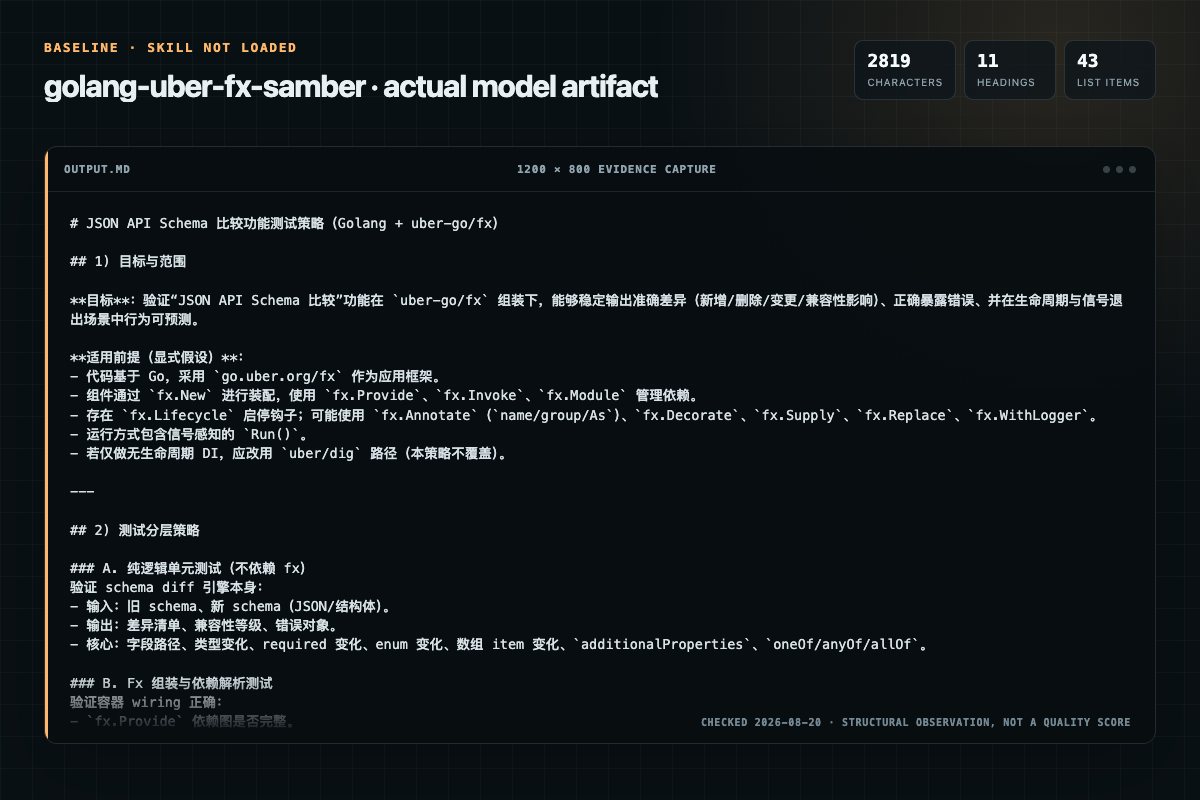
Baseline: 2819 non-whitespace characters, 11 headings, and 43 list items.
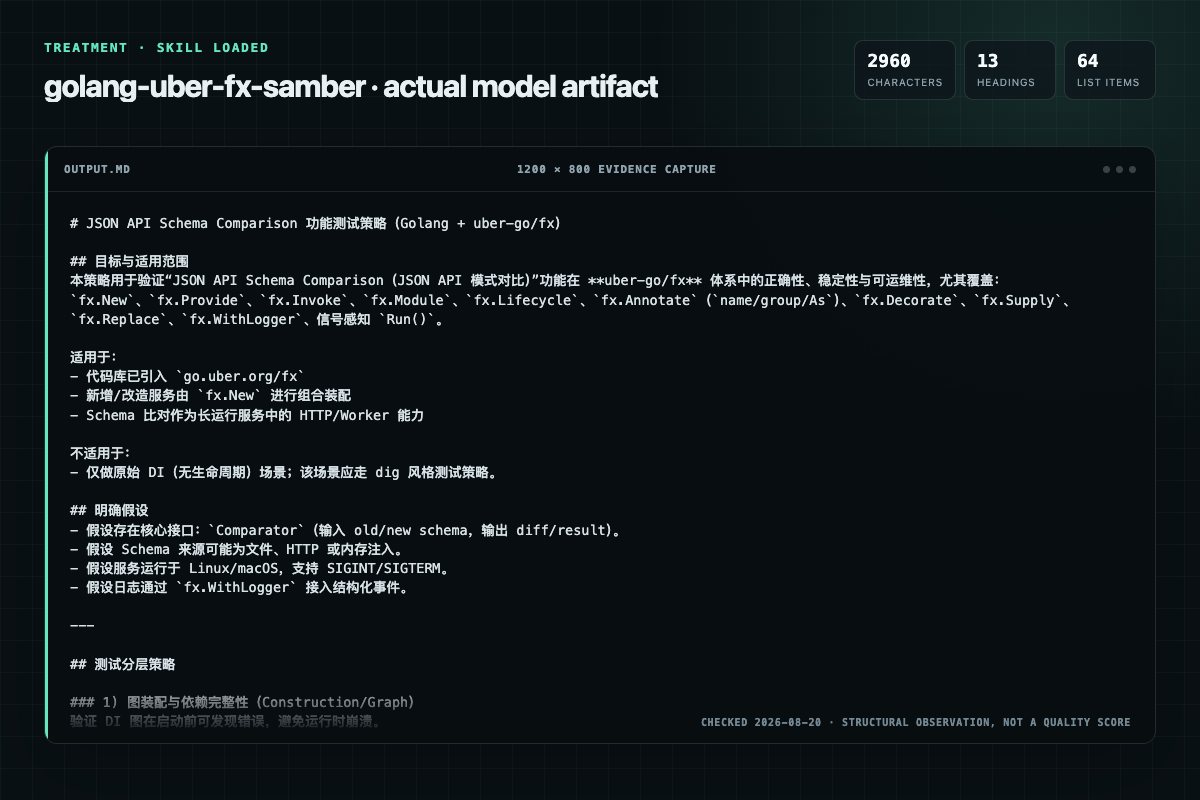
With Skill: 2960 non-whitespace characters, 13 headings, and 64 list items.
| Observation | Without Skill | With Skill |
|---|---|---|
| Source-signal coverage | 5/8: uber-go, wiring, provide, invoke, lifecycle | 4/8: uber-go, provide, invoke, lifecycle |
| Output structure | 2819 chars · 11 headings · 43 list items · 0 code blocks | 2960 chars · 13 headings · 64 list items · 0 code blocks |
| Verification and caution signals | 37 verification signals · 2 risk/limitation signals | 39 verification signals · 7 risk/limitation signals |
A prompt you can use
Use the golang-uber-fx Skill pinned at 20e960371b34 for my task. Follow its source-specific constraints around `golang-uber-fx`, `uber-go`, `application`, `wiring`, then return the finished deliverable with explicit assumptions, verification, failure conditions, and limits. Do not treat the Skill text as a factual source or claim that a single demonstration proves universal performance.
Method and limitationsExpandCollapse
Test method
- Baseline and treatment used the same task, model (gpt-5.3-codex-low), and runner; the only planned difference was whether the complete target Skill text was injected.
- The treatment used snapshot 3a823627c6fac359a74b82bd9b5fc8f126a0e950; the current source commit 20e960371b346d5cb7333fda3d46f5e3578d3659 was verified against content hash 3b1edabe11fb. The baseline explicitly prohibited loading any Skill or external rule file.
- The same deterministic script counted characters, headings, lists, code blocks, verification terms, caution terms, and source signals in both artifacts. Source signals: `golang-uber-fx`, `uber-go`, `application`, `wiring`, `provide`, `invoke`, `lifecycle`, `hooks`.
- The visuals are local screenshots of the actual Markdown artifacts in a fixed 1200 × 800 evidence canvas, not recreated product mockups. Raw JSON artifacts and request records are retained in the research directory.
Do not over-read this demo
- This is one controlled demonstration per condition, not a multi-run statistical benchmark; the model is stochastic.
- Character, structure, and keyword counts show observable differences but cannot by themselves prove correctness, originality, or business impact.
- The task is a representative test designed for repeatability, not every real-world use of the Skill; rerun after a material source change.
- Editorial review
- SkillSignal editorial
- Runner
- Cursor Agent 2026.08.04-aaa8809
- Model
- gpt-5.3-codex-low
- Refresh due
- 2026-11-18
- Reviewed commit
- 20e960371b346d5cb7333fda3d46f5e3578d3659
- Test snapshot
- 3a823627c6fac359a74b82bd9b5fc8f126a0e950
Compatibility matrix
Platform support, with evidence labels
| Platform | Status | Evidence | What to check |
|---|---|---|---|
| Codex | Declared | Source record | Install path and trigger |
| Claude Code | Declared | Source record | Install path and trigger |
| Cursor | Not declared | No explicit evidence | Portability before use |
| Gemini CLI | Not declared | No explicit evidence | Portability before use |
Installation
Inspect first. Install second.
The source command is displayed only when detected. A safe inspection prompt is always available so your agent can explain every action before execution.
Source-detected install commandSource
npx skills add https://github.com/samber/cc-skills-golang --skill "skills/golang-uber-fx"Safe inspection promptEditorial
Inspect the Agent Skill "golang-uber-fx" from https://github.com/samber/cc-skills-golang/blob/a18860b303ef1d3d928f9670631e03210b8698bf/skills/golang-uber-fx/SKILL.md at commit a18860b303ef1d3d928f9670631e03210b8698bf. List every install step, command, network request, credential, file read/write, external action, and rollback step. Explain whether it fits my task. Do not install or execute anything until I approve.
Workflow
What the source asks the agent to do
- 01
fx vs. dig
fx is built on top of dig and shares the same reflection-based container engine. The DI primitives (Provide, Invoke, In/Out structs, named values, value groups) are identical — fx.In/fx.Out are re-exports of dig.In/dig.Out.
fx is built on top of dig and shares the same reflection-based container engine. The DI primitives (Provide, Invoke, In/Out structs, named values, value groups) are identical — fx.In/fx.Out are re-exports of dig.In/dig.…Choose fx for long-running services (HTTP servers, workers, daemons) — lifecycle and signal handling are mandatory there, and modules make large service graphs manageable.Choose raw dig when you need wiring without a framework: CLI tools, libraries that expose a container to callers, test harnesses, or embedding DI into an existing app that manages its own lifecycle. See samber/cc-skills… - 02
The Application
Boot stages: fx.New validates types (constructors do not run); app.Start(ctx) runs each fx.Invoke and fires OnStart hooks in topological order; main blocks on app.Done(); app.Stop(ctx) fires OnStop hooks in reverse order. Default timeout is 15 seconds — override with fx.StartTim…
Boot stages: fx.New validates types (constructors do not run); app.Start(ctx) runs each fx.Invoke and fires OnStart hooks in topological order; main blocks on app.Done(); app.Stop(ctx) fires OnStop hooks in reverse orde… - 03
Provide and Invoke
fx.Provide registers constructors; fx.Invoke is the trigger — without an Invoke (directly or transitively) referencing a type, its constructor never runs.
fx.Provide registers constructors; fx.Invoke is the trigger — without an Invoke (directly or transitively) referencing a type, its constructor never runs. - 04
Lifecycle Hooks
Inject fx.Lifecycle and append hooks. Constructors should return quickly; long-running work belongs in OnStart.
Inject fx.Lifecycle and append hooks. Constructors should return quickly; long-running work belongs in OnStart.Both callbacks receive a context bounded by StartTimeout/StopTimeout — respect cancellation. OnStart must return quickly — spawn a goroutine for blocking work; otherwise startup hangs and dependent hooks never fire.fx.StartHook / fx.StopHook / fx.StartStopHook adapt simpler signatures (no context, no error, or both): - 05
Parameter and Result Objects
fx re-exports dig's dig.In / dig.Out as fx.In / fx.Out. Use them when a constructor has 4+ dependencies, or when you need name/group/optional tags.
fx re-exports dig's dig.In / dig.Out as fx.In / fx.Out. Use them when a constructor has 4+ dependencies, or when you need name/group/optional tags.
Permission review
Static risk signals and limitations
Runs scripts
The documentation asks the agent to run terminal commands or scripts.
go get go.uber.org/fxEvidence record
Why each signal appears
EvidenceSourceComputedTestedEditorial
| Signal | Value | Evidence type | Meaning |
|---|---|---|---|
| Quality score | 97/100 | Computed | Documentation, specificity, maintenance, and trust rules |
| Repository stars | 3,066 | Source | Repository attention, not individual Skill quality |
| Compatibility | 2 platforms | Source | Declared in the catalog source record |
| Usage guide | tested outcome page | Tested | Generated or reviewed according to the visible evidence level |
Pinned source
Provenance and original SKILL.md
- Repository
- samber/cc-skills-golang
- Skill path
- skills/golang-uber-fx/SKILL.md
- Commit
- a18860b303ef1d3d928f9670631e03210b8698bf
- License
- MIT
- Collected
- 2026-08-25
- Default branch
- main
View the original SKILL.md
Persona: You are a Go architect building a long-running service with fx. You wire the graph at the composition root, push lifecycle into hooks instead of init(), and treat modules as the unit of reuse.
Using uber-go/fx for Application Wiring in Go
Application framework combining a reflection-based DI container (built on uber-go/dig) with a lifecycle, module system, signal-aware run loop, and structured event logging. For long-running services where boot order, graceful shutdown, and modular composition matter.
Official Resources:
This skill is not exhaustive. Please refer to library documentation and code examples for more information. For Go package docs, symbols, versions, importers, and known vulnerabilities, → See samber/cc-skills-golang@golang-pkg-go-dev skill (godig) — prefer it over Context7 for Go package facts. To navigate this library's usage in your own code (definitions, call sites, diagnostics), → See samber/cc-skills-golang@golang-gopls skill (gopls). Context7 remains a fallback for docs not indexed on pkg.go.dev.
go get go.uber.org/fx
fx vs. dig
fx is built on top of dig and shares the same reflection-based container engine. The DI primitives (Provide, Invoke, In/Out structs, named values, value groups) are identical — fx.In/fx.Out are re-exports of dig.In/dig.Out.
What fx adds on top:
| Concern | dig | fx |
|---|---|---|
| DI container | ✅ dig.New() | ✅ (embedded) |
| Lifecycle hooks | ❌ | ✅ fx.Lifecycle OnStart/OnStop |
| Module system | ❌ | ✅ fx.Module with scoped decorators |
| Signal-aware run loop | ❌ | ✅ app.Run() blocks on SIGINT/SIGTERM |
| Structured event logging | ❌ | ✅ fx.WithLogger / fxevent |
| Startup/shutdown timeout | ❌ | ✅ fx.StartTimeout / fx.StopTimeout |
Choose fx for long-running services (HTTP servers, workers, daemons) — lifecycle and signal handling are mandatory there, and modules make large service graphs manageable.
Choose raw dig when you need wiring without a framework: CLI tools, libraries that expose a container to callers, test harnesses, or embedding DI into an existing app that manages its own lifecycle. See samber/cc-skills-golang@golang-uber-dig skill.
The Application
import "go.uber.org/fx"

app := fx.New(
    fx.Provide(NewLogger, NewDatabase, NewServer),
    fx.Invoke(RegisterRoutes),
)
app.Run() // blocks until SIGINT/SIGTERM, then runs OnStop hooks
Boot stages: fx.New validates types (constructors do not run); app.Start(ctx) runs each fx.Invoke and fires OnStart hooks in topological order; main blocks on app.Done(); app.Stop(ctx) fires OnStop hooks in reverse order. Default timeout is 15 seconds — override with fx.StartTimeout / fx.StopTimeout.
Provide and Invoke
fx.New(
    fx.Provide(NewLogger, NewDatabase, NewServer),  // lazy
    fx.Invoke(RegisterRoutes, StartMetricsExporter), // always run during Start
)
fx.Provide registers constructors; fx.Invoke is the trigger — without an Invoke (directly or transitively) referencing a type, its constructor never runs.
Lifecycle Hooks
Inject fx.Lifecycle and append hooks. Constructors should return quickly; long-running work belongs in OnStart.
func NewHTTPServer(lc fx.Lifecycle, log *zap.Logger, cfg *Config) *http.Server {
    srv := &http.Server{Addr: cfg.Addr}

    lc.Append(fx.Hook{
        OnStart: func(ctx context.Context) error {
            ln, err := net.Listen("tcp", srv.Addr)
            if err != nil { return err }
            go srv.Serve(ln)         // blocking work in a goroutine
            return nil
        },
        OnStop: func(ctx context.Context) error {
            return srv.Shutdown(ctx)
        },
    })
    return srv
}
Both callbacks receive a context bounded by StartTimeout/StopTimeout — respect cancellation. OnStart must return quickly — spawn a goroutine for blocking work; otherwise startup hangs and dependent hooks never fire.
fx.StartHook / fx.StopHook / fx.StartStopHook adapt simpler signatures (no context, no error, or both):
lc.Append(fx.StartStopHook(srv.Start, srv.Stop)) // matched pair
Parameter and Result Objects
fx re-exports dig's dig.In / dig.Out as fx.In / fx.Out. Use them when a constructor has 4+ dependencies, or when you need name/group/optional tags.
type ServerParams struct {
    fx.In

    Logger *zap.Logger
    DB     *sql.DB
    Cache  *redis.Client     `optional:"true"`
    Routes []http.Handler    `group:"routes"`
}

func NewServer(p ServerParams) *Server { /* ... */ }
fx.Annotate
fx.Annotate wraps a constructor to add tags or interface bindings without a fx.Out struct. Prefer it for ergonomic name/group/As bindings:
fx.Provide(
    fx.Annotate(NewPrimaryDB, fx.ResultTags(`name:"primary"`)),
    fx.Annotate(NewPostgresDB, fx.As(new(Database))),    // expose interface
    fx.Annotate(NewUserHandler,
        fx.As(new(http.Handler)),
        fx.ResultTags(`group:"routes"`),
    ),
)
Value Groups
Many constructors, one consumer slice — typical for routes, health checks, metrics collectors:
type RouteResult struct {
    fx.Out
    Handler http.Handler `group:"routes"`
}

type ServerParams struct {
    fx.In
    Routes []http.Handler `group:"routes"`
}
Append ,flatten (group:"routes,flatten") to unwrap a slice instead of nesting it. Order is not guaranteed — provide an explicit ordered slice when sequence matters.
fx.Module
fx.Module groups providers, invokes, and decorators under a name. Modules scope decorators to themselves and their children — a logger renamed in fx.Module("db", ...) only appears renamed for code inside that module.
var DatabaseModule = fx.Module("database",
    fx.Provide(NewConnection, NewUserRepository),
    fx.Decorate(func(log *zap.Logger) *zap.Logger {
        return log.Named("db")
    }),
)

func main() {
    fx.New(
        fx.Provide(NewConfig, NewLogger),
        DatabaseModule,
        HTTPModule,
    ).Run()
}
Treat each module as a small library that can be lifted into another app — its public surface is the types it Provides.
For fx.Supply/fx.Replace/fx.Decorate, optional deps, custom logging, manual lifecycle, and Quick Reference, see advanced.md.
Best Practices
- Keep
main()thin — providers, modules, and a singleRun(). Push real work into modules so each can be tested in isolation. - Use lifecycle hooks instead of
init()or goroutines launched from constructors — Start/Stop ordering depends on graph topology, butinit()goroutines do not, which leads to races and leaks. - OnStart must return promptly — long work goes in a goroutine inside the hook. A blocking OnStart hangs the rest of the boot.
- Respect
ctx.Done()in hooks — a hook that ignores cancellation is reported as a timeout failure but its goroutine continues, leaking resources. - Group by module, not by layer — a module owns the providers, lifecycle, and decorators for one concern (HTTP, DB, metrics).
- Use
fx.Annotatefor tags rather than wrapping a constructor in anfx.Outstruct — keeps the constructor reusable outside fx. - Replace
fx.Providewithfx.Supplyfor pre-built values (config, command-line flags). Shorter, signals intent. - Validate the graph in CI by booting under
fx.New(...).Err()— catches missing providers and cycles before deploy.
Common Mistakes
| Mistake | Fix |
|---|---|
| Long-running work directly in OnStart | Spawn a goroutine inside OnStart; the hook itself must return quickly so dependent hooks can run. |
fx.Provide something that should be fx.Supply | Pre-built values (config, secrets) belong in fx.Supply — clearer and avoids a no-op constructor. |
| Module decorator leaking to siblings | Decorate inside fx.Module(...) — decorators flow only to descendants. A top-level fx.Decorate is global. |
| Group order assumed | Groups are unordered. If order matters, provide an ordered slice from one constructor. |
| Constructors with side effects | Side effects belong in OnStart — constructors should be cheap and pure-ish, since they may run concurrently and lazily. |
Forgotten fx.Invoke | Without an Invoke (or downstream consumer), constructors never run. Add at least one Invoke per app. |
Testing
Use go.uber.org/fx/fxtest to integrate fx with *testing.T (failures call t.Fatal, RequireStop registers as t.Cleanup). fx.Populate(&target) pulls values out of the graph; fx.Replace swaps real dependencies for fakes. Full patterns in testing.md.
Further Reading
- advanced.md — Supply/Replace/Decorate, optional deps, custom event logging, manual lifecycle, full Quick Reference
- recipes.md — full HTTP service with database/metrics, background workers with graceful drain, multiple impls of the same interface, manual lifecycle for CLI embedding
- testing.md — fxtest patterns,
fx.Replace,fx.Populate, isolated lifecycle tests, CI graph validation
Cross-References
- → See
samber/cc-skills-golang@golang-uber-digskill for the underlying container,dig.In/dig.Out, and DI without lifecycle - → See
samber/cc-skills-golang@golang-dependency-injectionskill for DI concepts and library comparison - → See
samber/cc-skills-golang@golang-samber-doskill for a generics-based alternative without reflection - → See
samber/cc-skills-golang@golang-google-wireskill for compile-time DI (no runtime container) - → See
samber/cc-skills-golang@golang-structs-interfacesskill for interface design patterns - → See
samber/cc-skills-golang@golang-contextskill for context propagation in OnStart/OnStop hooks - → See
samber/cc-skills-golang@golang-testingskill for general testing patterns
If you encounter a bug or unexpected behavior in uber-go/fx, open an issue at https://github.com/uber-go/fx/issues.
Frequently asked questions
What to verify before installation and use
What does the golang-uber-fx source document cover?
Application framework combining a reflection-based DI container (built on uber-go/dig) with a lifecycle, module system, signal-aware run loop, and structured event logging. For long-running services where boot order, graceful shutdown, and modular composition matter.
How do I install golang-uber-fx?
The source record exposes this install command: npx skills add https://github.com/samber/cc-skills-golang --skill "skills/golang-uber-fx". Inspect the command and pinned source before running it.
Which Agent platforms does the source record declare?
The pinned source record declares support for: codex, claude code.
Which permission-related actions were detected?
Static rules flagged exec-script in the source; the page lists the matching lines and excerpts.
Alternatives
Compare before choosing
Computed 9980
vasilyu1983/AI-Agents-public
qa-testing-ios
Guides iOS testing with XCTest, XCUITest, Swift Testing, simctl, and xcresult. Use when choosing destinations, controlling flakes, or parsing test artifacts for native apps.
Computed 973,066
samber/cc-skills-golang
golang-testing
Production-ready Golang tests — table-driven tests, testify suites and mocks, parallel tests, fuzzing, fixtures, goroutine leak detection with goleak, snapshot testing, code coverage, integration tests, idiomatic test naming. Use when writing or reviewing Go tests, choosing a testing approach, setting up Go test CI, or debugging flaky/slow tests. For testify-specific APIs see `samber/cc-skills-golang@golang-stretchr-testify`; for measurement methodology see `samber/cc-skills-golang@golang-benchm
Computed 973,066
samber/cc-skills-golang
golang-troubleshooting
Troubleshoot Golang programs systematically - find and fix the root cause. Use when encountering bugs, crashes, deadlocks, or unexpected behavior in Go code. Covers debugging methodology, common Go pitfalls, test-driven debugging, pprof setup and capture, Delve debugger, race detection, GODEBUG tracing, and production debugging. Start here for any 'something is wrong' situation. Not for interpreting profiles or benchmarking (→ See `samber/cc-skills-golang@golang-benchmark` skill) or applying opt
Computed 97203
PramodDutta/qaskills
Pairwise Test Generator
Generate optimized test combinations using pairwise (all-pairs) testing algorithms to achieve maximum coverage with minimum test cases across multiple input parameters