
Best for
- Confirm that a freshly customized BSP landed correctly — both as a static artifact on disk and as a running system on the target — without re-promoting or re-flashing. Forms the validation tail of Deploy in the Setup →…
NVIDIA/skills/skills/jetson-validate-image/SKILL.md
Use after jetson-flash-image to run static BSP checks, on-target smoke/regression tests on a flashed DUT, or both. Not for build or flash steps. Triggers: validate bsp, on-target validation.
Decision brief
Status: the DUT-access contract is stable; the rest of the validation procedure is a skeleton.
In this controlled same-task single run, enabling jetson-validate-image changed the output from 3860 non-whitespace characters and 7 headings to 3631 characters and 9 headings. Matches among 8 signals extracted from the pinned source changed from 2 to 2. Both actual outputs are shown; this is a structural observation, not a quality score or a universal performance claim.
Design and implement a representative production change for a TypeScript webhook retry service. Include the key code or pseudocode, tradeoffs, and verification steps. The deliverable must specifically reflect this user intent: Use after jetson-flash-image to run static BSP checks, on-target smoke/regression tests on a flashed DUT, or both. Not for build or flash steps. Triggers: validate bsp, on-target validation.
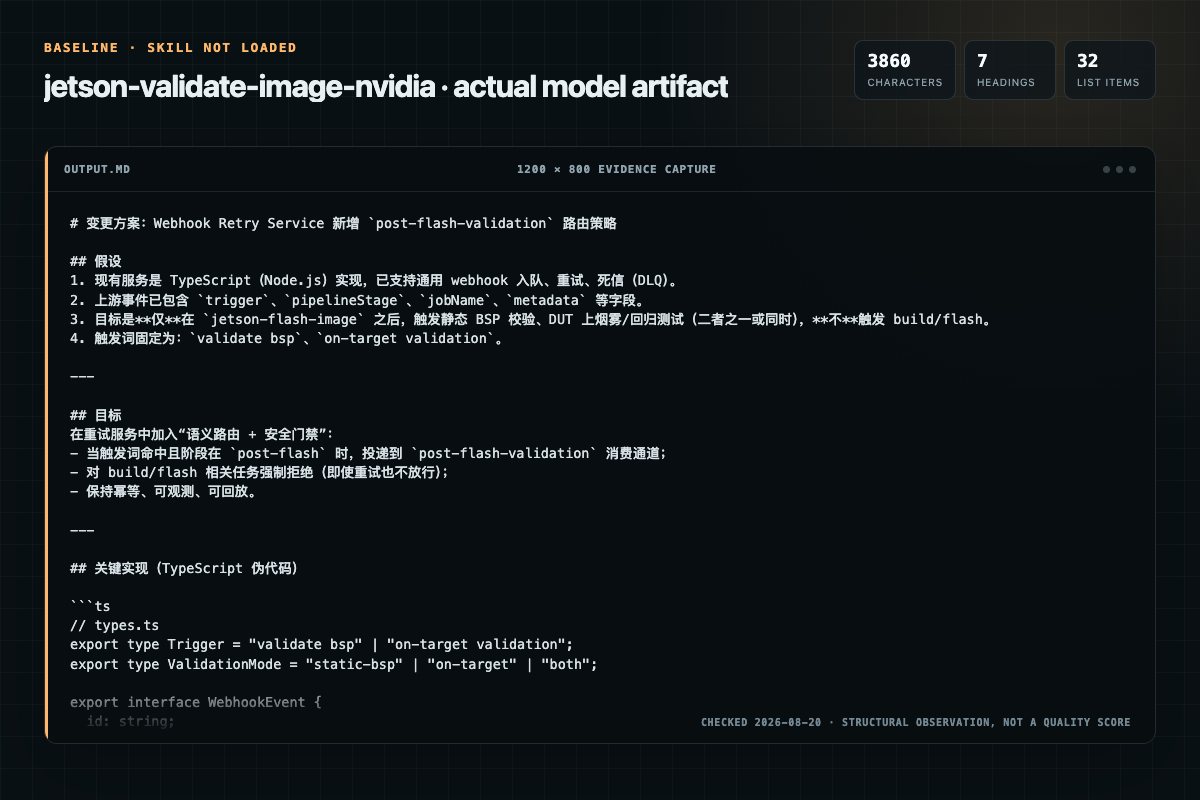
Baseline: 3860 non-whitespace characters, 7 headings, and 32 list items.
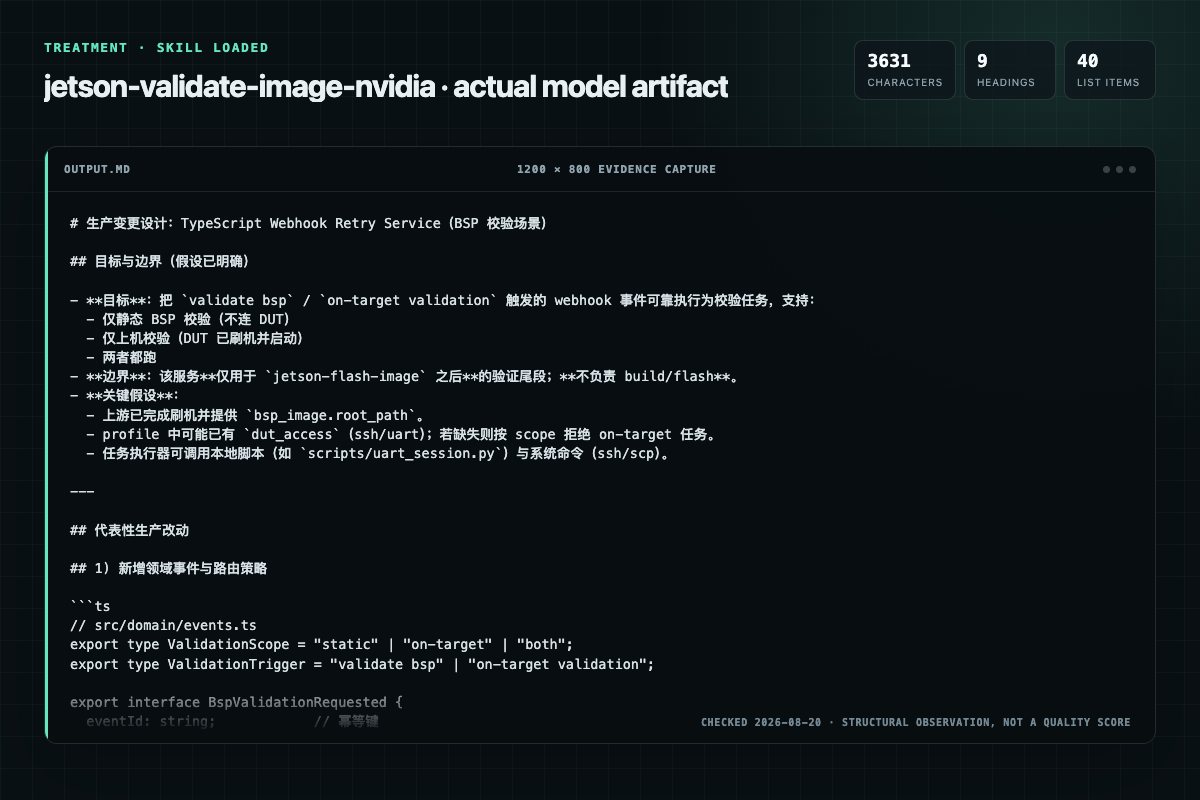
With Skill: 3631 non-whitespace characters, 9 headings, and 40 list items.
| Observation | Without Skill | With Skill |
|---|---|---|
| Source-signal coverage | 2/8: validate, image | 2/8: validate, image |
| Output structure | 3860 chars · 7 headings · 32 list items · 3 code blocks | 3631 chars · 9 headings · 40 list items · 6 code blocks |
| Verification and caution signals | 24 verification signals · 3 risk/limitation signals | 23 verification signals · 8 risk/limitation signals |
Use the jetson-validate-image Skill pinned at 20bb6aaea832 for my task. Follow its source-specific constraints around `jetson-validate-image`, `validate`, `image`, `purpose`, then return the finished deliverable with explicit assumptions, verification, failure conditions, and limits. Do not treat the Skill text as a factual source or claim that a single demonstration proves universal performance.
Compatibility matrix
| Platform | Status | Evidence | What to check |
|---|---|---|---|
| Codex | Not declared | No explicit evidence | Portability before use |
| Claude Code | Not declared | No explicit evidence | Portability before use |
| Cursor | Not declared | No explicit evidence | Portability before use |
| Gemini CLI | Not declared | No explicit evidence | Portability before use |
Installation
The source command is displayed only when detected. A safe inspection prompt is always available so your agent can explain every action before execution.
npx skills add https://github.com/NVIDIA/skills --skill "skills/jetson-validate-image"Inspect the Agent Skill "jetson-validate-image" from https://github.com/NVIDIA/skills/blob/3a38625bf3e863eb9f26ea0d985130ddfb5c66ae/skills/jetson-validate-image/SKILL.md at commit 3a38625bf3e863eb9f26ea0d985130ddfb5c66ae. List every install step, command, network request, credential, file read/write, external action, and rollback step. Explain whether it fits my task. Do not install or execute anything until I approve.
Workflow
The procedure below is a skeleton.
Confirm that a freshly customized BSP landed correctly — both as a static artifact on disk and as a running system on the target — without re-promoting or re-flashing. Forms the validation tail of Deploy in the Setup → Customize → Build → Deploy pipeline (see ../../context/bsp-c…
Active target-platform profile with bspimage: resolved (run
After jetson-flash-image has put the BSP onto a target.
The on-target leg needs a way to reach the just-flashed DUT. Two transports are supported as full peers: ssh (primary) and uart (fallback for DUTs with no network).
Permission review
The documentation asks the agent to run terminal commands or scripts.
| `command timed out` (exit 129) | Long-running DUT command exceeded the script's timeout | Run the command directly via `ssh` transport, or split into shorter steps. |Evidence record
| Signal | Value | Evidence type | Meaning |
|---|---|---|---|
| Quality score | 99/100 | Computed | Documentation, specificity, maintenance, and trust rules |
| Repository stars | 3,093 | Source | Repository attention, not individual Skill quality |
| Compatibility | 0 platforms | Source | Declared in the catalog source record |
| Usage guide | tested outcome page | Tested | Generated or reviewed according to the visible evidence level |
Pinned source
Status: the DUT-access contract is stable; the rest of the validation procedure is a skeleton.
Confirm that a freshly customized BSP landed correctly — both as a
static artifact on disk and as a running system on the target —
without re-promoting or re-flashing. Forms the validation tail of
Deploy in the Setup → Customize → Build → Deploy pipeline (see
../../context/bsp-customization-workflow.md
for the pipeline view) and is independently re-runnable.
bsp_image: resolved (run
/jetson-init-image first).<bsp_image.root_path> directly./jetson-flash-image already pushed the staged BSP to the DUT.dut_access: block authored in the active profile (or filled
interactively at runtime — see ## DUT access).ssh + sshpass for SSH; Python
3.6+ with pyserial for UART.auth=password
or sudo.method=password (password_env / sudo.password_env
name the env var; never inline the secret in YAML).jetson-flash-image has put the BSP onto a target.The procedure below is a skeleton.
bsp_image on
disk, no DUT needed) and/or on-target (DUT must be booted
from the just-flashed image).<bsp_image.root_path>/Linux_for_Tegra/..conf's XML.bsp_image
(they should be identical post-promotion).<bsp_image>/Linux_for_Tegra/bootloader/l4t_initrd.img and
<bsp_image>/Linux_for_Tegra/rootfs/boot/initrd; verify
three invariants against the promoted bsp_image state:
(a) <bsp_image>/Linux_for_Tegra/kernel/Image matches
<bsp_image>/Linux_for_Tegra/rootfs/boot/Image byte-for-
byte — drift here means
the "Mirror kernel Image into rootfs" step
was skipped and any subsequent initramfs refresh built
against the previous kernel.
(b) for each module path the two initrd images ship, the
bytes / md5 match the file under
<bsp_image>/Linux_for_Tegra/rootfs/lib/modules/<ver>/ —
any drift means modules will be shadowed at early boot.
(c) the vermagic stamped on every initramfs *.ko matches
the UTS_RELEASE reachable from
<bsp_image>/Linux_for_Tegra/kernel/Image (e.g. parse the
Linux version … string with strings) — a vermagic skew
means the kernel Image was refreshed without rerunning
l4t_update_initrd.sh, and modules will fail to load with
"disagrees about version of symbol …". All three failure
modes are closed by /jetson-promote-image's gate on
either kernel/Image or rootfs/lib/modules/ plus the
kernel-Image mirror; surface drift here and route the user
back to a clean promote. See
../jetson-promote-image/SKILL.md.## DUT access
section below — resolve transport (ssh / uart), credentials,
and sudo method from the active profile's dut_access:
block (with interactive fallback when fields are missing /
marked prompt), then run the connection probe and refuse
if it fails.cat /sys/module/<name>/srcversion on the DUT against the
modinfo /lib/modules/$(uname -r)/.../<name>.ko | awk '/srcversion/ {print $2}' reading. A mismatch means the
kernel is running an older copy than the rootfs ships —
almost always a stale initramfs (the bootloader-side initrd
shipped a pre-customize module, it loaded first, and the
rootfs copy cannot replace a live module). Recommend
re-running /jetson-promote-image and re-flashing. Note:
some modules don't emit srcversion; fall back to an md5
check against the binary the kernel loaded by extracting the
region under /sys/module/<name>/sections/ or by comparing
behaviorally (printk / sysfs nodes / DT properties the new
version is known to expose).Image. Compare
cat /proc/version (or uname -v) on the DUT against the
Linux version … string extracted from
/boot/Image (strings /boot/Image | grep -m1 'Linux version').
A mismatch — usually the build timestamp / LOCALVERSION —
means the bootloader is running an older kernel Image than
the rootfs holds, almost certainly because a fresh Image
was promoted but the initramfs / extlinux.conf / QSPI
boot partition wasn't refreshed. Modules in the rootfs
will then have a different vermagic and any subsequent
modprobe of a built-against-the-new-kernel .ko will
fail. Recommend /jetson-promote-image and re-flash.kernel.dmesg_restrict=1; non-root dmesg reads return
"Operation not permitted" and silently zero hits. Every
dmesg-based check must run with sudo (or temporarily
lower the restriction via sudo sysctl kernel.dmesg_restrict=0). Surfacing this in the validate
layer keeps printk-based customization checks honest.The on-target leg needs a way to reach the just-flashed DUT.
Two transports are supported as full peers: ssh (primary) and
uart (fallback for DUTs with no network).
The contract is locked in but lives in
references/dut-access.md to keep this
SKILL.md under the agent-routing budget. That reference covers:
dut_access: profile schema (ssh, uart, sudo, workdir).uname -r +
cat /etc/nv_tegra_release) and its output-validation rules.scp vs. base64-over-tty, with
the >100 KB warning).sudo.method × transport.scripts/uart_session.py
honors (state machines for login / exec / push / pull, exit
codes, robustness notes).| Script | Purpose | Arguments |
|---|---|---|
scripts/uart_session.py | UART transport black box for the on-target leg: login, command exec (with optional sudo), and base64-over-tty file transfer. Replaces ssh when the DUT has no network or ssh is broken. | --tty <dev> [--baud <n>] --user <name> --password-env <ENVVAR> [--sudo-password-env <ENVVAR>] [--shell-prompt <regex>] [--lock-strategy refuse|wait] <probe|exec|push|pull> [...] |
Invocation (the skill calls scripts as a subprocess — run_script()
in agent-runtime terminology):
# run_script: probe the DUT over UART
DUT_UART_PASSWORD_ENV=DUT_UART_PWD \
DUT_UART_PWD="$(read -rs -p 'UART login pw: '; echo "$REPLY")" \
  scripts/uart_session.py \
    --tty /dev/ttyACM0 --baud 115200 \
    --user ubuntu --password-env DUT_UART_PASSWORD_ENV \
    probe

# run_script: exec a sudo command and capture exit code
scripts/uart_session.py --tty /dev/ttyACM0 --user ubuntu \
  --password-env DUT_UART_PASSWORD_ENV \
  --sudo-password-env DUT_SUDO_PWD \
  exec --use-sudo 'dmesg | tail -200'
The script's exit code is the contract — see the exit-code table in
UART implementation contract.
Static-only validation (no DUT needed):
/jetson-validate-image
> static checks only against the staged BSP
On-target validation over SSH after a freshly flashed DUT:
/jetson-flash-image
   ↓
/jetson-validate-image
> on-target checks via dut_access.ssh
On-target validation over UART (no network on the DUT):
/jetson-validate-image
> use the uart transport at /dev/ttyACM0; the dut_access.uart block
  in the profile already has the tty and login_password_env wired up
uart_session.py helper are locked in. The static-check list,
test-suite selection, result-sink layout, and pass/fail policy
are tracked under ## Open items and may change.uart_session.py opens and closes the tty per subcommand
invocation (~1–2 s login per call). Validation passes running
10 commands amortize poorly on UART; prefer SSH.
StrictHostKeyChecking=accept-new with a per-profile
known_hosts file. A fingerprint change refuses — typically
means the DUT was reflashed (host keys regenerated) or the IP
was reassigned. Remove the per-profile entry manually rather
than auto-accepting.password_env (env-var name) is persisted. auth=prompt /
sudo.method=prompt exposes the password in the conversation
log, which is the user's responsibility to manage.transport=uart with lock_strategy=steal is not implemented
(would require sending control characters that could corrupt the
holder's state).| Error | Cause | Solution |
|---|---|---|
no DUT transport configured (refuse) | On-target scope requested but dut_access.transport unresolved across profile / env / interactive prompt | Author dut_access: in the active profile, or rerun with static-only scope. |
$PASSWORD_ENV is unset (refuse) | auth=password (or sudo.method=password) names an env var that isn't exported on the host | export <ENVVAR>=... before invoking the skill; do NOT inline the password in YAML. |
tty held by another process (refuse, exit 3) | lock_strategy=refuse and fuser reports another holder (minicom, picocom, getty) | Close the holding process (sudo fuser -k <tty> only if you know what's there), or rerun with lock_strategy=wait. |
pyserial import failed (exit 4) | UART transport selected but pyserial not installed in the skill's Python | apt install python3-serial or pip install pyserial. |
| SSH fingerprint refused | DUT's host keys changed since the per-profile known_hosts was pinned (typically a reflash) | Remove the matching line from <workspace>/target-platform/<profile-stem>.known_hosts and rerun — the new key will be accepted on first connect. |
login failed (exit 128) | UART probe couldn't match a login or shell prompt within timeout | Confirm the DUT is powered + booted to userspace; check --shell-prompt override if the DUT carries an unusual PS1; verify the --user matches a real account. |
DUT not booted from the just-flashed BSP (warn / refuse) | /etc/nv_tegra_release on the DUT doesn't match bsp_image.version | Re-run /jetson-flash-image and confirm the DUT actually power-cycled into the new BSP, not the previous one. |
sudo prompt detected but no sudo password configured (exit 130) | --use-sudo passed to uart_session.py exec but --sudo-password-env not set, and DUT user lacks NOPASSWD | Set sudo.method=password + sudo.password_env in the profile, or grant NOPASSWD on the DUT via /etc/sudoers.d/. |
command timed out (exit 129) | Long-running DUT command exceeded the script's timeout | Run the command directly via ssh transport, or split into shorter steps. |
references/dut-access.md — full DUT-access contract: profile schema, resolution order, probe, file transfer, sudo, UART implementation, security.../../context/target-platform-contract.md — target-platform contract.../../context/bsp-customization-workflow.md — Workspace edit protocol (this skill is the Deploy tail).../jetson-build-source/SKILL.md — Build builder; produces the artifacts this skill validates.Frequently asked questions
Status: the DUT-access contract is stable; the rest of the validation procedure is a skeleton.
The source record exposes this install command: npx skills add https://github.com/NVIDIA/skills --skill "skills/jetson-validate-image". Inspect the command and pinned source before running it.
Static rules flagged exec-script in the source; the page lists the matching lines and excerpts.
Alternatives
coreyhaines31/marketingskills
When the user wants to plan, design, or implement an A/B test or experiment, or build a growth experimentation program. Also use when the user mentions "A/B test," "split test," "experiment," "test this change," "variant copy," "multivariate test," "hypothesis," "should I test this," "which version is better," "test two versions," "statistical significance," "how long should I run this test," "growth experiments," "experiment velocity," "experiment backlog," "ICE score," "experimentation program
garrytan/gbrain
End-to-end discipline for turning any large data source (audio libraries, email takeouts, document corpora, chat exports, API dumps) into brain pages at scale. The lifecycle spine: SCHEMA → ACCESS → TRIAL → EVALUATE → IMPROVE → CODIFY → TEST → SKILLIFY → BULK → MONITOR. State is tracked in a durable JSON manifest (see MANIFEST-PATTERN.md) so any crash, session boundary, or subagent fan-out resumes from ground truth instead of memory.
alirezarezvani/claude-skills
App Store Optimization (ASO) toolkit for researching keywords, analyzing competitor rankings, generating metadata suggestions, and improving app visibility on Apple App Store and Google Play Store. Use when the user asks about ASO, app store rankings, app metadata, app titles and descriptions, app store listings, app visibility, or mobile app marketing on iOS or Android. Supports keyword research and scoring, competitor keyword analysis, metadata optimization, A/B test planning, launch checklist
dotnet/skills
Migrates .NET test projects from VSTest to Microsoft.Testing.Platform (MTP). Use when user asks to "migrate to MTP", "switch from VSTest", "enable Microsoft.Testing.Platform", "use MTP runner", set OutputType=Exe only for test projects in Directory.Build.props, or mentions EnableMSTestRunner, EnableNUnitRunner, or UseMicrosoftTestingPlatformRunner. USE FOR: MTP behavioral differences vs VSTest (exit code 8, zero tests discovered, --ignore-exit-code, TESTINGPLATFORM_EXITCODE_IGNORE); centralizing