
Best for
- Use when building MCP servers, implementing tool handlers, choosing a transport, adding OAuth authentication, wiring MCP Apps UI with @mcp-ui, hardening MCP security, or debugging MCP integrations.
yonatangross/orchestkit/plugins/ork/skills/mcp-patterns/SKILL.md
MCP server building, advanced patterns, and security hardening. Use when building MCP servers, implementing tool handlers, choosing a transport, adding OAuth authentication, wiring MCP Apps UI with @mcp-ui, hardening MCP security, or debugging MCP integrations.
Decision brief
Patterns for building, composing, and securing Model Context Protocol servers. Based on the 2025-11-25 specification — the latest stable release maintained by the Agentic AI Foundation (Linux Foundation), co-founded by Anthropic, Block, and OpenAI.
In this controlled same-task single run, enabling mcp-patterns changed the output from 2647 non-whitespace characters and 18 headings to 2378 characters and 12 headings. Matches among 8 signals extracted from the pinned source changed from 0 to 0. Both actual outputs are shown; this is a structural observation, not a quality score or a universal performance claim.
Create a design direction and implementation handoff for a developer tool that compares two API responses. Prioritize the repeated user workflow and responsive behavior. The deliverable must specifically reflect this user intent: MCP server building, advanced patterns, and security hardening. Use when building MCP servers, implementing tool handlers, choosing a transport, adding OAuth authentication, wiring MCP Apps UI with @mcp-ui, hardening MCP security, or debugging MCP integrations.
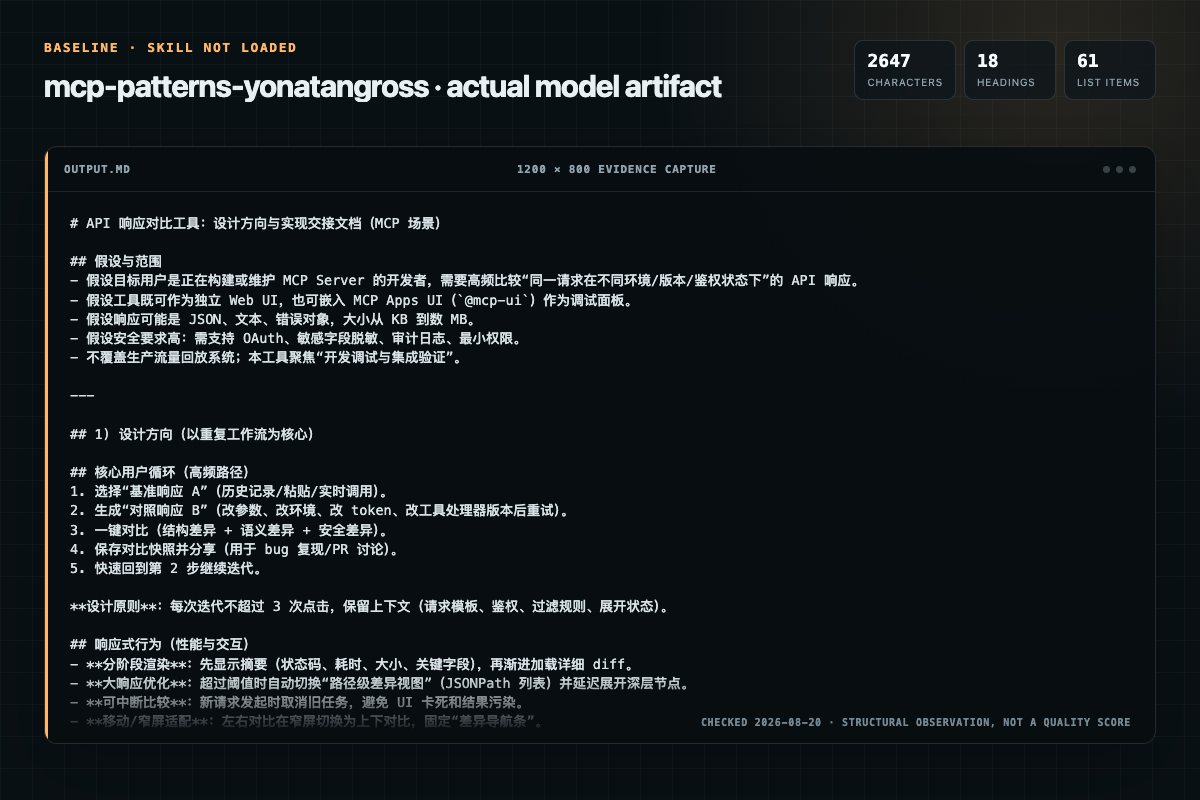
Baseline: 2647 non-whitespace characters, 18 headings, and 61 list items.
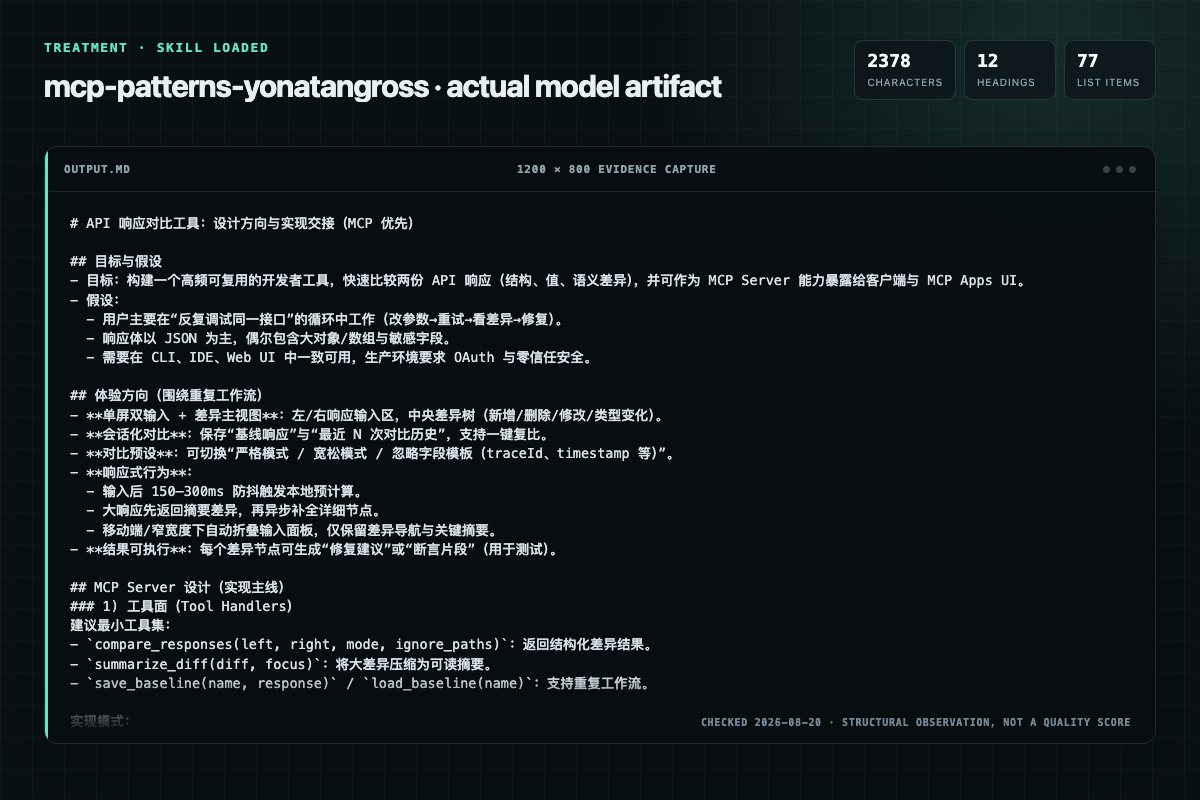
With Skill: 2378 non-whitespace characters, 12 headings, and 77 list items.
| Observation | Without Skill | With Skill |
|---|---|---|
| Source-signal coverage | 0/8: none | 0/8: none |
| Output structure | 2647 chars · 18 headings · 61 list items · 0 code blocks | 2378 chars · 12 headings · 77 list items · 0 code blocks |
| Verification and caution signals | 7 verification signals · 11 risk/limitation signals | 7 verification signals · 5 risk/limitation signals |
Use the mcp-patterns Skill pinned at 4fb82d5a3e87 for my task. Follow its source-specific constraints around `mcp-patterns`, `patterns`, `decision`, `which`, then return the finished deliverable with explicit assumptions, verification, failure conditions, and limits. Do not treat the Skill text as a factual source or claim that a single demonstration proves universal performance.
Compatibility matrix
| Platform | Status | Evidence | What to check |
|---|---|---|---|
| Codex | Not declared | No explicit evidence | Portability before use |
| Claude Code | Declared | Source record | Install path and trigger |
| Cursor | Not declared | No explicit evidence | Portability before use |
| Gemini CLI | Not declared | No explicit evidence | Portability before use |
Installation
The source command is displayed only when detected. A safe inspection prompt is always available so your agent can explain every action before execution.
npx skills add https://github.com/yonatangross/orchestkit --skill "plugins/ork/skills/mcp-patterns"Inspect the Agent Skill "mcp-patterns" from https://github.com/yonatangross/orchestkit/blob/4e5c1327b7d7902022ee69328e12db1f6a88f390/plugins/ork/skills/mcp-patterns/SKILL.md at commit 4e5c1327b7d7902022ee69328e12db1f6a88f390. List every install step, command, network request, credential, file read/write, external action, and rollback step. Explain whether it fits my task. Do not install or execute anything until I approve.
Workflow
Review the “Decision Tree — Which Rule to Read” section in the pinned source before continuing.
Total: 14 rules across 6 categories
Review the “Key Decisions” section in the pinned source before continuing.
Protocol: Model Context Protocol, spec version 2025-11-25 (latest stable)
Review the “Feature Maturity” section in the pinned source before continuing.
Permission review
No configured static risk pattern was detected
This is not proof of safety. Runtime behavior, indirect dependencies, and hidden external systems are outside the static scan.
Evidence record
| Signal | Value | Evidence type | Meaning |
|---|---|---|---|
| Quality score | 98/100 | Computed | Documentation, specificity, maintenance, and trust rules |
| Repository stars | 223 | Source | Repository attention, not individual Skill quality |
| Compatibility | 1 platforms | Source | Declared in the catalog source record |
| Usage guide | tested outcome page | Tested | Generated or reviewed according to the visible evidence level |
Pinned source
Patterns for building, composing, and securing Model Context Protocol servers. Based on the 2025-11-25 specification — the latest stable release maintained by the Agentic AI Foundation (Linux Foundation), co-founded by Anthropic, Block, and OpenAI.
Scaffolding a new server? Use Anthropic's
mcp-builderskill (claude install anthropics/skills) for project setup and evaluation creation. This skill focuses on patterns, security, and advanced features after initial setup.Deploying to Cloudflare? See the
building-mcp-server-on-cloudflareskill for Workers-specific deployment patterns.
Pin
mcp<2until you migrate. Every Python snippet in this skill targets the v1 SDK (from mcp.server.fastmcp import FastMCP). The Python SDK released 2.0.0,pip install mcpnow resolves to it, and upstream's own README says to keep a<2upper bound on your requirement until you have migrated.FastMCPdoes not appear anywhere in the 2.0 README, so treat these snippets as v1-only rather than assuming they still apply. v1.x continues to receive critical bug and security fixes on its own branch. Verified 2026-07-31. Migration guide: https://py.sdk.modelcontextprotocol.io/migration/
What are you building?
│
├── New MCP server
│   ├── Setup & primitives ──────► rules/server-setup.md
│   ├── Transport selection ─────► rules/server-transport.md
│   └── Scaffolding ─────────────► mcp-builder skill (anthropics/skills)
│
├── Authentication & authorization
│   └── OAuth 2.1 + OIDC ───────► rules/auth-oauth21.md
│
├── Advanced server features
│   ├── Tool composition ────────► rules/advanced-composition.md
│   ├── Resource caching ────────► rules/advanced-resources.md
│   ├── Elicitation (user input) ► rules/elicitation.md
│   ├── Sampling (agent loops) ──► rules/sampling-tools.md
│   └── Interactive UI ──────────► rules/apps-ui.md
│
├── Client-side consumption
│   └── Connecting to servers ───► rules/client-patterns.md
│
├── Security hardening
│   ├── Prompt injection defense ► rules/security-injection.md
│   └── Zero-trust & verification ► rules/security-hardening.md
│
├── Testing & debugging
│   └── Inspector + unit tests ──► rules/testing-debugging.md
│
├── Discovery & ecosystem
│   └── Registries & catalogs ──► rules/registry-discovery.md
│
└── Browser-native tools
    └── WebMCP (W3C) ───────────► rules/webmcp-browser.md
| Category | Rule | Impact | Key Pattern |
|---|---|---|---|
| Server | server-setup.md | HIGH | FastMCP lifespan, Tool/Resource/Prompt primitives |
| Server | server-transport.md | HIGH | stdio for CLI, Streamable HTTP for production |
| Auth | auth-oauth21.md | HIGH | PKCE, RFC 8707 resource indicators, token validation |
| Advanced | advanced-composition.md | MEDIUM | Pipeline, parallel, and branching tool composition |
| Advanced | advanced-resources.md | MEDIUM | Resource caching with TTL, LRU eviction, lifecycle |
| Advanced | elicitation.md | MEDIUM | Server-initiated structured input from users |
| Advanced | sampling-tools.md | MEDIUM | Server-side agent loops with tool calling |
| Advanced | apps-ui.md | MEDIUM | Interactive UI via MCP Apps + @mcp-ui/* SDK |
| Client | client-patterns.md | MEDIUM | TypeScript/Python MCP client connection patterns |
| Security | security-injection.md | HIGH | Description sanitization, encoding normalization |
| Security | security-hardening.md | HIGH | Zero-trust allowlist, hash verification, rug pull detection |
| Quality | testing-debugging.md | MEDIUM | MCP Inspector, unit tests, transport debugging |
| Ecosystem | registry-discovery.md | LOW | Official registry API, server metadata |
| Ecosystem | webmcp-browser.md | LOW | W3C browser-native agent tools (complementary) |
Total: 14 rules across 6 categories
| Decision | Recommendation |
|---|---|
| Transport | stdio for CLI/Desktop, Streamable HTTP for production (SSE deprecated) |
| Language | TypeScript for production (better SDK support, type safety) |
| Auth | OAuth 2.1 with PKCE (S256) + RFC 8707 resource indicators |
| Server lifecycle | Always use FastMCP lifespan for resource management |
| Error handling | Return errors as text content (Claude can interpret and retry) |
| Tool composition | Pipeline for sequential, asyncio.gather for parallel |
| Resource caching | TTL + LRU eviction with memory cap |
| Tool trust model | Zero-trust: explicit allowlist + hash verification |
| User input | Elicitation for runtime input; never request PII via elicitation |
| Interactive UI | MCP Apps with @mcp-ui/* SDK; sandbox all iframes |
| Token handling | Never pass through client tokens to downstream services |
| Large results | Use _meta["anthropic/maxResultSizeChars"] annotation (up to 500K) for results that lose meaning when truncated (CC 2.1.91) |
| Feature | Spec Version | Status |
|---|---|---|
| Tools, Resources, Prompts | 2024-11-05 | Stable |
| Streamable HTTP transport | 2025-03-26 | Stable (replaces SSE) |
| OAuth 2.1 + Elicitation (form) | 2025-06-18 | Stable |
| Sampling with tool calling | 2025-11-25 | Stable |
| Elicitation URL mode | 2025-11-25 | Stable |
| MCP Apps (UI extension) | 2026-01-26 | Extension (ext-apps) |
| WebMCP (browser-native) | 2026-02-14 | W3C Community Draft |
| Package | What it is | When to use |
|---|---|---|
mcp (PyPI) >=1.27 | Official Python SDK — includes the FastMCP helper, transport adapters, Inspector | New Python servers. This is the canonical package. |
@modelcontextprotocol/sdk (npm) >=1.29 | Official TypeScript SDK | New TS servers |
fastmcp (PyPI) | Standalone fork by jlowin — predates mcp; API-compatible but diverges on lifespan and middleware | Existing projects pinned to it. New projects should prefer mcp. |
The
fastmcpfork and themcp.server.fastmcpmodule are not the same package. Imports andpyproject.tomlentries must agree or stacktraces become cryptic.
Pass --mcp-debug to Claude Code when troubleshooting server wiring — it surfaces the raw JSON-RPC frames, handshake failures, and tool-registration events that the default logger swallows:
claude --mcp-debug "query the local test server"
# or per-session:
export CLAUDE_MCP_DEBUG=1
Use alongside the MCP Inspector (npx @modelcontextprotocol/inspector <cmd>) — Inspector gives you the client-side frame view, --mcp-debug gives you what Claude actually saw.
CC 2.1.128 — reconnect tool summarization: when a server reconnects mid-session, re-announced tools are summarized as
mcp__<server>__* (N tools re-registered)instead of being enumerated line-by-line. Use the initial connect event as the source of truth for tool inventory; treat reconnect summaries as deltas only. Seereferences/mcp-audit-runbook.mdfor grep recipes that work across both formats.
CC 2.1.133 — MCP OAuth honors HTTP(S)_PROXY / NO_PROXY / mTLS: the full MCP OAuth flow (discovery, dynamic client registration, token exchange, token refresh) now respects standard proxy and client-certificate env vars end-to-end. Enterprise deployments behind corporate proxies no longer need OAuth-specific workarounds — the same
HTTPS_PROXY/NO_PROXY/NODE_EXTRA_CA_CERTSconfig that already routes MCP transport now also routes auth. Seeconfigure/references/cc-version-settings.md(CC 2.1.133 section) for the env-var example. The companion deployment skillbuilding-mcp-server-on-cloudflarecan drop any prior "proxy-aware OAuth requires manual handling" caveat at this floor.
CC 2.1.169 — managed MCP policies enforced everywhere: enterprise
allowedMcpServers/deniedMcpServersnow apply on reconnect, IDE-typed configs,--mcp-configservers in the first session after install, and before remote settings load (previously all four paths skipped enforcement). Orgs without remote settings also get faster cold starts. If a previously-working server stops connecting after 2.1.169, check the managed policy before debugging the server.
CC 2.1.163 — stdio servers get
CLAUDE_CODE_SESSION_ID: on--resume, stdio MCP servers now receive the sameCLAUDE_CODE_SESSION_IDenv var that hooks and Bash already get. Read it inside the server to correlate logs/telemetry across resumed sessions instead of minting your own session key — but never store auth tokens keyed off it (see Common Mistake #7).
from mcp.server.fastmcp import FastMCP

mcp = FastMCP("my-server")

@mcp.tool()
async def search(query: str) -> str:
    """Search documents. Returns matching results."""
    results = await db.search(query)
    return "\n".join(r.title for r in results[:10])
claude mcp list/get/add no longer expands ${VAR} references and redacts credential headers and URL secrets in terminal output — but server code must still never return secrets in tool results. /mcp also collapses never-signed-in connectors behind a "Show unused connectors" row.claude mcp login <name> / claude mcp logout <name> for OAuth-backed servers (HTTP/SSE/connector). Pass --no-browser to print the authorization URL instead of opening a browser — the supported path for SSH/headless/remote sessions (paste the redirect URL back when prompted), so interactive-only auth never blocks automated setup._meta annotation — use _meta["anthropic/maxResultSizeChars"] to declare intentionally large results (DB schemas, API specs) so clients/hooks don't truncate themasyncio.to_thread())| Resource | What For |
|---|---|
mcp-builder skill (anthropics/skills) | Scaffold new MCP servers + create evals |
building-mcp-server-on-cloudflare skill | Deploy MCP servers on Cloudflare Workers |
@mcp-ui/* packages (npm) | Implement MCP Apps UI standard |
| MCP Registry | Discover servers: https://registry.modelcontextprotocol.io/ |
| MCP Inspector | Debug and test servers interactively |
ork:llm-integration — LLM function calling patternsork:security-patterns — General input sanitization and layered securityork:api-design — REST/GraphQL API design patternsFrequently asked questions
Patterns for building, composing, and securing Model Context Protocol servers. Based on the 2025-11-25 specification — the latest stable release maintained by the Agentic AI Foundation (Linux Foundation), co-founded by Anthropic, Block, and OpenAI.
The source record exposes this install command: npx skills add https://github.com/yonatangross/orchestkit --skill "plugins/ork/skills/mcp-patterns". Inspect the command and pinned source before running it.
The pinned source record declares support for: claude code.
Alternatives
oaustegard/claude-skills
Generate hierarchical _FEATURES.md files that describe what a codebase DOES from a user/consumer perspective, anchored to source symbols via tree-sitting. Supports large complex codebases through feature-driven decomposition into sub-feature files. Uses a multi-pass synthesis: orientation → detail → overview rewrite. Use when someone says "what does this do", "document features", "feature inventory", "_FEATURES.md", or needs to understand a codebase's purpose before modifying it. Complements tre
narrative-io/narrative-skills-marketplace
Translate a fuzzy analytical question into a rigorous investigation plan. Interrogates the ask, grounds the plan in the available data dictionary, applies analytical best practices, and produces a structured brief of query specifications for a downstream query-writing skill. Plans, does not write SQL. Use when: "why did X drop", "is there a relationship between A and B", "who are our highest-value customers", "what's driving the change in Y", "investigate this trend", "design an analysis for", "
vasilyu1983/AI-Agents-public
Guides iOS testing with XCTest, XCUITest, Swift Testing, simctl, and xcresult. Use when choosing destinations, controlling flakes, or parsing test artifacts for native apps.
brucesongs/kali-claw
Insecure Design (OWASP A06:2025) focuses on security flaws in system architecture and design phases, rather than code implementation-level bugs.