
Best for
- Deciding between Polars and Pandas for a data pipeline
- Optimizing memory usage with zero-copy Arrow patterns
- Loading data from ClickHouse into PyTorch DataLoaders
terrylica/cc-skills/plugins/devops-tools/skills/ml-data-pipeline-architecture/SKILL.md
Patterns for efficient ML data pipelines using Polars, Arrow, and ClickHouse. TRIGGERS - data pipeline, polars vs pandas, arrow format
Decision brief
Patterns for efficient ML data pipelines using Polars, Arrow, and ClickHouse.
In this controlled same-task single run, enabling ml-data-pipeline-architecture changed the output from 2320 non-whitespace characters and 20 headings to 2322 characters and 21 headings. Matches among 8 signals extracted from the pinned source changed from 3 to 2. Both actual outputs are shown; this is a structural observation, not a quality score or a universal performance claim.
Analyze a small SaaS churn scenario and produce a concrete analysis plan with data checks, method choices, expected outputs, and validation steps. The deliverable must specifically reflect this user intent: Patterns for efficient ML data pipelines using Polars, Arrow, and ClickHouse. TRIGGERS - data pipeline, polars vs pandas, arrow format
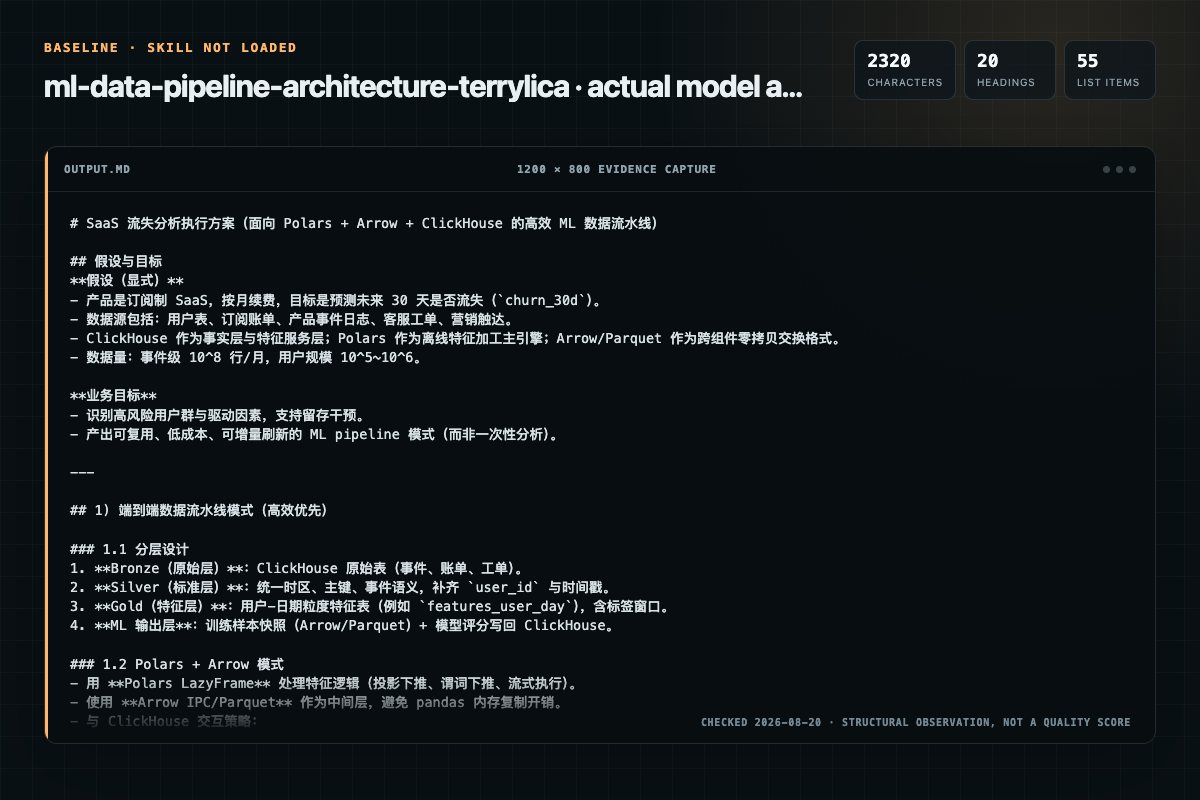
Baseline: 2320 non-whitespace characters, 20 headings, and 55 list items.
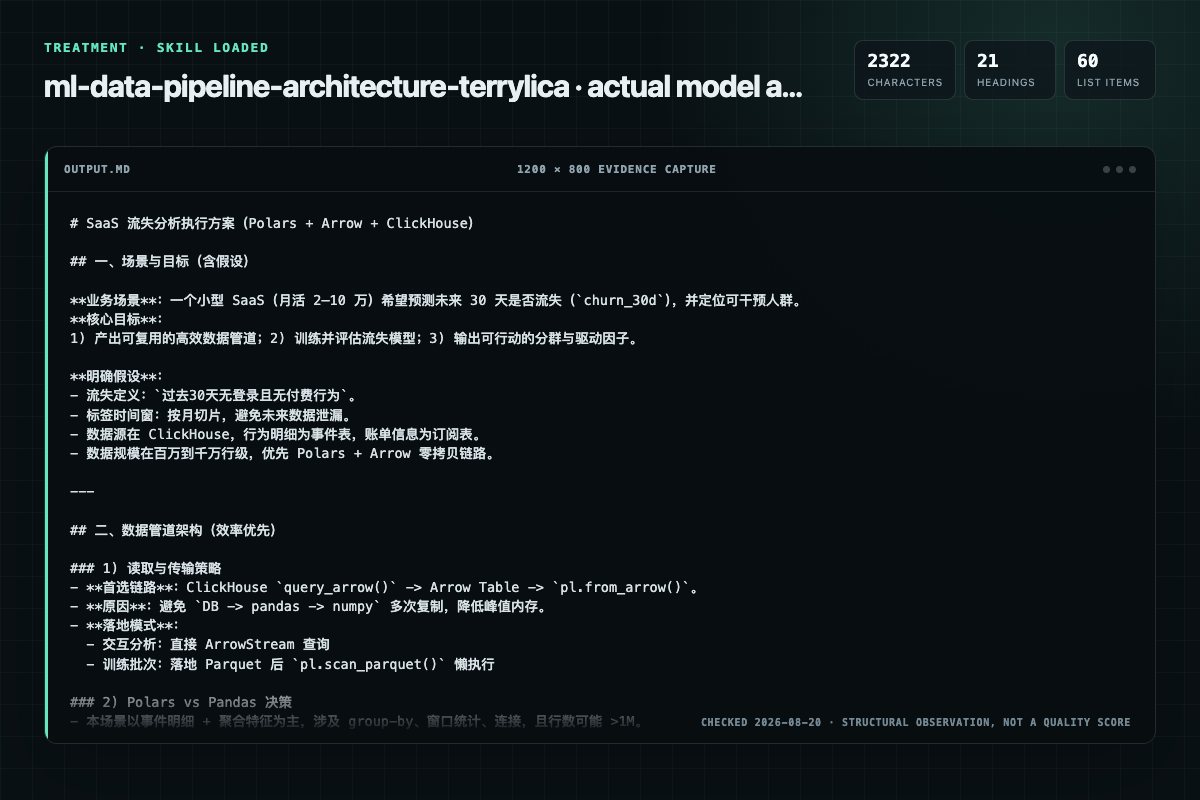
With Skill: 2322 non-whitespace characters, 21 headings, and 60 list items.
| Observation | Without Skill | With Skill |
|---|---|---|
| Source-signal coverage | 3/8: pipeline, polars, pandas | 2/8: polars, pandas |
| Output structure | 2320 chars · 20 headings · 55 list items · 0 code blocks | 2322 chars · 21 headings · 60 list items · 0 code blocks |
| Verification and caution signals | 16 verification signals · 7 risk/limitation signals | 20 verification signals · 8 risk/limitation signals |
Use the ml-data-pipeline-architecture Skill pinned at 2c1efdaeb5ce for my task. Follow its source-specific constraints around `ml-data-pipeline-architecture`, `pipeline`, `architecture`, `decision`, then return the finished deliverable with explicit assumptions, verification, failure conditions, and limits. Do not treat the Skill text as a factual source or claim that a single demonstration proves universal performance.
Compatibility matrix
| Platform | Status | Evidence | What to check |
|---|---|---|---|
| Codex | Not declared | No explicit evidence | Portability before use |
| Claude Code | Not declared | No explicit evidence | Portability before use |
| Cursor | Not declared | No explicit evidence | Portability before use |
| Gemini CLI | Not declared | No explicit evidence | Portability before use |
Installation
The source command is displayed only when detected. A safe inspection prompt is always available so your agent can explain every action before execution.
npx skills add https://github.com/terrylica/cc-skills --skill "plugins/devops-tools/skills/ml-data-pipeline-architecture"Inspect the Agent Skill "ml-data-pipeline-architecture" from https://github.com/terrylica/cc-skills/blob/a5f847b22ee5afa35677e446973a903d098cd1d4/plugins/devops-tools/skills/ml-data-pipeline-architecture/SKILL.md at commit a5f847b22ee5afa35677e446973a903d098cd1d4. List every install step, command, network request, credential, file read/write, external action, and rollback step. Explain whether it fits my task. Do not install or execute anything until I approve.
Workflow
df = queryarrow(client, "SELECT FROM bars WHERE ts = '2024-01-01'") python
def processlargefile(path: str, chunksize: int = 100000): reader = pl.scanparquet(path)
[ ] Add polars = "" to dependencies (see PyPI)
[ ] Add pl.frompandas() wrapper at trainer entry
[ ] Convert file reads to pl.scan
Permission review
No configured static risk pattern was detected
This is not proof of safety. Runtime behavior, indirect dependencies, and hidden external systems are outside the static scan.
Evidence record
| Signal | Value | Evidence type | Meaning |
|---|---|---|---|
| Quality score | 97/100 | Computed | Documentation, specificity, maintenance, and trust rules |
| Repository stars | 62 | Source | Repository attention, not individual Skill quality |
| Compatibility | 0 platforms | Source | Declared in the catalog source record |
| Usage guide | tested outcome page | Tested | Generated or reviewed according to the visible evidence level |
Pinned source
Patterns for efficient ML data pipelines using Polars, Arrow, and ClickHouse.
ADR: 2026-01-22-polars-preference-hook (efficiency preferences framework)
Note: A PreToolUse hook enforces Polars preference. To use Pandas, add
# polars-exception: <reason>at file top.
Self-Evolving Skill: This skill improves through use. If instructions are wrong, parameters drifted, or a workaround was needed — fix this file immediately, don't defer. Only update for real, reproducible issues.
Use this skill when:
Dataset size?
├─ < 1M rows → Pandas OK (simpler API, richer ecosystem)
├─ 1M-10M rows → Consider Polars (2-5x faster, less memory)
└─ > 10M rows → Use Polars (required for memory efficiency)

Operations?
├─ Simple transforms → Either works
├─ Group-by aggregations → Polars 5-10x faster
├─ Complex joins → Polars with lazy evaluation
└─ Streaming/chunked → Polars scan_* functions

Integration?
├─ scikit-learn heavy → Pandas (better interop)
├─ PyTorch/custom → Polars + Arrow (zero-copy to tensor)
└─ ClickHouse source → Arrow stream → Polars (optimal)
# BAD: 3 memory copies
df = pd.read_sql(query, conn)     # Copy 1: DB → pandas
X = df[features].values           # Copy 2: pandas → numpy
tensor = torch.from_numpy(X)      # Copy 3: numpy → tensor
# Peak memory: 3x data size
# GOOD: 0-1 memory copies
import clickhouse_connect
import polars as pl
import torch

client = clickhouse_connect.get_client(...)
arrow_table = client.query_arrow("SELECT * FROM bars")  # Arrow in DB memory
df = pl.from_arrow(arrow_table)                          # Zero-copy view
X = df.select(features).to_numpy()                       # Single allocation
tensor = torch.from_numpy(X)                             # View (no copy)
# Peak memory: 1.2x data size
def query_arrow(client, query: str) -> pl.DataFrame:
    """ClickHouse → Arrow → Polars (zero-copy chain)."""
    arrow_table = client.query_arrow(f"{query} FORMAT ArrowStream")
    return pl.from_arrow(arrow_table)

# Usage
df = query_arrow(client, "SELECT * FROM bars WHERE ts >= '2024-01-01'")
# Polars has native ClickHouse support (see pola.rs for version requirements)
df = pl.read_database_uri(
    query="SELECT * FROM bars",
    uri="clickhouse://user:pass@host/db"
)
# For reproducible batch processing
client.query("SELECT * FROM bars INTO OUTFILE 'data.parquet' FORMAT Parquet")
df = pl.scan_parquet("data.parquet")  # Lazy, memory-mapped
from torch.utils.data import TensorDataset, DataLoader

# Accept both pandas and polars
def prepare_data(df) -> tuple[torch.Tensor, torch.Tensor]:
    if isinstance(df, pd.DataFrame):
        df = pl.from_pandas(df)

    X = df.select(features).to_numpy()
    y = df.select(target).to_numpy()

    return (
        torch.from_numpy(X).float(),
        torch.from_numpy(y).float()
    )

X, y = prepare_data(df)
dataset = TensorDataset(X, y)
loader = DataLoader(dataset, batch_size=32, pin_memory=True)
class PolarsDataset(torch.utils.data.Dataset):
    """Memory-efficient dataset from Polars DataFrame."""

    def __init__(self, df: pl.DataFrame, features: list[str], target: str):
        self.arrow = df.to_arrow()  # Arrow backing for zero-copy slicing
        self.features = features
        self.target = target

    def __len__(self) -> int:
        return self.arrow.num_rows

    def __getitem__(self, idx: int) -> tuple[torch.Tensor, torch.Tensor]:
        row = self.arrow.slice(idx, 1)
        x = torch.tensor([row[f][0].as_py() for f in self.features], dtype=torch.float32)
        y = torch.tensor(row[self.target][0].as_py(), dtype=torch.float32)
        return x, y
# Define transformations lazily (no computation yet)
pipeline = (
    pl.scan_parquet("raw_data.parquet")
    .filter(pl.col("timestamp") >= start_date)
    .with_columns([
        (pl.col("close").pct_change()).alias("returns"),
        (pl.col("volume").log()).alias("log_volume"),
    ])
    .select(features + [target])
)

# Execute only when needed
train_df = pipeline.filter(pl.col("timestamp") < split_date).collect()
test_df = pipeline.filter(pl.col("timestamp") >= split_date).collect()
# Process file in chunks (never loads full file)
def process_large_file(path: str, chunk_size: int = 100_000):
    reader = pl.scan_parquet(path)

    for batch in reader.iter_batches(n_rows=chunk_size):
        # Process each chunk
        features = compute_features(batch)
        yield features.to_numpy()
from pydantic import BaseModel, field_validator

class FeatureConfig(BaseModel):
    features: list[str]
    target: str
    seq_len: int = 15

    @field_validator("features")
    @classmethod
    def validate_features(cls, v):
        required = {"returns_vs", "momentum_z", "atr_pct"}
        missing = required - set(v)
        if missing:
            raise ValueError(f"Missing required features: {missing}")
        return v
def validate_schema(df: pl.DataFrame, required: list[str], stage: str) -> None:
    """Fail-fast schema validation."""
    missing = [c for c in required if c not in df.columns]
    if missing:
        raise ValueError(
            f"[{stage}] Missing columns: {missing}\n"
            f"Available: {sorted(df.columns)}"
        )
| Operation | Pandas | Polars | Speedup |
|---|---|---|---|
| Read CSV (1GB) | 45s | 4s | 11x |
| Filter rows | 2.1s | 0.4s | 5x |
| Group-by agg | 3.8s | 0.3s | 13x |
| Sort | 5.2s | 0.4s | 13x |
| Memory peak | 10GB | 2.5GB | 4x |
Benchmark: 50M rows, 20 columns, MacBook M2
polars = "<version>" to dependencies (see PyPI)query_arrow() in data clientpl.from_pandas() wrapper at trainer entryprepare_sequences() to accept both typespl.scan_*.collect() only before .to_numpy()# BAD: Convert back and forth
df_polars = pl.from_pandas(df_pandas)
df_pandas_again = df_polars.to_pandas() # Why?
# BAD: Defeats lazy evaluation
df = pl.scan_parquet("data.parquet").collect()  # Full load
filtered = df.filter(...)  # After the fact

# GOOD: Filter before collect
df = pl.scan_parquet("data.parquet").filter(...).collect()
# BAD: Loads entire file
df = pl.read_parquet("huge_file.parquet")

# GOOD: Stream in chunks
for batch in pl.scan_parquet("huge_file.parquet").iter_batches():
    process(batch)
| Issue | Cause | Solution |
|---|---|---|
| Memory spike during load | Collecting too early | Use lazy evaluation, call collect() only when needed |
| Arrow conversion fails | Unsupported data type | Check for object columns, convert to native types |
| ClickHouse connection error | Wrong port or credentials | Verify host:8123 (HTTP) or host:9000 (native) |
| Zero-copy not working | Intermediate pandas conversion | Remove to_pandas() calls, stay in Arrow/Polars |
| Polars hook blocking code | Pandas used without exception | Add # polars-exception: reason comment at file top |
| Slow group-by operations | Using pandas for large datasets | Migrate to Polars for 5-10x speedup |
| Schema validation failure | Column names case-sensitive | Verify exact column names from source |
| PyTorch DataLoader OOM | Loading full dataset into memory | Use PolarsDataset with Arrow backing for lazy access |
| Parquet scan performance | Not using predicate pushdown | Add filters before collect() for lazy evaluation |
| Type mismatch in tensor | Float64 vs Float32 mismatch | Explicitly cast with .cast(pl.Float32) before numpy |
After this skill completes, reflect before closing the task:
Do NOT defer. The next invocation inherits whatever you leave behind.
Frequently asked questions
Patterns for efficient ML data pipelines using Polars, Arrow, and ClickHouse.
The source record exposes this install command: npx skills add https://github.com/terrylica/cc-skills --skill "plugins/devops-tools/skills/ml-data-pipeline-architecture". Inspect the command and pinned source before running it.
Alternatives
terrylica/cc-skills
Control Notion via Python SDK. TRIGGERS - Notion API, create page, query database, add blocks.
K-Dense-AI/scientific-agent-skills
Distributed computing for larger-than-RAM pandas/NumPy workflows. Use when you need to scale existing pandas/NumPy code beyond memory or across clusters. Best for parallel file processing, distributed ML, integration with existing pandas code. For out-of-core analytics on single machine use vaex; for in-memory speed use polars.
K-Dense-AI/scientific-agent-skills
Medicinal chemistry filters for compound triage. Apply drug-likeness rules (Lipinski, Veber, CNS), structural alert catalogs (PAINS, NIBR, ChEMBL), complexity metrics, and the medchem query language for library filtering.
K-Dense-AI/scientific-agent-skills
Use NeuroKit2 to build or audit reproducible research workflows for physiological time-series preprocessing, event/interval analysis, multimodal alignment, variability, and complexity. Trigger when code imports neurokit2 or needs its current APIs, schemas, and method-aware validation—not for diagnosis or device validation.