
Best for
- Predicting PCR amplicons from primer sequences and templates
- Simulating restriction enzyme digestions and predicting fragment sizes
- Designing Golden Gate assembly with 4bp overhang compatibility
synthetic-sciences/openscience/backend/cli/skills/biology/molecular-cloning/SKILL.md
Molecular cloning simulation and design. PCR amplicon prediction, restriction enzyme digestion, Golden Gate and Gibson assembly simulation, primer design, CRISPR sgRNA design, and plasmid annotation. For protein-level sequence analysis use biopython or esm; for database lookups use gene-database or ensembl-database.
Decision brief
Molecular cloning simulation and design. PCR amplicon prediction, restriction enzyme digestion, Golden Gate and Gibson assembly simulation, primer design, CRISPR sgRNA design, and plasmid annotation.
In this controlled same-task single run, enabling molecular-cloning changed the output from 1955 non-whitespace characters and 12 headings to 2313 characters and 13 headings. Matches among 8 signals extracted from the pinned source changed from 0 to 1. Both actual outputs are shown; this is a structural observation, not a quality score or a universal performance claim.
Create a design direction and implementation handoff for a developer tool that compares two API responses. Prioritize the repeated user workflow and responsive behavior. The deliverable must specifically reflect this user intent: Molecular cloning simulation and design. PCR amplicon prediction, restriction enzyme digestion, Golden Gate and Gibson assembly simulation, primer design, CRISPR sgRNA design, and plasmid annotation. For protein-level sequence analysis use biopython or esm; for database lookups use gene-database or ensembl-database.
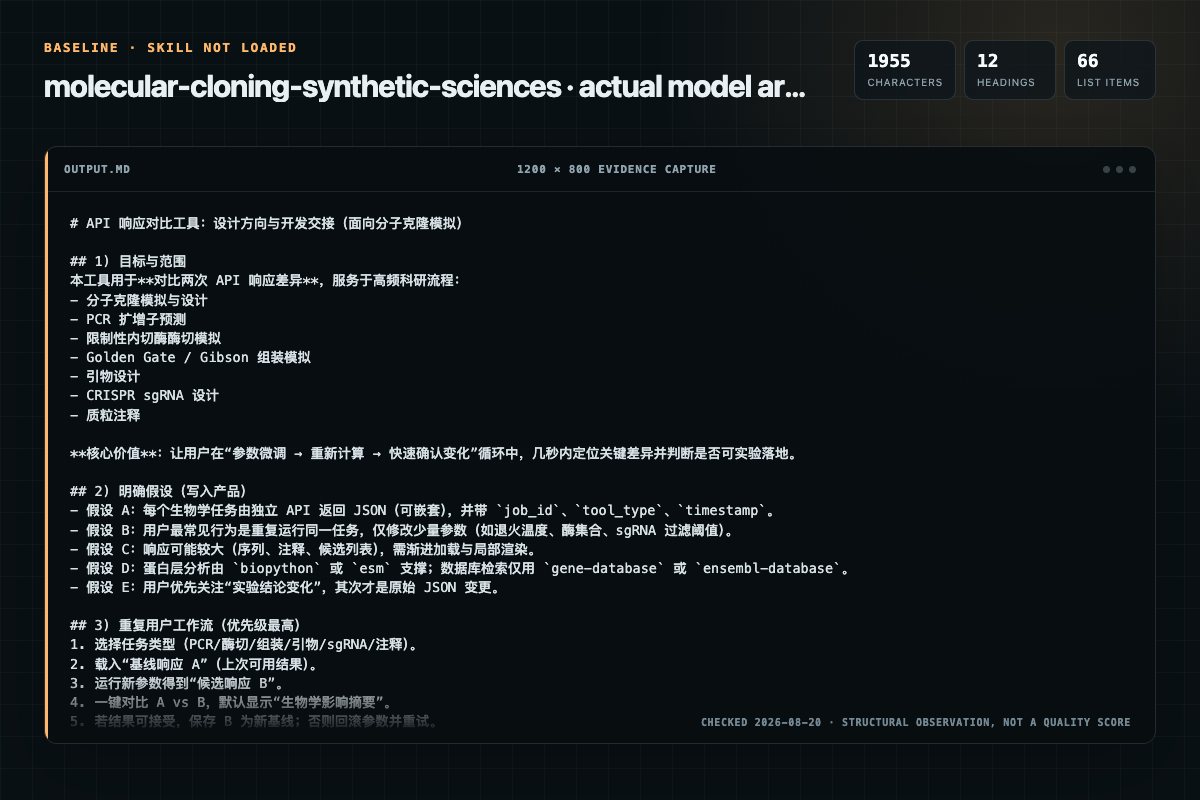
Baseline: 1955 non-whitespace characters, 12 headings, and 66 list items.
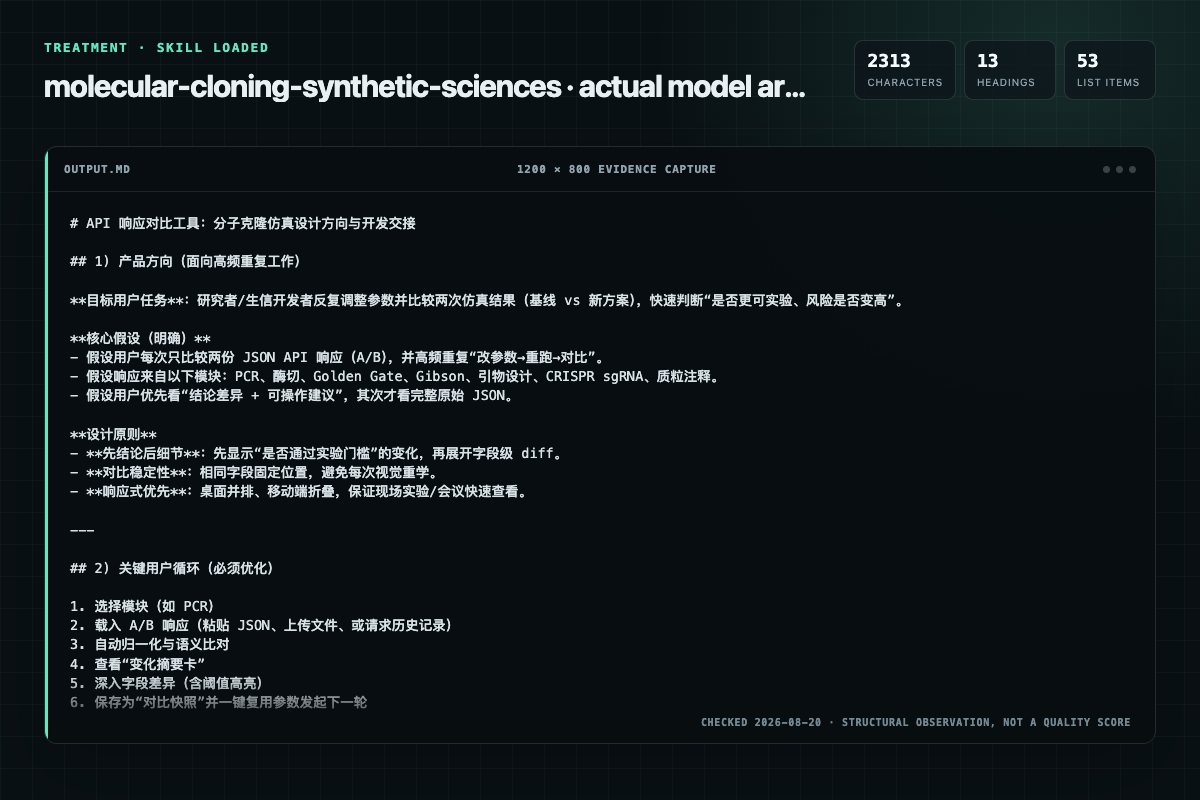
With Skill: 2313 non-whitespace characters, 13 headings, and 53 list items.
| Observation | Without Skill | With Skill |
|---|---|---|
| Source-signal coverage | 0/8: none | 1/8: design |
| Output structure | 1955 chars · 12 headings · 66 list items · 0 code blocks | 2313 chars · 13 headings · 53 list items · 1 code blocks |
| Verification and caution signals | 3 verification signals · 16 risk/limitation signals | 2 verification signals · 13 risk/limitation signals |
Use the molecular-cloning Skill pinned at 0e1e42e75212 for my task. Follow its source-specific constraints around `molecular-cloning`, `molecular`, `cloning`, `sequence`, then return the finished deliverable with explicit assumptions, verification, failure conditions, and limits. Do not treat the Skill text as a factual source or claim that a single demonstration proves universal performance.
Compatibility matrix
| Platform | Status | Evidence | What to check |
|---|---|---|---|
| Codex | Not declared | No explicit evidence | Portability before use |
| Claude Code | Not declared | No explicit evidence | Portability before use |
| Cursor | Not declared | No explicit evidence | Portability before use |
| Gemini CLI | Not declared | No explicit evidence | Portability before use |
Installation
The source command is displayed only when detected. A safe inspection prompt is always available so your agent can explain every action before execution.
npx skills add https://github.com/synthetic-sciences/openscience --skill "backend/cli/skills/biology/molecular-cloning"Inspect the Agent Skill "molecular-cloning" from https://github.com/synthetic-sciences/openscience/blob/d7129109cc959e2bbbfee84bba019e4e722221da/backend/cli/skills/biology/molecular-cloning/SKILL.md at commit d7129109cc959e2bbbfee84bba019e4e722221da. List every install step, command, network request, credential, file read/write, external action, and rollback step. Explain whether it fits my task. Do not install or execute anything until I approve.
Workflow
python from Bio.Seq import Seq from Bio.Restriction import BamHI, EcoRI from Bio.SeqUtils import MeltingTemp as mt
Review the “Workflow 1: Design PCR Primers and Predict Amplicon” section in the pinned source before continuing.
Review the “Workflow 2: Plan Golden Gate Assembly with 4 Parts” section in the pinned source before continuing.
Review the “Workflow 3: Design CRISPR Knockout sgRNAs” section in the pinned source before continuing.
Related Skills: For protein-level sequence analysis use biopython or esm. For gene/transcript lookups use gene-database or ensembl-database. For synthetic biology circuit design use synthetic-biology.
Permission review
No configured static risk pattern was detected
This is not proof of safety. Runtime behavior, indirect dependencies, and hidden external systems are outside the static scan.
Evidence record
| Signal | Value | Evidence type | Meaning |
|---|---|---|---|
| Quality score | 95/100 | Computed | Documentation, specificity, maintenance, and trust rules |
| Repository stars | 3,337 | Source | Repository attention, not individual Skill quality |
| Compatibility | 0 platforms | Source | Declared in the catalog source record |
| Usage guide | tested outcome page | Tested | Generated or reviewed according to the visible evidence level |
Pinned source
Molecular Cloning provides computational tools for simulating and designing molecular cloning workflows. This skill covers PCR amplicon prediction with primer binding analysis, restriction enzyme digestion simulation, Golden Gate and Gibson assembly design and verification, primer design with thermodynamic calculations, CRISPR sgRNA design with off-target scoring, and plasmid feature annotation. All simulations use Biopython's Bio.Restriction and Bio.SeqUtils for accurate enzyme and sequence handling.
Related Skills: For protein-level sequence analysis use biopython or esm. For gene/transcript lookups use gene-database or ensembl-database. For synthetic biology circuit design use synthetic-biology.
uv pip install biopython primer3-py numpy
from Bio.Seq import Seq
from Bio.Restriction import BamHI, EcoRI
from Bio.SeqUtils import MeltingTemp as mt

# Restriction digestion
sequence = Seq("ATCGATCGGGATCCATCGATCGAATTCATCGATCG")
print(f"BamHI cuts at: {BamHI.search(sequence)}")
print(f"EcoRI cuts at: {EcoRI.search(sequence)}")

# Primer Tm calculation
primer = Seq("ATCGATCGGATCCATCGATCG")
tm = mt.Tm_NN(primer)
print(f"Primer Tm: {tm:.1f} C")
Predict amplicon from primer binding on template.
from Bio.Seq import Seq
from Bio.SeqUtils import MeltingTemp as mt
import re

def find_primer_binding(template, primer, max_mismatches=2):
    """Find primer binding sites on template (both strands).

    Returns list of (position, strand, mismatches) tuples.
    """
    template_str = str(template).upper()
    primer_str = str(primer).upper()
    rc_template = str(template.reverse_complement()).upper()

    sites = []

    # Search forward strand
    for i in range(len(template_str) - len(primer_str) + 1):
        region = template_str[i:i+len(primer_str)]
        mismatches = sum(a != b for a, b in zip(primer_str, region))
        if mismatches <= max_mismatches:
            sites.append((i, '+', mismatches))

    # Search reverse strand
    for i in range(len(rc_template) - len(primer_str) + 1):
        region = rc_template[i:i+len(primer_str)]
        mismatches = sum(a != b for a, b in zip(primer_str, region))
        if mismatches <= max_mismatches:
            pos = len(template_str) - i - len(primer_str)
            sites.append((pos, '-', mismatches))

    return sites

def simulate_pcr(template, fwd_primer, rev_primer, max_mismatches=2):
    """Simulate PCR and predict amplicon.

    Args:
        template: Bio.Seq template sequence (can be circular)
        fwd_primer: forward primer sequence
        rev_primer: reverse primer sequence (as ordered, 5'->3')
    """
    fwd_sites = find_primer_binding(template, fwd_primer, max_mismatches)
    rev_rc = Seq(str(rev_primer)).reverse_complement()
    rev_sites = find_primer_binding(template, rev_rc, max_mismatches)

    amplicons = []
    for f_pos, f_strand, f_mm in fwd_sites:
        if f_strand != '+':
            continue
        for r_pos, r_strand, r_mm in rev_sites:
            if r_strand != '-':
                continue
            if r_pos > f_pos:
                amp_len = r_pos + len(str(rev_primer)) - f_pos
                if 50 < amp_len < 10000:  # Reasonable amplicon size
                    amplicon = template[f_pos:r_pos + len(str(rev_primer))]
                    amplicons.append({
                        'start': f_pos,
                        'end': r_pos + len(str(rev_primer)),
                        'length': amp_len,
                        'fwd_mismatches': f_mm,
                        'rev_mismatches': r_mm,
                        'sequence': str(amplicon)
                    })

    # Calculate primer Tm
    fwd_tm = mt.Tm_NN(fwd_primer)
    rev_tm = mt.Tm_NN(rev_primer)

    print(f"Forward primer Tm: {fwd_tm:.1f} C")
    print(f"Reverse primer Tm: {rev_tm:.1f} C")
    print(f"Tm difference: {abs(fwd_tm - rev_tm):.1f} C")
    print(f"Predicted amplicons: {len(amplicons)}")

    for i, amp in enumerate(amplicons):
        print(f"  Amplicon {i+1}: {amp['length']} bp "
              f"(pos {amp['start']}-{amp['end']}, "
              f"mismatches: fwd={amp['fwd_mismatches']}, rev={amp['rev_mismatches']})")

    return amplicons
Simulate enzyme digestion and predict fragments.
from Bio.Seq import Seq
from Bio.Restriction import *
from Bio.Restriction import RestrictionBatch, Analysis

def restriction_digest(sequence, enzymes, is_linear=True):
    """Simulate restriction enzyme digestion.

    Args:
        sequence: Bio.Seq DNA sequence
        enzymes: list of enzyme names (e.g., ['EcoRI', 'BamHI'])
        is_linear: True for linear DNA, False for circular
    """
    # Create restriction batch
    rb = RestrictionBatch()
    for enz_name in enzymes:
        rb.add(eval(enz_name))

    # Run analysis
    analysis = Analysis(rb, sequence, linear=is_linear)
    results = analysis.full()

    all_cut_sites = []
    for enzyme, sites in results.items():
        if sites:
            print(f"{enzyme}: cuts at positions {sites}")
            all_cut_sites.extend(sites)
        else:
            print(f"{enzyme}: no cut sites")

    # Calculate fragment sizes
    if not all_cut_sites:
        print(f"No cuts — single fragment: {len(sequence)} bp")
        return [len(sequence)]

    all_cut_sites = sorted(set(all_cut_sites))

    if is_linear:
        positions = [0] + all_cut_sites + [len(sequence)]
    else:
        positions = all_cut_sites

    fragments = []
    if is_linear:
        for i in range(len(positions) - 1):
            fragments.append(positions[i+1] - positions[i])
    else:
        for i in range(len(positions)):
            next_i = (i + 1) % len(positions)
            if next_i == 0:
                frag = len(sequence) - positions[i] + positions[0]
            else:
                frag = positions[next_i] - positions[i]
            fragments.append(frag)

    fragments.sort(reverse=True)
    print(f"\nFragments ({len(fragments)}): {fragments}")
    print(f"Total: {sum(fragments)} bp")

    return fragments

# Example: double digest
seq = Seq("ATCG" * 100 + "GGATCC" + "ATCG" * 50 + "GAATTC" + "ATCG" * 75)
frags = restriction_digest(seq, ['BamHI', 'EcoRI'], is_linear=True)
Design and simulate Golden Gate cloning.
from Bio.Seq import Seq

def design_golden_gate(parts, enzyme='BsaI'):
    """Design Golden Gate assembly with verified overhang compatibility.

    Args:
        parts: list of dicts with 'name', 'sequence' keys
        enzyme: Type IIS enzyme ('BsaI' or 'BpiI')
    """
    # Standard overhangs for 4-part Golden Gate
    standard_overhangs = [
        'AATG',  # Start codon region
        'AGGT',
        'TTCG',
        'GCTT',
        'CGCT',  # After last part (return to vector)
    ]

    if len(parts) + 1 > len(standard_overhangs):
        raise ValueError(f"Too many parts ({len(parts)}) for standard overhang set")

    # Check overhang compatibility (no palindromes, no near-matches)
    overhangs_used = standard_overhangs[:len(parts) + 1]
    for i, oh in enumerate(overhangs_used):
        rc = str(Seq(oh).reverse_complement())
        if oh == rc:
            print(f"WARNING: Overhang {oh} is palindromic — may self-ligate")
        for j, oh2 in enumerate(overhangs_used):
            if i != j and oh == oh2:
                raise ValueError(f"Duplicate overhangs: position {i} and {j}")

    # Build assembly plan
    assembly = []
    for i, part in enumerate(parts):
        left_oh = overhangs_used[i]
        right_oh = overhangs_used[i + 1]

        # Part with enzyme sites added
        if enzyme == 'BsaI':
            recognition = 'GGTCTC'
            spacer = 'N'
        else:  # BpiI
            recognition = 'GAAGAC'
            spacer = 'NN'

        assembled_part = f"{recognition}{spacer}{left_oh}{part['sequence']}{right_oh}"

        assembly.append({
            'name': part['name'],
            'left_overhang': left_oh,
            'right_overhang': right_oh,
            'part_length': len(part['sequence']),
            'total_length': len(assembled_part)
        })

        print(f"Part {i+1} ({part['name']}): [{left_oh}]--{len(part['sequence'])}bp--[{right_oh}]")

    # Predict assembled product
    total_insert = sum(len(p['sequence']) for p in parts) + \
                   len(overhangs_used) * 4  # Overhangs contribute 4bp each
    print(f"\nAssembly: {len(parts)} parts")
    print(f"Total insert: ~{total_insert} bp (excluding vector)")
    print(f"Overhang set: {' -> '.join(overhangs_used)}")

    return assembly

# Example
parts = [
    {'name': 'Promoter', 'sequence': 'TTGACAATTAATCATCGGCTCG' * 5},
    {'name': 'RBS', 'sequence': 'AAGGAGATATACAT'},
    {'name': 'GFP_CDS', 'sequence': 'ATGGTGAGCAAGGGCGAG' * 40},
    {'name': 'Terminator', 'sequence': 'TTTTTTTTTTT' * 4},
]

assembly = design_golden_gate(parts)
Design overlapping fragments for Gibson assembly.
from Bio.Seq import Seq
from Bio.SeqUtils import MeltingTemp as mt

def design_gibson_assembly(fragments, overlap_length=30):
    """Design Gibson assembly with overlap primers.

    Args:
        fragments: list of dicts with 'name', 'sequence' keys (in assembly order)
        overlap_length: overlap length in bp (20-40 recommended)
    """
    assembly_plan = []

    for i in range(len(fragments)):
        current = fragments[i]
        next_frag = fragments[(i + 1) % len(fragments)]

        # Forward primer: end of previous fragment + start of current
        if i == 0:
            fwd_primer = current['sequence'][:20]
        else:
            prev = fragments[i - 1]
            overlap_5 = prev['sequence'][-overlap_length:]
            fwd_primer = overlap_5 + current['sequence'][:20]

        # Reverse primer: RC of (end of current + start of next)
        overlap_3 = next_frag['sequence'][:overlap_length]
        rev_binding = str(Seq(current['sequence'][-20:]).reverse_complement())
        rev_primer = str(Seq(overlap_3).reverse_complement()) + rev_binding

        # Tm of binding region
        fwd_tm = mt.Tm_NN(Seq(current['sequence'][:20]))
        rev_tm = mt.Tm_NN(Seq(current['sequence'][-20:]))

        assembly_plan.append({
            'fragment': current['name'],
            'fragment_length': len(current['sequence']),
            'fwd_primer': fwd_primer,
            'rev_primer': rev_primer,
            'fwd_tm': fwd_tm,
            'rev_tm': rev_tm,
            'overlap_length': overlap_length
        })

        print(f"Fragment {i+1} ({current['name']}): {len(current['sequence'])} bp")
        print(f"  Fwd primer: {fwd_primer[:40]}... ({len(fwd_primer)} nt, Tm={fwd_tm:.1f} C)")
        print(f"  Rev primer: {rev_primer[:40]}... ({len(rev_primer)} nt, Tm={rev_tm:.1f} C)")

    total = sum(len(f['sequence']) for f in fragments)
    print(f"\nTotal assembled length: ~{total} bp")

    return assembly_plan
Design primers with thermodynamic constraints.
import primer3

def design_primers(template_seq, target_start, target_length,
                   product_size_range=(200, 500), tm_target=60):
    """Design PCR primers using primer3.

    Args:
        template_seq: template DNA sequence (string)
        target_start: start position of target region
        target_length: length of target region
        product_size_range: (min, max) product size
        tm_target: target melting temperature
    """
    result = primer3.bindings.design_primers(
        seq_args={
            'SEQUENCE_TEMPLATE': template_seq,
            'SEQUENCE_TARGET': [target_start, target_length],
        },
        global_args={
            'PRIMER_NUM_RETURN': 5,
            'PRIMER_OPT_SIZE': 20,
            'PRIMER_MIN_SIZE': 18,
            'PRIMER_MAX_SIZE': 25,
            'PRIMER_OPT_TM': tm_target,
            'PRIMER_MIN_TM': tm_target - 5,
            'PRIMER_MAX_TM': tm_target + 5,
            'PRIMER_MIN_GC': 40,
            'PRIMER_MAX_GC': 60,
            'PRIMER_PRODUCT_SIZE_RANGE': [list(product_size_range)],
            'PRIMER_MAX_SELF_COMPLEMENT': 6,
            'PRIMER_MAX_SELF_END': 3,
            'PRIMER_MAX_HAIRPIN_TH': 47,
        }
    )

    primers = []
    for i in range(result.get('PRIMER_PAIR_NUM_RETURNED', 0)):
        pair = {
            'left_seq': result[f'PRIMER_LEFT_{i}_SEQUENCE'],
            'right_seq': result[f'PRIMER_RIGHT_{i}_SEQUENCE'],
            'left_tm': result[f'PRIMER_LEFT_{i}_TM'],
            'right_tm': result[f'PRIMER_RIGHT_{i}_TM'],
            'left_gc': result[f'PRIMER_LEFT_{i}_GC_PERCENT'],
            'right_gc': result[f'PRIMER_RIGHT_{i}_GC_PERCENT'],
            'product_size': result[f'PRIMER_PAIR_{i}_PRODUCT_SIZE'],
            'penalty': result[f'PRIMER_PAIR_{i}_PENALTY'],
        }
        primers.append(pair)
        print(f"Pair {i+1}: product={pair['product_size']}bp, penalty={pair['penalty']:.2f}")
        print(f"  Fwd: {pair['left_seq']} (Tm={pair['left_tm']:.1f}, GC={pair['left_gc']:.0f}%)")
        print(f"  Rev: {pair['right_seq']} (Tm={pair['right_tm']:.1f}, GC={pair['right_gc']:.0f}%)")

    return primers
Design guide RNAs for CRISPR-Cas9 knockout.
from Bio.Seq import Seq
import re

def design_crispr_guides(target_seq, pam='NGG', guide_length=20, top_n=10):
    """Design CRISPR sgRNAs for SpCas9.

    Args:
        target_seq: target gene/region sequence (string)
        pam: PAM sequence ('NGG' for SpCas9)
        guide_length: guide RNA length (typically 20)
        top_n: number of top guides to return
    """
    seq = str(target_seq).upper()
    rc_seq = str(Seq(seq).reverse_complement())

    guides = []

    # Search forward strand for PAM (NGG at 3' end of target)
    for i in range(len(seq) - guide_length - len(pam) + 1):
        pam_site = seq[i + guide_length:i + guide_length + 3]
        if re.match(pam.replace('N', '.'), pam_site):
            guide_seq = seq[i:i + guide_length]
            score = score_guide(guide_seq)
            guides.append({
                'sequence': guide_seq,
                'pam': pam_site,
                'position': i,
                'strand': '+',
                'score': score,
                'full_target': guide_seq + pam_site
            })

    # Search reverse strand
    for i in range(len(rc_seq) - guide_length - len(pam) + 1):
        pam_site = rc_seq[i + guide_length:i + guide_length + 3]
        if re.match(pam.replace('N', '.'), pam_site):
            guide_seq = rc_seq[i:i + guide_length]
            score = score_guide(guide_seq)
            guides.append({
                'sequence': guide_seq,
                'pam': pam_site,
                'position': len(seq) - i - guide_length,
                'strand': '-',
                'score': score,
                'full_target': guide_seq + pam_site
            })

    # Sort by score (higher is better)
    guides.sort(key=lambda x: x['score'], reverse=True)

    print(f"Found {len(guides)} potential guide RNAs")
    print(f"\nTop {min(top_n, len(guides))} guides:")
    for i, g in enumerate(guides[:top_n]):
        print(f"  {i+1}. {g['sequence']} {g['pam']} "
              f"(strand={g['strand']}, pos={g['position']}, score={g['score']:.2f})")

    return guides[:top_n]

def score_guide(guide_seq):
    """Heuristic guide scoring based on known design rules."""
    score = 50.0  # Base score

    # GC content (40-70% preferred)
    gc = (guide_seq.count('G') + guide_seq.count('C')) / len(guide_seq)
    if 0.4 <= gc <= 0.7:
        score += 10
    elif gc < 0.3 or gc > 0.8:
        score -= 20

    # Avoid poly-T (>4 consecutive T = pol III terminator)
    if 'TTTT' in guide_seq:
        score -= 30

    # G at position 20 (adjacent to PAM) preferred
    if guide_seq[-1] == 'G':
        score += 5

    # Avoid GG at position 19-20 (can cause off-target)
    if guide_seq[-2:] == 'GG':
        score -= 5

    # Self-complementarity penalty
    rc = str(Seq(guide_seq).reverse_complement())
    matches = sum(a == b for a, b in zip(guide_seq, rc))
    if matches > 12:
        score -= 15

    return max(score, 0)
Identify and annotate features in plasmid sequences.
from Bio.Seq import Seq
from Bio.SeqRecord import SeqRecord
from Bio.SeqFeature import SeqFeature, FeatureLocation
from Bio import SeqIO
from Bio.Restriction import RestrictionBatch, Analysis, CommOnly

def annotate_plasmid(sequence, name='plasmid'):
    """Annotate plasmid features and restriction sites.

    Args:
        sequence: plasmid DNA sequence (string)
        name: plasmid name
    """
    seq = Seq(sequence)
    record = SeqRecord(seq, id=name, name=name,
                       description=f'{name} annotated plasmid',
                       annotations={'molecule_type': 'DNA', 'topology': 'circular'})

    # Common feature patterns
    feature_patterns = {
        'T7_promoter': 'TAATACGACTCACTATAG',
        'lac_operator': 'AATTGTGAGCGGATAACAATT',
        'RBS_consensus': 'AAGGAG',
        'T7_terminator': 'CTAGCATAACCCCTTGGGGCCTCTAAACGGGTCTTGAGG',
        'ColE1_origin': 'CCTGTTTTGGCGGATGAGAGAAG',
    }

    for feat_name, pattern in feature_patterns.items():
        pos = str(seq).find(pattern)
        if pos >= 0:
            record.features.append(SeqFeature(
                FeatureLocation(pos, pos + len(pattern)),
                type='misc_feature',
                qualifiers={'label': feat_name}
            ))
            print(f"Found {feat_name} at position {pos}")

    # Find ORFs (>300bp)
    for strand, nuc in [(1, seq), (-1, seq.reverse_complement())]:
        for frame in range(3):
            trans = str(nuc[frame:].translate())
            start = 0
            while True:
                start = trans.find('M', start)
                if start == -1:
                    break
                stop = trans.find('*', start)
                if stop == -1:
                    stop = len(trans)
                orf_len = (stop - start) * 3

                if orf_len >= 300:
                    if strand == 1:
                        dna_start = frame + start * 3
                        dna_end = frame + stop * 3 + 3
                    else:
                        dna_end = len(seq) - frame - start * 3
                        dna_start = len(seq) - frame - stop * 3 - 3

                    record.features.append(SeqFeature(
                        FeatureLocation(min(dna_start, dna_end),
                                       max(dna_start, dna_end), strand),
                        type='CDS',
                        qualifiers={'label': f'ORF_{orf_len}bp'}
                    ))
                    print(f"ORF: {orf_len}bp at {dna_start}-{dna_end} (strand {'+' if strand==1 else '-'})")

                start = stop + 1

    # Map restriction sites
    rb = CommOnly
    analysis = Analysis(rb, seq, linear=False)
    unique_sites = {str(enz): sites for enz, sites in analysis.full().items()
                    if len(sites) == 1}

    print(f"\nUnique restriction sites: {len(unique_sites)}")
    for enz, sites in sorted(unique_sites.items()):
        print(f"  {enz}: {sites[0]}")

    return record

# Write annotated plasmid
# record = annotate_plasmid(plasmid_seq, name='pMyPlasmid')
# SeqIO.write(record, 'pMyPlasmid.gb', 'genbank')
from Bio.Seq import Seq

template = Seq("ATCGATCGATCGATCGATCGATCGATCG" * 50)  # 1400 bp template
fwd = Seq("ATCGATCGATCGATCGATCG")
rev = Seq("CGATCGATCGATCGATCGAT")

amplicons = simulate_pcr(template, fwd, rev)
if amplicons:
    print(f"Amplicon size: {amplicons[0]['length']} bp")
parts = [
    {'name': 'J23100_promoter', 'sequence': 'TTGACGGCTAGCTCAGTCCTAGGTACAGTGCTAGC'},
    {'name': 'B0034_RBS', 'sequence': 'AAAGAGGAGAAA'},
    {'name': 'GFP', 'sequence': 'ATGGTGAGCAAGGGCGAGGAG' + 'NNN' * 230 + 'TAA'},
    {'name': 'B0015_terminator', 'sequence': 'CCAGGCATCAAATAAAACGAAAGGCTCAGTCGAAAG'},
]
assembly = design_golden_gate(parts)
# Target: exon 3 of a gene
target_exon = "ATGCGATCGATCGATCGATCGATCGAGGCGATCGATCGATCGATCGATCGATCGATCGATCG"
guides = design_crispr_guides(target_exon, pam='NGG', top_n=5)
Problem: PCR simulation finds no amplicons
Solution: Check primer orientation (forward should match sense strand 5'->3'). Increase max_mismatches. Verify template contains the target region.
Problem: Restriction enzyme doesn't cut expected site
Solution: Check for CpG methylation sensitivity (dam/dcm methylation). Verify site isn't in a modified context. Use isoschizomers() to find alternatives.
Problem: Golden Gate assembly produces wrong product Solution: Verify all overhangs are unique. Check enzyme is BsaI (not BsmBI) — different cut distances. Ensure parts are in correct orientation.
Problem: primer3 returns no primers Solution: Relax constraints: widen Tm range, increase max size, lower GC requirement. Ensure target region has sufficient flanking sequence.
Problem: CRISPR guide design returns few candidates Solution: Expand search region (use full gene, not just one exon). Try alternative PAM sequences (NAG for relaxed SpCas9). Consider Cas12a (TTTV PAM) for AT-rich regions.
Frequently asked questions
Molecular cloning simulation and design. PCR amplicon prediction, restriction enzyme digestion, Golden Gate and Gibson assembly simulation, primer design, CRISPR sgRNA design, and plasmid annotation.
The source record exposes this install command: npx skills add https://github.com/synthetic-sciences/openscience --skill "backend/cli/skills/biology/molecular-cloning". Inspect the command and pinned source before running it.
Alternatives
brucesongs/kali-claw
Insecure Design (OWASP A06:2025) focuses on security flaws in system architecture and design phases, rather than code implementation-level bugs.
NintendaDev/unikit-ai
Generate and maintain the project's TECHNICAL documentation from its codebase — scans the project structure, tech stack, and module boundaries, then writes a lean README landing page plus detailed topic pages (architecture, modules, setup, build, APIs), only the docs that are relevant. Use whenever the user wants to create, update, or validate documentation of the CODE or the project itself, e.g. "generate documentation", "create docs", "write the README", "update the project docs", "document th
Jamie-BitFlight/claude_skills
Create high-quality Claude Code agents from scratch or by adapting existing agents as templates. Use when the user wants to create a new agent, modify agent configurations, build specialized subagents, or design agent architectures. Guides through requirements gathering, template selection, and agent file generation following Anthropic best practices (v2.1.63+).
magnus919/agent-skills
Use this skill to reverse-engineer an existing software system, map its architecture, data flow, privacy posture, coupling, quality characteristics, and feature surface, then produce an evidence-grounded clean-room design document, PRD, or migration plan under new constraints. Use for codebase archaeology, implicit contract extraction, architecture health assessment, or decomposition-readiness analysis. Do not use for greenfield architecture design, direct code review, bug hunting, security audi