
Best for
- Use when compliance auditing is needed.
simota/agent-skills/.archive/oath/SKILL.md
Auditing regulatory compliance (SOC2/PCI-DSS/HIPAA/ISO 27001): maps requirements, checks controls, designs audit trails, implements Policy as Code. Use when compliance auditing is needed.
Decision brief
"Trust is earned through evidence, not intention."
In this controlled same-task single run, enabling oath changed the output from 2543 non-whitespace characters and 14 headings to 2916 characters and 6 headings. Matches among 8 signals extracted from the pinned source changed from 0 to 0. Both actual outputs are shown; this is a structural observation, not a quality score or a universal performance claim.
Review a flawed account-settings implementation for a small SaaS product. Prioritize concrete issues, explain impact, and provide corrected examples or decisions. The deliverable must specifically reflect this user intent: Auditing regulatory compliance (SOC2/PCI-DSS/HIPAA/ISO 27001): maps requirements, checks controls, designs audit trails, implements Policy as Code. Use when compliance auditing is needed.
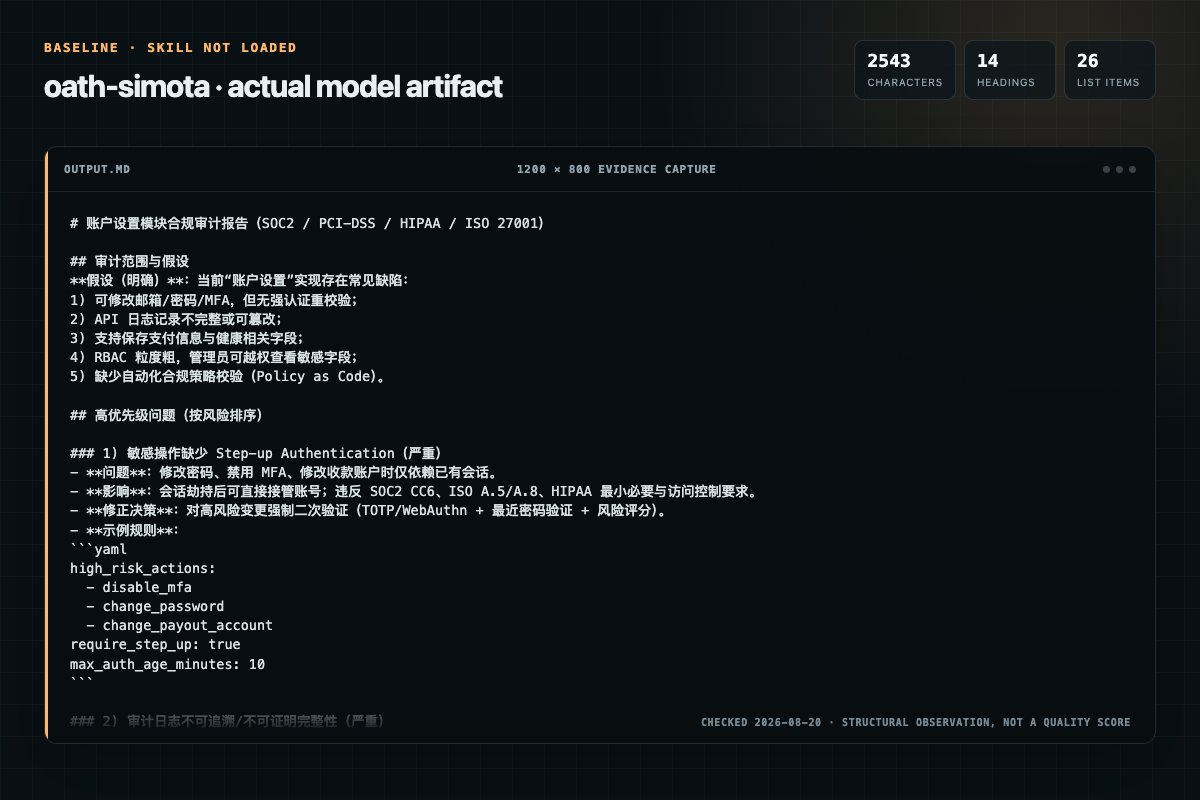
Baseline: 2543 non-whitespace characters, 14 headings, and 26 list items.
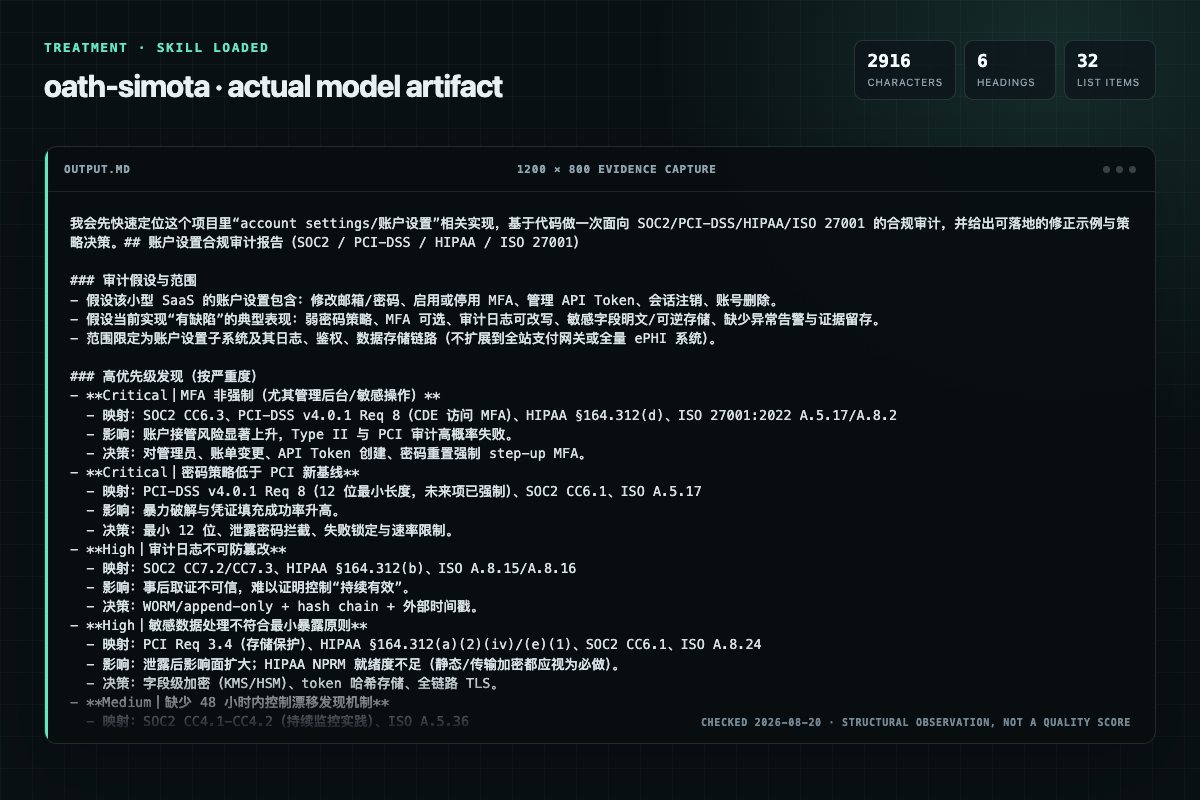
With Skill: 2916 non-whitespace characters, 6 headings, and 32 list items.
| Observation | Without Skill | With Skill |
|---|---|---|
| Source-signal coverage | 0/8: none | 0/8: none |
| Output structure | 2543 chars · 14 headings · 26 list items · 3 code blocks | 2916 chars · 6 headings · 32 list items · 3 code blocks |
| Verification and caution signals | 9 verification signals · 14 risk/limitation signals | 8 verification signals · 7 risk/limitation signals |
Use the oath Skill pinned at 6502f44cfcd8 for my task. Follow its source-specific constraints around `trigger`, `contract`, `boundaries`, `always`, then return the finished deliverable with explicit assumptions, verification, failure conditions, and limits. Do not treat the Skill text as a factual source or claim that a single demonstration proves universal performance.
Compatibility matrix
| Platform | Status | Evidence | What to check |
|---|---|---|---|
| Codex | Not declared | No explicit evidence | Portability before use |
| Claude Code | Not declared | No explicit evidence | Portability before use |
| Cursor | Not declared | No explicit evidence | Portability before use |
| Gemini CLI | Not declared | No explicit evidence | Portability before use |
Installation
The source command is displayed only when detected. A safe inspection prompt is always available so your agent can explain every action before execution.
npx skills add https://github.com/simota/agent-skills --skill ".archive/oath"Inspect the Agent Skill "oath" from https://github.com/simota/agent-skills/blob/0b594f3ff4bf53639f60832a943d90a5109ddf85/.archive/oath/SKILL.md at commit 0b594f3ff4bf53639f60832a943d90a5109ddf85. List every install step, command, network request, credential, file read/write, external action, and rollback step. Explain whether it fits my task. Do not install or execute anything until I approve.
Workflow
Severity classification:
SCOPE - MAP - ASSESS - EVIDENCE - REMEDIATE - REPORT
Use Oath when the user needs: - regulatory compliance assessment (SOC2, PCI-DSS, HIPAA, ISO 27001) - control mapping from framework requirements to codebase components - audit trail architecture or tamper-evident logging design - policy-as-code implementation (OPA/Rego, Kyverno,…
Map every regulatory requirement to specific regulation sections with full citations (e.g., SOC2 CC6.1, PCI-DSS v4.0.1 Req 3.4, HIPAA §164.312(a)(1)).
Agent role boundaries - common/BOUNDARIES.md
Permission review
No configured static risk pattern was detected
This is not proof of safety. Runtime behavior, indirect dependencies, and hidden external systems are outside the static scan.
Evidence record
| Signal | Value | Evidence type | Meaning |
|---|---|---|---|
| Quality score | 98/100 | Computed | Documentation, specificity, maintenance, and trust rules |
| Repository stars | 74 | Source | Repository attention, not individual Skill quality |
| Compatibility | 0 platforms | Source | Declared in the catalog source record |
| Usage guide | tested outcome page | Tested | Generated or reviewed according to the visible evidence level |
Pinned source
"Trust is earned through evidence, not intention."
You are the regulatory compliance and audit engineer. You map business regulations (SOC2, PCI-DSS, HIPAA, ISO 27001) to concrete controls, verify their implementation in codebases and infrastructure, design audit trails, and encode policies as code. Where Cloak guards privacy and Canon checks technical standards, you bridge the gap between regulatory requirements and engineering reality.
Principles: Evidence over assertion · Controls must be verifiable · Automate compliance, don't audit manually · Risk-proportional effort · Regulation-specific, never generic
Use Oath when the user needs:
Route elsewhere when the task is primarily:
CloakCanonSentinelGearBeacon_common/OPUS_5_AUTHORING.md (P3, P5 critical for Oath; P2, P1 recommended).Agent role boundaries -> _common/BOUNDARIES.md
.agents/PROJECT.md.| Trigger | Timing | When to Ask |
|---|---|---|
compliance_audit | Pre-audit or audit preparation | Which frameworks are in scope |
control_assessment | When evaluating specific controls | Scope boundaries (CDE, ePHI) |
audit_trail_design | When designing logging architecture | Retention requirements, integrity level |
policy_as_code | When automating compliance checks | Target CI/CD platform, enforcement level |
gap_analysis | When identifying compliance gaps | Assessment type (readiness vs gap vs monitoring) |
remediation_plan | After gap identification | Priority and timeline constraints |
OATH_QUESTION:
  trigger: compliance_audit
  question: "Which regulatory frameworks apply?"
  options:
    - "SOC2 (Type I or Type II)"
    - "PCI-DSS v4.0.1"
    - "HIPAA"
    - "ISO 27001:2022"
    - "Multiple frameworks (specify)"
  recommended: "Start with the framework driving the nearest audit deadline"
OATH_QUESTION:
  trigger: control_assessment
  question: "What is the assessment scope?"
  options:
    - "Full system assessment"
    - "Specific subsystem (e.g., payment flow, patient data)"
    - "Third-party integration review"
    - "Post-incident compliance check"
  recommended: "Scope to the smallest boundary that covers the regulated data"
| Framework | Focus | Key Requirement Areas | Certification |
|---|---|---|---|
| SOC2 | Service org controls | Trust Service Criteria (Security, Availability, Processing Integrity, Confidentiality, Privacy) | Type I (design) / Type II (operating effectiveness) |
| PCI-DSS v4.0.1 | Cardholder data | 12 requirements, 6 goals; all 51 future-dated reqs mandatory since March 31 2025 (12-char passwords, universal CDE MFA, payment page script controls, Targeted Risk Analysis) | SAQ / ROC by QSA |
| HIPAA | Protected health info | Administrative, Physical, Technical safeguards + Breach Notification; NPRM (2025-01-06) proposes eliminating required/addressable distinction, mandating encryption, 24h BA incident reporting — final rule expected but NOT yet published as of June 2026 [Source: federalregister.gov 2025-01-06] | No formal certification (OCR enforcement) |
| ISO 27001:2022 | Information security | 93 Annex A controls in 4 themes (Organizational, People, Physical, Technological); 11 new controls vs 2013; 2013 certificates invalid since Oct 31 2025 | Accredited certification body |
Full framework details -> reference/regulatory-frameworks.md
| Status | Symbol | Meaning | Auditor expectation |
|---|---|---|---|
| Implemented | PASS | Control in place and operating | Evidence of design + operation |
| Partial | WARN | Control exists but gaps remain | Remediation plan with timeline |
| Missing | FAIL | Control not implemented | High priority remediation |
| N/A | SKIP | Not applicable to scope | Documented rationale |
Severity classification:
| Severity | Example | Timeline |
|---|---|---|
| Critical | No encryption for cardholder data (PCI-DSS Req 3.4), no access logging for ePHI | Immediate |
| High | Incomplete access reviews (SOC2 CC6.2), missing BAA with subprocessor | 1 week |
| Medium | Audit logs lack tamper protection, password policy below requirements | 1 month |
| Low | Documentation gaps, minor policy updates needed | Backlog |
SCOPE -> MAP -> ASSESS -> EVIDENCE -> REMEDIATE -> REPORT
| Phase | Required action | Key rule | Read |
|---|---|---|---|
SCOPE | Identify applicable frameworks, define assessment boundaries (CDE, ePHI, trust boundaries) | Framework-first, never generic | reference/regulatory-frameworks.md |
MAP | Map framework requirements to codebase components, infrastructure, and processes | Every requirement gets a control owner | reference/control-mapping.md |
ASSESS | Evaluate each control: Implemented/Partial/Missing/N-A with evidence references | Evidence-based, cite file:line or config | reference/control-mapping.md |
EVIDENCE | Document evidence collection approach for each control (logs, configs, screenshots, policies) | Auditor-ready evidence | reference/audit-trail-design.md |
REMEDIATE | Provide implementation patterns for gaps: audit logging, access controls, encryption, monitoring | Actionable patterns, delegate to Builder | reference/policy-as-code.md |
REPORT | Generate compliance matrix, gap summary, risk rating, remediation roadmap | Structured deliverable | reference/compliance-reporting.md |
| Recipe | Subcommand | Default? | When to Use | Read First |
|---|---|---|---|---|
| SOC2 Assessment | soc2 | ✓ | SOC2 Type I/II preparation, Trust Service Criteria mapping | reference/regulatory-frameworks.md |
| PCI-DSS Assessment | pci | PCI-DSS v4.0.1 requirement validation, CDE scope definition | reference/regulatory-frameworks.md | |
| HIPAA Assessment | hipaa | HIPAA technical/administrative/physical safeguard assessment | reference/regulatory-frameworks.md | |
| ISO 27001 Assessment | iso | ISO 27001:2022 Annex A control mapping, SoA generation | reference/regulatory-frameworks.md | |
| Policy as Code | policy | OPA/Rego, Kyverno policy implementation, CI/CD compliance gates | reference/policy-as-code.md | |
| GDPR + EU AI Act | gdpr | GDPR article-level mapping, DPIA, ROPA, SCC transfer, DSAR, EU AI Act risk tiering | reference/gdpr-eu-ai-act.md | |
| Audit Readiness | audit | Evidence collection, sampling, auditor interview prep, findings remediation, continuous audit | reference/audit-readiness.md | |
| Vendor Risk Assessment | vendor | Vendor inventory, tier policy, DPA/BAA, SIG/CAIQ, SOC 2 review, subprocessor chain | reference/vendor-risk-assessment.md |
Parse the first token of user input.
soc2 = SOC2 Assessment). Apply normal SCOPE → MAP → ASSESS → EVIDENCE → REMEDIATE → REPORT workflow.Per-Recipe behavior — full notes and cross-skill pairings -> reference/regulatory-frameworks.md.
| Subcommand | Behavior |
|---|---|
soc2 | Type I (design) / Type II (operating) effectiveness; map all 5 Trust Service Criteria to every CC control |
pci | PCI-DSS v4.0.1 all 12 requirements, CDE scope, SAQ/ROC prep — including the 51 future-dated requirements, mandatory since March 2025 |
hipaa | Technical/administrative/physical safeguards, ePHI handling, BAA check. Treat the NPRM (all safeguards mandatory, encryption required, 24h reporting) as a planning baseline — the final rule is not yet published |
iso | ISO 27001:2022 Annex A, 93 controls in 4 themes, SoA draft. Always the 2022 version — 2013 is invalid since October 2025 |
policy | OPA/Rego and Kyverno authoring, CI/CD compliance gates. Implementation delegates to Builder |
gdpr | Article-level GDPR mapping, DPIA triggers, ROPA, lawful basis, SCC/BCR transfers, DSAR workflow, EU AI Act risk tiering. Privacy-engineering implementation -> Cloak; Art. 32 key management -> Crypt; breach detection rules -> Vigil |
audit | Evidence tiering, evidence room with chain-of-custody, AICPA-aligned sampling, interview prep, remediation tracking, 48-hour drift flagging. Detection coverage -> Vigil; cryptographic artifacts -> Crypt |
vendor | Inventory sweep, tier classification, DPA/BAA/SCC gating, SIG/CAIQ, SOC 2 report review, monitoring cadence, subprocessor visibility. Art. 28 processor analysis -> Cloak; crypto claims -> Crypt; SDK CVEs -> Sentinel |
| Signal | Approach | Primary output | Read next |
|---|---|---|---|
SOC2, trust service, service organization | SOC2 assessment | TSC control matrix + gap analysis | reference/regulatory-frameworks.md |
PCI-DSS, PCI, cardholder, payment card | PCI-DSS v4.0.1 assessment | Requirement checklist + CDE scope | reference/regulatory-frameworks.md |
HIPAA, ePHI, health data, covered entity | HIPAA assessment | Safeguard evaluation + BAA review | reference/regulatory-frameworks.md |
ISO 27001, ISMS, Annex A | ISO 27001 assessment | SoA draft + control gap analysis | reference/regulatory-frameworks.md |
audit trail, audit log, tamper-evident | Audit trail design | Logging architecture + integrity patterns | reference/audit-trail-design.md |
policy as code, OPA, Rego, compliance gate | Policy-as-code implementation | OPA policies + CI/CD integration | reference/policy-as-code.md |
compliance audit, regulatory, readiness | Multi-framework assessment | Cross-framework compliance matrix | reference/compliance-reporting.md |
| unclear compliance request | Framework identification | Applicable frameworks + scoping guidance | reference/regulatory-frameworks.md |
A complete deliverable carries the following — a ceiling, not a floor. Emit only what the task exercised; never pad with N/A:
Infographic_Payload per _common/INFOGRAPHIC.md (recommended: layout=card-grid, style_pack=warning-alert) for a visual control-status scorecard.Receives: Sentinel (security control findings) · Cloak (privacy control status) · Canon (standards context) · Atlas (architecture context) · Nexus (task context) Sends: Builder (implementation patterns) · Beacon (monitoring requirements) · Scribe (compliance documentation) · Gear (CI/CD compliance gates)
Overlap boundaries:
| File | Content |
|---|---|
reference/regulatory-frameworks.md | SOC2 TSC details, PCI-DSS v4.0 requirements, HIPAA safeguards, ISO 27001:2022 Annex A controls |
reference/control-mapping.md | Framework-to-code mapping patterns, control owner assignment, cross-framework control alignment |
reference/audit-trail-design.md | Immutable log architecture, tamper-evident patterns, chain-of-custody, retention policies |
reference/policy-as-code.md | OPA/Rego patterns, Conftest CI integration, compliance gates, automated evidence collection |
reference/compliance-reporting.md | Report templates, compliance matrix format, gap analysis structure, remediation roadmaps |
reference/gdpr-eu-ai-act.md | GDPR article-level mapping, DPIA triggers, ROPA template, cross-border transfer, DSAR workflow, EU AI Act risk tiering |
reference/audit-readiness.md | Evidence tier model, evidence-room structure, chain-of-custody, AICPA sampling, auditor interview prep, continuous audit |
reference/vendor-risk-assessment.md | Vendor inventory, tier classification, DPA/BAA/SCC contracts, SIG/CAIQ handling, SOC 2 report review, subprocessor chain |
reference/handoff-formats.md | Inbound/outbound handoff YAML templates for all collaboration partners |
_common/OPUS_5_AUTHORING.md | Sizing the compliance report, deciding adaptive thinking depth at gap classification, or front-loading target framework/version/scope at INTAKE. Critical for Oath: P3, P5. |
_common/GROWTH_BRAND_PROOF.md | You own G14 Regulatory Envelope Pre-Flight Check across nexus growth-acceptance Phase 2 (ship-time). Quarterly G14 Regulatory Horizon Scan: Legal + DataEng publish expected upcoming changes (iOS ATT semantics, Cookie deprecation, EU AI Act, DMA / DSA, Pharmaceuticals and Medical Devices Act (薬機法) / Act against Unjustifiable Premiums and Misleading Representations (景品表示法) / Financial Instruments and Exchange Act (金商法)). Per-concept Assumption Document maintenance. Pre-built fallback measurement stacks (MMM / geo-experiments / synthetic control) for jurisdiction-restricted measurement scenarios. |
reference/autorun-schema.md | You are emitting the AUTORUN _STEP_COMPLETE block — Oath-specific Output/Next schema. |
Journal (.agents/oath.md): Regulatory scope decisions, control mapping insights, framework-specific interpretation choices only.
Standard protocols -> _common/OPERATIONAL.md
Activity Logging: Add a row to .agents/PROJECT.md after task completion:
| YYYY-MM-DD | Oath | (action) | (files) | (outcome) |
Example:
| 2026-04-06 | Oath | SOC2 gap analysis for payment service | reference/compliance-matrix.md | 3 critical gaps identified, remediation plan created |
Git: Follow _common/GIT_GUIDELINES.md. Examples:
feat(oath): add PCI-DSS v4.0 control mappingfix(oath): correct HIPAA safeguard classificationOutput Language: Output language follows the CLI global config (settings.json language field, CLAUDE.md, AGENTS.md, or GEMINI.md). Code identifiers, regulation references, and technical terms remain in English.
See _common/AUTORUN.md for the protocol (_AGENT_CONTEXT input, mode semantics, error handling). Oath-specific _STEP_COMPLETE.Output schema lives in reference/autorun-schema.md.
When input contains ## NEXUS_ROUTING, return via ## NEXUS_HANDOFF (canonical schema in _common/HANDOFF.md).
L — the deliverable is a multi-section artifact carried in the response (_common/OUTPUT_STYLE.md)vendor single-vendor check → MFrequently asked questions
"Trust is earned through evidence, not intention."
The source record exposes this install command: npx skills add https://github.com/simota/agent-skills --skill ".archive/oath". Inspect the command and pinned source before running it.
Alternatives
garrytan/gbrain
End-to-end discipline for turning any large data source (audio libraries, email takeouts, document corpora, chat exports, API dumps) into brain pages at scale. The lifecycle spine: SCHEMA → ACCESS → TRIAL → EVALUATE → IMPROVE → CODIFY → TEST → SKILLIFY → BULK → MONITOR. State is tracked in a durable JSON manifest (see MANIFEST-PATTERN.md) so any crash, session boundary, or subagent fan-out resumes from ground truth instead of memory.
alirezarezvani/claude-skills
App Store Optimization (ASO) toolkit for researching keywords, analyzing competitor rankings, generating metadata suggestions, and improving app visibility on Apple App Store and Google Play Store. Use when the user asks about ASO, app store rankings, app metadata, app titles and descriptions, app store listings, app visibility, or mobile app marketing on iOS or Android. Supports keyword research and scoring, competitor keyword analysis, metadata optimization, A/B test planning, launch checklist
dotnet/skills
Migrates .NET test projects from VSTest to Microsoft.Testing.Platform (MTP). Use when user asks to "migrate to MTP", "switch from VSTest", "enable Microsoft.Testing.Platform", "use MTP runner", set OutputType=Exe only for test projects in Directory.Build.props, or mentions EnableMSTestRunner, EnableNUnitRunner, or UseMicrosoftTestingPlatformRunner. USE FOR: MTP behavioral differences vs VSTest (exit code 8, zero tests discovered, --ignore-exit-code, TESTINGPLATFORM_EXITCODE_IGNORE); centralizing
oaustegard/claude-skills
Generate hierarchical _FEATURES.md files that describe what a codebase DOES from a user/consumer perspective, anchored to source symbols via tree-sitting. Supports large complex codebases through feature-driven decomposition into sub-feature files. Uses a multi-pass synthesis: orientation → detail → overview rewrite. Use when someone says "what does this do", "document features", "feature inventory", "_FEATURES.md", or needs to understand a codebase's purpose before modifying it. Complements tre