
Best for
- Use when user says "写大纲", "paper outline", "plan the paper", "论文规划", or wants to create a paper plan before writing.
wanshuiyin/Auto-claude-code-research-in-sleep/skills/paper-plan/SKILL.md
Use it for operations and research tasks; the detail page covers purpose, installation, and practical steps.
Decision brief
Generate a structured, section-by-section paper outline from: $ARGUMENTS
In this controlled same-task single run, enabling paper-plan changed the output from 2134 non-whitespace characters and 26 headings to 3080 characters and 14 headings. Matches among 8 signals extracted from the pinned source changed from 0 to 2. Both actual outputs are shown; this is a structural observation, not a quality score or a universal performance claim.
Review a flawed account-settings implementation for a small SaaS product. Prioritize concrete issues, explain impact, and provide corrected examples or decisions. The deliverable must specifically reflect this user intent: Generate a structured paper outline from review conclusions and experiment results. Use when user says "写大纲", "paper outline", "plan the paper", "论文规划", or wants to create a paper plan before writing.
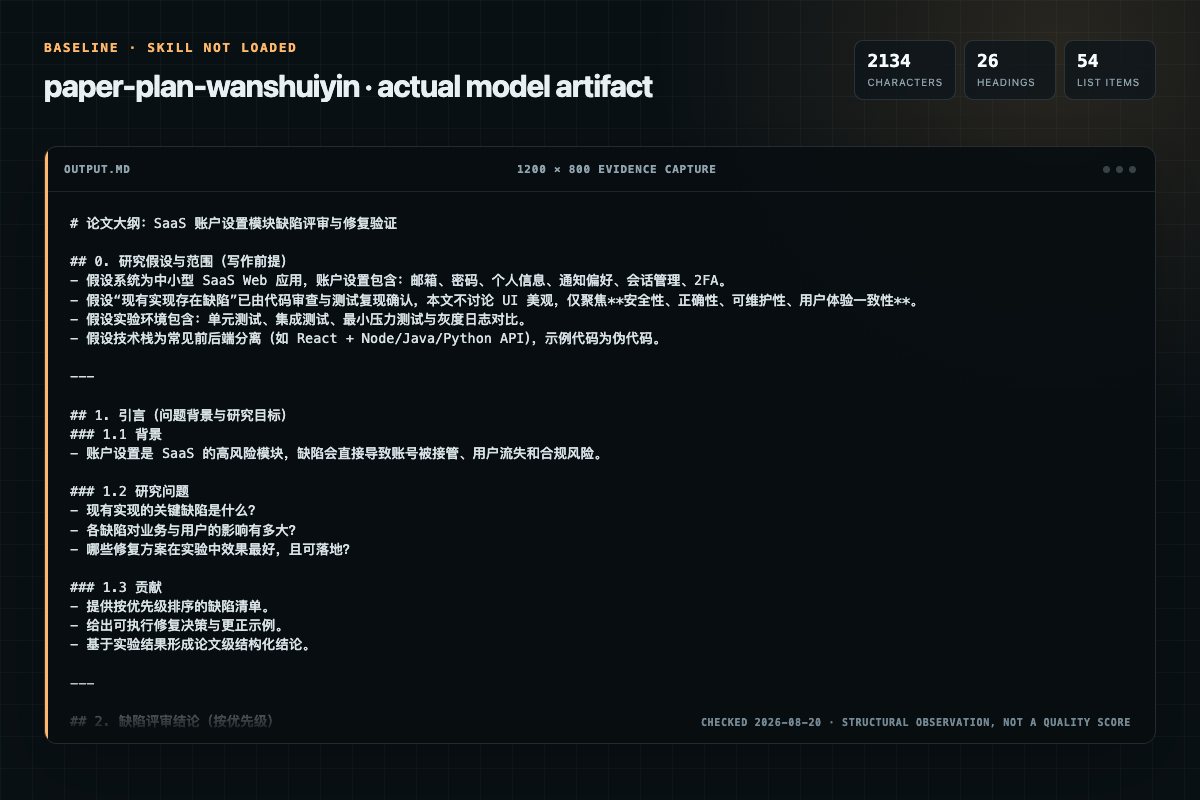
Baseline: 2134 non-whitespace characters, 26 headings, and 54 list items.
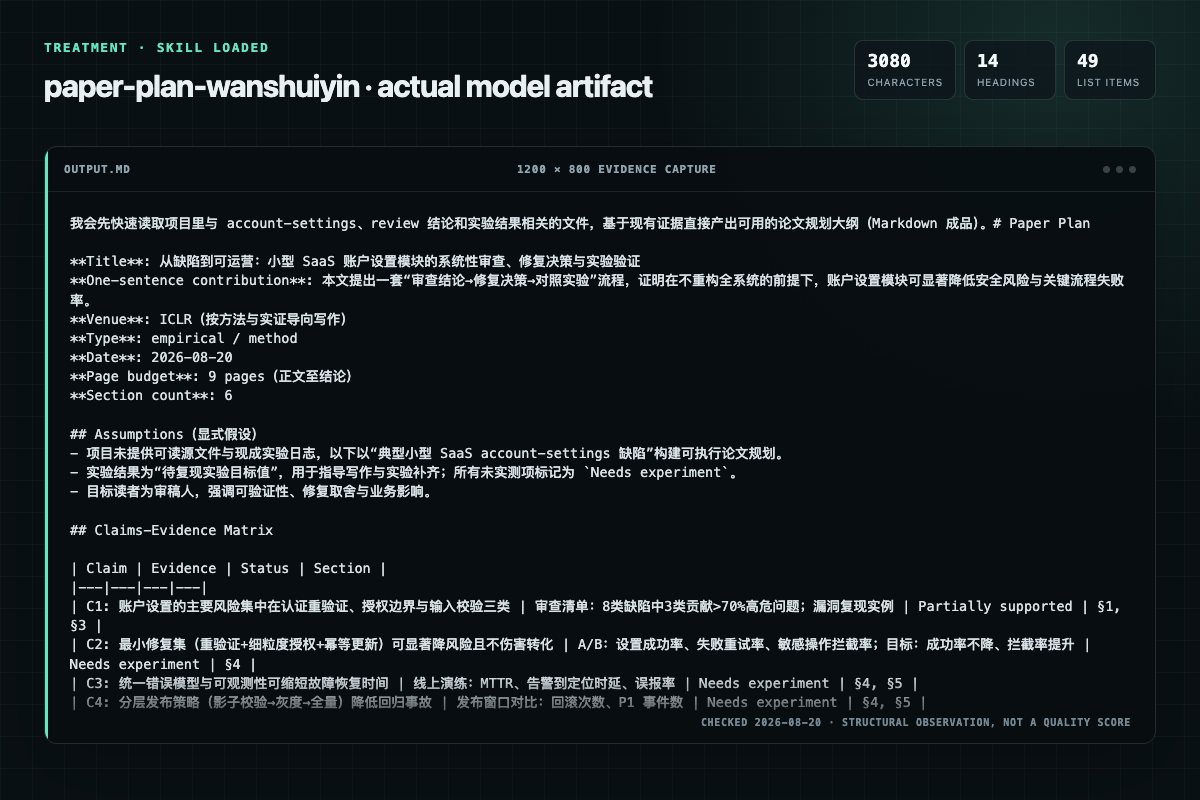
With Skill: 3080 non-whitespace characters, 14 headings, and 49 list items.
| Observation | Without Skill | With Skill |
|---|---|---|
| Source-signal coverage | 0/8: none | 2/8: paper, conclusions |
| Output structure | 2134 chars · 26 headings · 54 list items · 3 code blocks | 3080 chars · 14 headings · 49 list items · 0 code blocks |
| Verification and caution signals | 9 verification signals · 14 risk/limitation signals | 19 verification signals · 16 risk/limitation signals |
Use the paper-plan Skill pinned at f4f20f90ead9 for my task. Follow its source-specific constraints around `paper-plan`, `paper`, `conclusions`, `outline`, then return the finished deliverable with explicit assumptions, verification, failure conditions, and limits. Do not treat the Skill text as a factual source or claim that a single demonstration proves universal performance.
Compatibility matrix
| Platform | Status | Evidence | What to check |
|---|---|---|---|
| Codex | Not declared | No explicit evidence | Portability before use |
| Claude Code | Not declared | No explicit evidence | Portability before use |
| Cursor | Not declared | No explicit evidence | Portability before use |
| Gemini CLI | Not declared | No explicit evidence | Portability before use |
Installation
The source command is displayed only when detected. A safe inspection prompt is always available so your agent can explain every action before execution.
npx skills add https://github.com/wanshuiyin/Auto-claude-code-research-in-sleep --skill "skills/paper-plan"Inspect the Agent Skill "paper-plan" from https://github.com/wanshuiyin/Auto-claude-code-research-in-sleep/blob/9cbb6aab1084cd622ccb016cc156008fbdaa1402/skills/paper-plan/SKILL.md at commit 9cbb6aab1084cd622ccb016cc156008fbdaa1402. List every install step, command, network request, credential, file read/write, external action, and rollback step. Explain whether it fits my task. Do not install or execute anything until I approve.
Workflow
First check for CLAIMSFROMRESULTS.md — if its first line is verdict: REVIEWUNAVAILABLE, treat the file as ABSENT for claim extraction (fall through to the narrative documents below) and then: under — assurance: submission (shared-references/assurance-contract.md; implied by — ef…
First check for CLAIMSFROMRESULTS.md — if its first line is verdict: REVIEWUNAVAILABLE, treat the file as ABSENT for claim extraction (fall through to the narrative documents below) and then: under — assurance: submission (shared-references/assurance-contract.md; implied by — ef…
Based on TARGETVENUE and paper content, classify and select structure.
For each section, specify:
Notation: [key symbols and their meanings]
Permission review
The documentation asks the agent to create, modify, or delete local files.
`/paper-write` reads this file and emits `<!-- DATA_NEEDED: <Slot ID> — <one-line description> -->` placeholders for `missing` slots instead of fabricating content.The documentation asks the agent to create, modify, or delete local files.
**Large file handling**: If the Write tool fails due to file size, immediately retry using Bash (`cat << 'EOF' > file`) to write in chunks. Do NOT ask the user for permission — just do it silently.Evidence record
| Signal | Value | Evidence type | Meaning |
|---|---|---|---|
| Quality score | 93/100 | Computed | Documentation, specificity, maintenance, and trust rules |
| Repository stars | 15,122 | Source | Repository attention, not individual Skill quality |
| Compatibility | 0 platforms | Source | Declared in the catalog source record |
| Usage guide | tested outcome page | Tested | Generated or reviewed according to the visible evidence level |
Pinned source
Generate a structured, section-by-section paper outline from: $ARGUMENTS
gpt-5.6-sol — Model used via Codex MCP for outline review. Must be an OpenAI model.ICLR — Default venue. User can override (e.g., /paper-plan "topic" — venue: NeurIPS). Supported: ICLR, NeurIPS, ICML, CVPR, ACL, AAAI, ACM, IEEE_JOURNAL (IEEE Transactions / Letters), IEEE_CONF (IEEE conferences).The skill expects one or more of these in the project directory:
./AUTO_REVIEW.md if not found)figures/, screen logs, tables./IDEA_REPORT.md if not found)idea-stage/IDEA_CANDIDATES.md (fall back to ./IDEA_CANDIDATES.md if not found), findings.md, EXPERIMENT_LOG.md — preferred over full files when present, saves context windowIf none exist, ask the user to describe the paper's contribution in 3-5 sentences.
Keep the existing insleep workflow and outputs, but use the shared references below to improve the quality of the story and outline.
../shared-references/writing-principles.md when framing the one-sentence contribution, Abstract, Introduction, Related Work, or hero figure.../shared-references/venue-checklists.md before freezing the outline for a specific venue.— style-ref: <source>, opt-in)Lets the user steer the structural layout of the outline (section ordering, subsection density, theorem-environment density, figure budget, citation style) toward a reference paper. Default OFF — when the user does not pass — style-ref, do nothing differently from before.
Only when — style-ref: <source> appears in $ARGUMENTS, run the helper FIRST, before drafting the outline:
# Resolve $STYLE_HELPER via the canonical strict-safe chain (see
# shared-references/integration-contract.md §2). Policy A — gate:
# unresolved helper means --style-ref cannot be satisfied, so abort.
cd "$(git rev-parse --show-toplevel 2>/dev/null || pwd)" || exit 1
if [ -z "${ARIS_REPO:-}" ] && [ -f .aris/installed-skills.txt ]; then
    ARIS_REPO=$(awk -F'\t' '$1=="repo_root"{print $2; exit}' .aris/installed-skills.txt 2>/dev/null) || true
fi
if [ -z "${ARIS_REPO:-}" ] && [ -f "$HOME/.aris/repo" ]; then
    ARIS_REPO=$(cat "$HOME/.aris/repo" 2>/dev/null) || true
fi
STYLE_HELPER=".aris/tools/extract_paper_style.py"
[ -f "$STYLE_HELPER" ] || STYLE_HELPER="tools/extract_paper_style.py"
[ -f "$STYLE_HELPER" ] || { [ -n "${ARIS_REPO:-}" ] && STYLE_HELPER="$ARIS_REPO/tools/extract_paper_style.py"; }
[ -f "$STYLE_HELPER" ] || {
  echo "ERROR: extract_paper_style.py not resolved at .aris/tools/, tools/, \$ARIS_REPO/tools/, or via ~/.aris/repo." >&2
  echo "       Fix: rerun bash tools/install_aris.sh or smart_update.sh (refreshes ~/.aris/repo), export ARIS_REPO, or copy the helper to tools/." >&2
  echo "       --style-ref cannot be satisfied; aborting." >&2
  exit 1
}
STYLE_STATUS=0
CACHE=$(python3 "$STYLE_HELPER" --source "<source>") || STYLE_STATUS=$?
case "$STYLE_STATUS" in
  0) ;;                                       # use $CACHE/style_profile.md as structural guidance
  2) echo "warning: style-ref skipped (missing optional dep)" >&2 ;;
  3) echo "error: --style-ref source failed; aborting outline" >&2 ; exit 1 ;;
  *) echo "error: helper failed unexpectedly; aborting outline" >&2 ; exit 1 ;;
esac
Sources accepted: local TeX dir / file, local PDF, arXiv id (2501.12345 or arxiv:2501.12345), http(s) URL. Overleaf URLs and project IDs are rejected — clone via /overleaf-sync setup <id> first and pass the local clone path.
Strict rules (full contract in tools/extract_paper_style.py docstring):
style_profile.md as structural guidance only when proposing the outline's section list, subsection counts, theorem density, figure budget.— style-ref (or the cache contents) to reviewer / auditor sub-agents. Cross-model review independence (../shared-references/reviewer-independence.md) requires reviewers see only the artifact and the user's prompt.GAP_REPORT.md, auto-emitted when style-ref is on)When — style-ref: succeeded AND any of figures/, results/, data/, tables/, sec/, NARRATIVE_REPORT.md, CLAIMS_FROM_RESULTS.md exists in the project, also emit a gap report before drafting the outline. The gap report maps the exemplar's section topology + density requirements (from style_profile.md) against the user's actual assets, surfacing structural slots where the user has no evidence to fill. It is the contract by which /paper-write decides when to emit <!-- DATA_NEEDED --> markers instead of fabricating content.
Procedure:
$CACHE/style_profile.md for exemplar's section list + per-section feature counts (figures, theorems, tables, citations, sentences per section).figures/* filenames, results/* evidence files, sec/*.tex existing prose, NARRATIVE_REPORT.md, CLAIMS_FROM_RESULTS.md (if /result-to-claim ran), references.bib for citation density.covered / partial / missing.<output-dir>/GAP_REPORT.md:# GAP_REPORT — exemplar vs user assets
- **Exemplar source:** <source identifier (file path, arXiv ID, URL)>
- **Generated:** <UTC ISO-8601>
- **Style profile:** <relative path to style_profile.md>
## Section topology gaps
| Exemplar slot | Exemplar feature | User evidence | Status | Slot ID |
|---|---|---|---|---|
| §5 Experiments | ablation table (3 axes × 4 levels) | `results/` has no ablation file | missing | `GAP_S5_ABLATION` |
| §5.3 Scaling | log-N scaling curve | `figures/scaling.pdf` not found | missing | `GAP_S5_SCALING` |
| §6 Discussion | failure-case analysis | not present in `NARRATIVE_REPORT.md` | missing | `GAP_S6_FAILURE` |
| §2 Related | citation density ≥ 60 | `references.bib` has 35 entries | partial | `GAP_S2_CITES` |
## Coverage summary
- covered: N
- partial: M
- missing: K
## Used by
- `/paper-write` reads this file and emits `<!-- DATA_NEEDED: <Slot ID> — <one-line description> -->` placeholders for `missing` slots instead of fabricating content.
- `/paper-claim-audit` can use Slot IDs to flag claims that cite sections with `missing` evidence.
Slot ID format: GAP_<SECTION>_<FEATURE>, all-caps, stable across regenerations unless user assets change.
Rules (hard):
/experiment-bridge's job. Gap Report just surfaces deficits.style_profile.md extraction failed or the user has no project assets, skip Gap Report (no error; just do not emit the file).style_profile.md).Original idea: @zhangpelf in #217.
First check for CLAIMS_FROM_RESULTS.md — if its first line is verdict: REVIEW_UNAVAILABLE, treat the file as ABSENT for claim extraction (fall through to the narrative documents below) and then: under — assurance: submission (shared-references/assurance-contract.md; implied by — effort: max|beast) STOP — the claims were never adjudicated, rerun /result-to-claim first; under assurance: draft continue but tag every claim [unadjudicated] in the claims matrix. Otherwise, if it exists (generated by /result-to-claim at the end of Workflow 2), use it as the starting point for claims. This file contains validated claims already mapped to experiment evidence. Merge with any additional claims from the narrative documents below.
If CLAIMS_FROM_RESULTS.md does not exist, extract claims from scratch:
Read all available narrative documents and extract:
Build a Claims-Evidence Matrix:
| Claim | Evidence | Status | Section |
|-------|----------|--------|---------|
| [claim 1] | [exp A, metric B] | Supported | §3.2 |
| [claim 2] | [exp C] | Partially supported | §4.1 |
Based on TARGET_VENUE and paper content, classify and select structure.
Before committing to a structure, apply the narrative principle from ../shared-references/writing-principles.md:
IMPORTANT: The section count is FLEXIBLE (5-8 sections). Choose what fits the content best. The templates below are starting points, not rigid constraints.
Empirical/Diagnostic paper:
1. Introduction (1.5 pages)
2. Related Work (1 page)
3. Method / Setup (1.5 pages)
4. Experiments (3 pages)
5. Analysis / Discussion (1 page)
6. Conclusion (0.5 pages)
Theory + Experiments paper:
1. Introduction (1.5 pages)
2. Related Work (1 page)
3. Preliminaries & Modeling (1.5 pages)
4. Experiments (1.5 pages)
5. Theory Part A (1.5 pages)
6. Theory Part B (1.5 pages)
7. Conclusion (0.5 pages)
— Total: 9 pages
Theory papers often need 7 sections (splitting theory into estimation + optimization, or setup + analysis). The total page budget MUST sum to MAX_PAGES.
Theory papers should:
Method paper:
1. Introduction (1.5 pages)
2. Related Work (1 page)
3. Method (2 pages)
4. Experiments (2.5 pages)
5. Ablation / Analysis (1 page)
6. Conclusion (0.5 pages)
For each section, specify:
### §0 Abstract
- **What we achieve**: [the paper's specific contribution, not field-level background]
- **Why it matters / is hard**: [why this problem is important and non-trivial]
- **How we do it**: [approach in one sentence]
- **Evidence**: [what supports the claim]
- **Most remarkable result**: [strongest quantitative or theoretical result]
- **Estimated length**: 150-250 words
- **Self-contained check**: can a reader understand this without the paper?

### §1 Introduction
- **Opening hook**: [1-2 sentences that motivate the problem]
- **Gap / challenge**: [what's missing in prior work, and why prior work is insufficient]
- **One-sentence contribution**: [the main takeaway of the paper]
- **Approach overview**: [what we do differently]
- **Key questions**: [the research questions this paper answers]
- **Contributions**: [2-4 numbered bullets, specific and falsifiable, matching Claims-Evidence Matrix]
- **Results preview**: [the strongest result or comparison to surface early]
- **Hero figure**: [describe what Figure 1 should show — MUST include clear comparison if applicable]
- **Estimated length**: 1.5 pages
- **Key citations**: [3-5 papers to cite here]
- **Front-loading check**: [would a skim reader know the main claim before reaching the method?]

### §2 Related Work
- **Subtopics**: [2-4 categories of related work]
- **Positioning**: [how this paper differs from each category]
- **Minimum length**: 1 full page (at least 3-4 paragraphs with substantive synthesis)
- **Organization rule**: organize by methodological family / assumption / question, not paper-by-paper
- **Must NOT be just a list** — synthesize, compare, and position

### §3 Method / Setup / Preliminaries
- **Notation**: [key symbols and their meanings]
- **Problem formulation**: [formal setup]
- **Method description**: [algorithm, model, or experimental design]
- **Formal statements**: [theorems, propositions if applicable]
- **Proof sketch locations**: [which key steps appear here vs. appendix]
- **Estimated length**: 1.5-2 pages

### §4 Experiments / Main Results
- **Figures planned**:
  - Fig 1: [description, type: bar/line/table/architecture, WHAT COMPARISON it shows]
  - Fig 2: [description]
  - Table 1: [what it shows, which methods/baselines compared]
- **Data source**: [which JSON files / experiment results]

### §5 Conclusion
- **Restatement**: [contributions rephrased, not copy-pasted from intro]
- **Limitations**: [honest assessment — reviewers value this]
- **Future work**: [1-2 concrete directions]
- **Estimated length**: 0.5 pages
List every figure and table:
## Figure Plan

| ID | Type | Description | Data Source | Priority |
|----|------|-------------|-------------|----------|
| Fig 1 | Hero/Architecture | System overview + comparison | manual | HIGH |
| Fig 2 | Line plot | Training curves comparison | figures/exp_A.json | HIGH |
| Fig 3 | Bar chart | Ablation results | figures/ablation.json | MEDIUM |
| Table 1 | Comparison table | Main results vs. baselines | figures/main_results.json | HIGH |
| Table 2 | Theory comparison | Prior bounds vs. ours | manual | HIGH (theory papers) |
CRITICAL for Figure 1 / Hero Figure: Describe in detail what the figure should contain, including:
For each section, list required citations:
## Citation Plan
- §1 Intro: [paper1], [paper2], [paper3] (problem motivation)
- §2 Related: [paper4]-[paper10] (categorized by subtopic)
- §3 Method: [paper11] (baseline), [paper12] (technique we build on)
Citation rules (from claude-scholar + Imbad0202/academic-research-skills):
[VERIFY]Send the complete outline to GPT-5.6-Sol xhigh for feedback:
mcp__codex__codex:
  model: gpt-5.6-sol
  config: {"model_reasoning_effort": "xhigh"}
  prompt: |
    Review this paper outline for a [VENUE] submission.
    [full outline including Claims-Evidence Matrix]

    Score 1-10 on:
    1. Logical flow — does the story build naturally?
    2. Claim-evidence alignment — every claim backed?
    3. Missing experiments or analysis
    4. Positioning relative to prior work
    5. Page budget feasibility (MAX_PAGES = main body to Conclusion end, excluding refs/appendix)
    6. Front-matter strength — are the abstract, introduction, and hero figure plan strong enough for skim-reading reviewers?

    For each weakness, suggest the MINIMUM fix.
    Be specific and actionable — "add X" not "consider more experiments".
Apply feedback before finalizing.
Save the final outline to PAPER_PLAN.md in the project root:
# Paper Plan

**Title**: [working title]
**One-sentence contribution**: [single-sentence statement of the paper's core takeaway]
**Venue**: [target venue]
**Type**: [empirical/theory/method]
**Date**: [today]
**Page budget**: [MAX_PAGES] pages (main body to Conclusion end, excluding references & appendix)
**Section count**: [N] (must match the number of section files that will be created)

## Claims-Evidence Matrix
[from Step 1]

## Structure
[from Step 2-3, section by section]

## Figure Plan
[from Step 4, with detailed hero figure description]

## Citation Plan
[from Step 5]

## Reviewer Feedback
[from Step 6, summarized]

## Next Steps
- [ ] /paper-figure to generate all figures
- [ ] /paper-write to draft LaTeX
- [ ] /paper-compile to build PDF
cat << 'EOF' > file) to write in chunks. Do NOT ask the user for permission — just do it silently.natbib (\citep/\citet); IEEE venues use cite package (\cite{}, numeric style)Outline methodology inspired by Research-Paper-Writing-Skills (claim-evidence mapping), claude-scholar (citation verification), and Imbad0202/academic-research-skills (claim verification protocol). The writing-framing overlay in this hybrid pack is adapted from Orchestra Research's paper-writing guidance.
Follow these shared protocols for all output files:
- Output Versioning Protocol — write timestamped file first, then copy to fixed name
- Output Manifest Protocol — log every output to MANIFEST.md
- Output Language Protocol — respect the project's language setting
Frequently asked questions
Generate a structured, section-by-section paper outline from: $ARGUMENTS
The source record exposes this install command: npx skills add https://github.com/wanshuiyin/Auto-claude-code-research-in-sleep --skill "skills/paper-plan". Inspect the command and pinned source before running it.
Static rules flagged write-files in the source; the page lists the matching lines and excerpts.
Alternatives
alirezarezvani/claude-skills
App Store Optimization (ASO) toolkit for researching keywords, analyzing competitor rankings, generating metadata suggestions, and improving app visibility on Apple App Store and Google Play Store. Use when the user asks about ASO, app store rankings, app metadata, app titles and descriptions, app store listings, app visibility, or mobile app marketing on iOS or Android. Supports keyword research and scoring, competitor keyword analysis, metadata optimization, A/B test planning, launch checklist
wanshuiyin/Auto-claude-code-research-in-sleep
Use it for operations and research tasks; the detail page covers purpose, installation, and practical steps.
prowler-cloud/prowler
PostgreSQL indexing best practices for Prowler: index design, partial indexes, partitioned table indexing, EXPLAIN ANALYZE validation, concurrent operations, monitoring, and maintenance. Trigger: When creating or modifying PostgreSQL indexes, analyzing query performance with EXPLAIN, debugging slow queries, reviewing index usage statistics, reindexing, dropping indexes, or working with partitioned table indexes. Also trigger when discussing index strategies, partial indexes, or index maintenance
brucesongs/kali-claw
Insecure Design (OWASP A06:2025) focuses on security flaws in system architecture and design phases, rather than code implementation-level bugs.