
Tested demoQuality 93/100
rampstackco/claude-skills/skills/product-analytics-setup/SKILL.md
product-analytics-setup
How to actually instrument product analytics correctly. Event taxonomy, property design, naming conventions, schema versioning, identity stitching, funnel design, retention cohorts, North Star metric selection, dashboard hygiene, instrumentation debt, and the failure modes that produce data nobody trusts. Triggers on product analytics setup, event taxonomy, tracking plan, instrumentation, schema versioning, North Star metric, retention cohorts, funnel design, naming conventions, instrument new f
- Source repository stars
- 733
- Declared platforms
- 0
- Static risk flags
- 0
- Last source update
- 2026-08-10
- Source checked
- 2026-08-25
Decision brief
What it does: where it fits
A senior PM and analyst's playbook for instrumenting product analytics correctly the first time.
Not for
- Tasks that require unconfirmed production actions or broad system permissions.
- Environments where the pinned source and install steps cannot be inspected.
Controlled single-run demoChecked 2026-08-20
What changed when the Skill was used
In this controlled same-task single run, enabling product-analytics-setup changed the output from 3044 non-whitespace characters and 21 headings to 2881 characters and 13 headings. Matches among 8 signals extracted from the pinned source changed from 3 to 2. Both actual outputs are shown; this is a structural observation, not a quality score or a universal performance claim.
Same test task
Analyze a small SaaS churn scenario and produce a concrete analysis plan with data checks, method choices, expected outputs, and validation steps. The deliverable must specifically reflect this user intent: How to actually instrument product analytics correctly. Event taxonomy, property design, naming conventions, schema versioning, identity stitching, funnel design, retention cohorts, North Star metric selection, dashboard hygiene, instrumentation debt, and the failure modes that produce data nobody trusts. Triggers on product analytics setup, event taxonomy, tracking plan, instrumentation, schema versioning, North Star metric, retention cohorts, funnel design, naming conventions, instrument new f
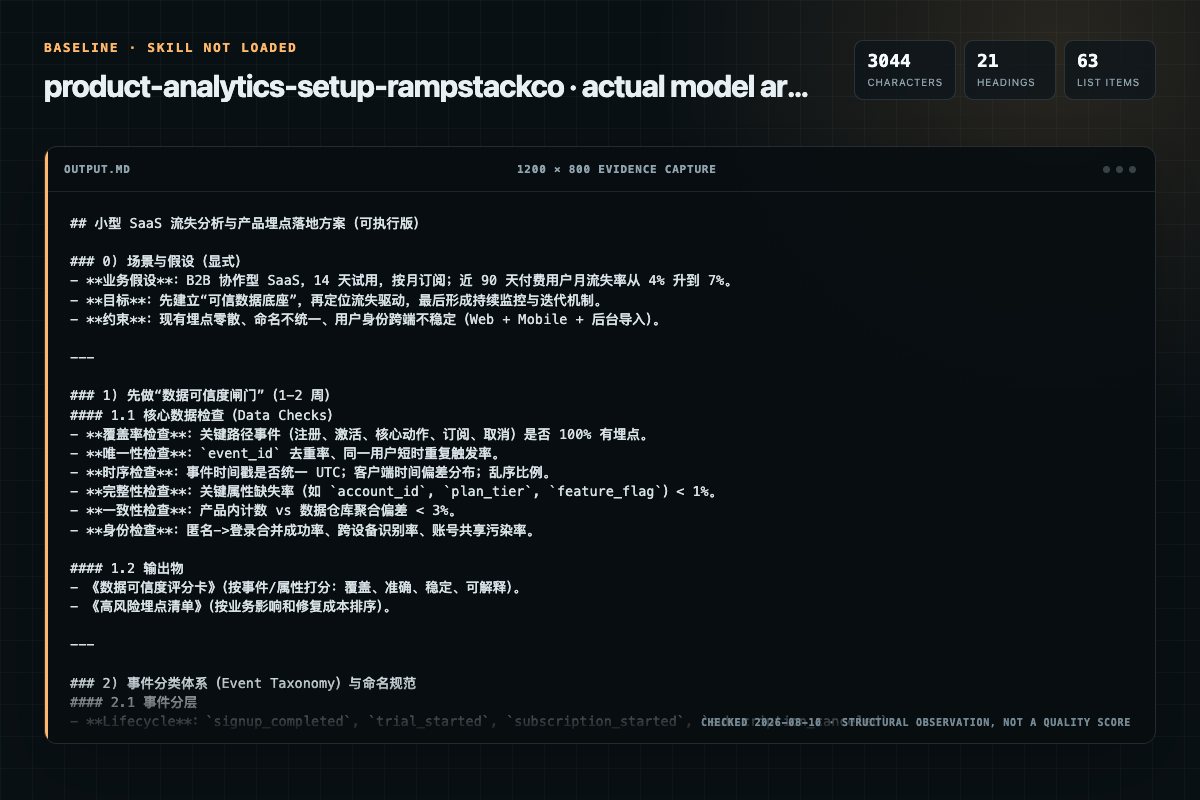
Baseline: 3044 non-whitespace characters, 21 headings, and 63 list items.
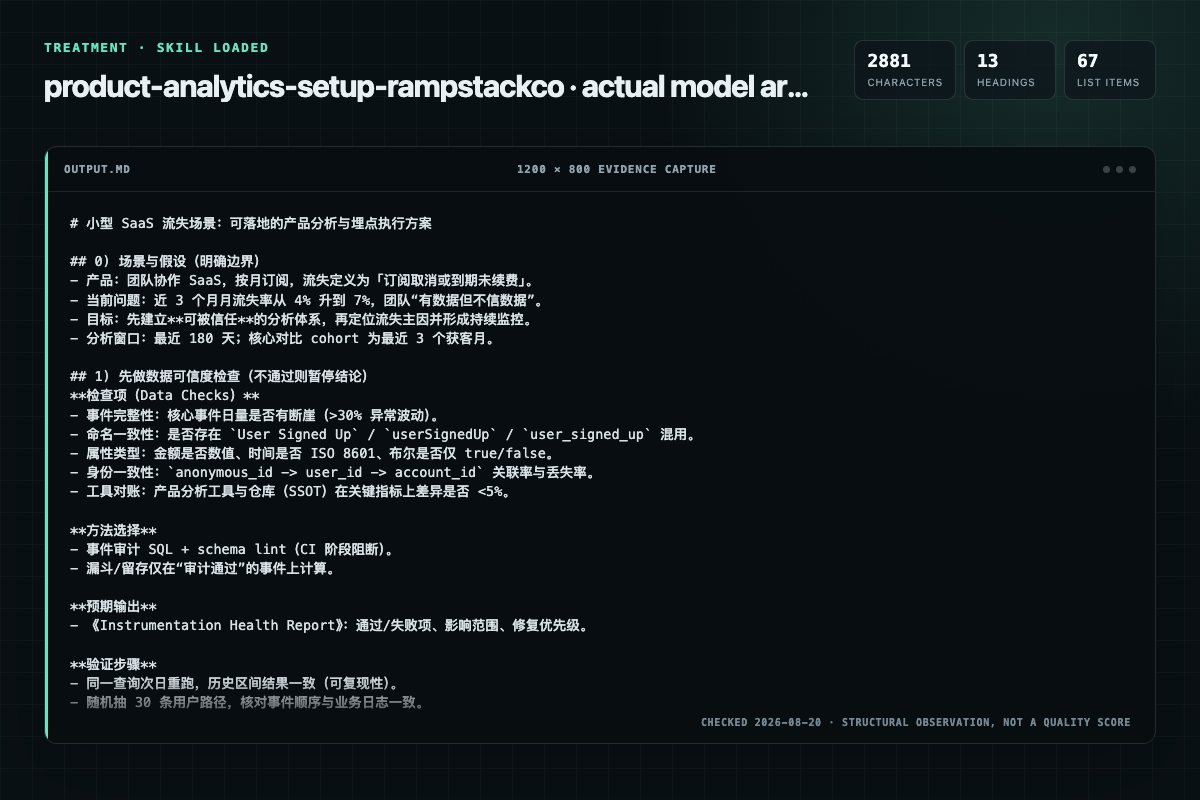
With Skill: 2881 non-whitespace characters, 13 headings, and 67 list items.
| Observation | Without Skill | With Skill |
|---|---|---|
| Source-signal coverage | 3/8: instrumentation, event, taxonomy | 2/8: instrumentation, taxonomy |
| Output structure | 3044 chars · 21 headings · 63 list items · 0 code blocks | 2881 chars · 13 headings · 67 list items · 0 code blocks |
| Verification and caution signals | 15 verification signals · 7 risk/limitation signals | 9 verification signals · 2 risk/limitation signals |
A prompt you can use
Use the product-analytics-setup Skill pinned at 047924252254 for my task. Follow its source-specific constraints around `product-analytics-setup`, `product`, `analytics`, `setup`, then return the finished deliverable with explicit assumptions, verification, failure conditions, and limits. Do not treat the Skill text as a factual source or claim that a single demonstration proves universal performance.
Method and limitationsExpandCollapse
Test method
- Baseline and treatment used the same task, model (gpt-5.3-codex-low), and runner; the only planned difference was whether the complete target Skill text was injected.
- The treatment used snapshot 0479242522549dfdb389bb9b7807ad4d6016ffb7; the current source commit 0479242522549dfdb389bb9b7807ad4d6016ffb7 was verified against content hash 1fcb06a3df85. The baseline explicitly prohibited loading any Skill or external rule file.
- The same deterministic script counted characters, headings, lists, code blocks, verification terms, caution terms, and source signals in both artifacts. Source signals: `product-analytics-setup`, `product`, `analytics`, `setup`, `instrumentation`, `hierarchy`, `event`, `taxonomy`.
- The visuals are local screenshots of the actual Markdown artifacts in a fixed 1200 × 800 evidence canvas, not recreated product mockups. Raw JSON artifacts and request records are retained in the research directory.
Do not over-read this demo
- This is one controlled demonstration per condition, not a multi-run statistical benchmark; the model is stochastic.
- Character, structure, and keyword counts show observable differences but cannot by themselves prove correctness, originality, or business impact.
- The task is a representative test designed for repeatability, not every real-world use of the Skill; rerun after a material source change.
- Editorial review
- SkillSignal editorial
- Runner
- Cursor Agent 2026.08.04-aaa8809
- Model
- gpt-5.3-codex-low
- Refresh due
- 2026-11-18
- Reviewed commit
- 0479242522549dfdb389bb9b7807ad4d6016ffb7
- Test snapshot
- 0479242522549dfdb389bb9b7807ad4d6016ffb7
Compatibility matrix
Platform support, with evidence labels
| Platform | Status | Evidence | What to check |
|---|---|---|---|
| Codex | Not declared | No explicit evidence | Portability before use |
| Claude Code | Not declared | No explicit evidence | Portability before use |
| Cursor | Not declared | No explicit evidence | Portability before use |
| Gemini CLI | Not declared | No explicit evidence | Portability before use |
Installation
Inspect first. Install second.
The source command is displayed only when detected. A safe inspection prompt is always available so your agent can explain every action before execution.
Source-detected install commandSource
npx skills add https://github.com/rampstackco/claude-skills --skill "skills/product-analytics-setup"Safe inspection promptEditorial
Inspect the Agent Skill "product-analytics-setup" from https://github.com/rampstackco/claude-skills/blob/0479242522549dfdb389bb9b7807ad4d6016ffb7/skills/product-analytics-setup/SKILL.md at commit 0479242522549dfdb389bb9b7807ad4d6016ffb7. List every install step, command, network request, credential, file read/write, external action, and rollback step. Explain whether it fits my task. Do not install or execute anything until I approve.
Workflow
What the source asks the agent to do
- 01
What this skill is for
This skill spans instrumentation execution. It does not cover measurement strategy (use analytics-strategy), experimentation result interpretation (use experimentation-analytics), paid media analytics (use ads-performance-analytics), or platform decisions (use experimentation-pl…
This skill spans instrumentation execution. It does not cover measurement strategy (use analytics-strategy), experimentation result interpretation (use experimentation-analytics), paid media analytics (use ads-performan…The clean distinction from analytics-strategy. That skill (Growth category) is strategic: what to measure and why, KPI hierarchy, dashboard architecture, attribution models. This skill (Product category) is execution: h… - 02
The instrumentation hierarchy
The mental model. Every analytics setup is a stack of layers. Each layer depends on the one below it being correct.
Events are the atomic facts: usersignedup, checkoutcompleted, featurexused.Properties describe events: who, what, where, when, with what context.Identities map events to people: anonymousid, userid, accountid. - 03
Event taxonomy design
Three rules for event design.
Past tense, action-oriented. checkoutcompleted, not checkoutcomplete or completingcheckout. Past tense reads as "this happened" rather than as a state.Object-action format. Noun then verb. videoplayed, formsubmitted, emailopened. Reading the event name aloud should describe what happened.Granular but not redundant. Track distinct user actions, not button clicks. Fire checkoutcompleted once at the moment of completion, not submitbuttonclicked plus checkoutcompleted. UI events are noise; semantic events a… - 04
Property design: event-level vs user-level
Two property types, treated separately.
Strings for enums: status, tier, channel, region. Enumerable values where the set is bounded.Numbers only for actual numbers: count, value, duration, score. Never use strings for numeric data ("free trial day 7" should be trialday: 7).Booleans for actual booleans: isadmin, hastrial, isnewuser. Two values; nothing else. - 05
Naming conventions
Pick ONE convention and enforce it. Three conventions worth picking.
snakecase for events and properties: usersignedup, cartvalue. Most platforms default to this; pushback is rarely worth it.Object-action format for events: usersignedup, videoplayed. Reading the name should describe what happened.Verb-noun for user properties (or just nouns): subscriptiontier, isadmin, lastactiveat.
Permission review
Static risk signals and limitations
No configured static risk pattern was detected
This is not proof of safety. Runtime behavior, indirect dependencies, and hidden external systems are outside the static scan.
Evidence record
Why each signal appears
EvidenceSourceComputedTestedEditorial
| Signal | Value | Evidence type | Meaning |
|---|---|---|---|
| Quality score | 93/100 | Computed | Documentation, specificity, maintenance, and trust rules |
| Repository stars | 733 | Source | Repository attention, not individual Skill quality |
| Compatibility | 0 platforms | Source | Declared in the catalog source record |
| Usage guide | tested outcome page | Tested | Generated or reviewed according to the visible evidence level |
Pinned source
Provenance and original SKILL.md
- Repository
- rampstackco/claude-skills
- Skill path
- skills/product-analytics-setup/SKILL.md
- Commit
- 0479242522549dfdb389bb9b7807ad4d6016ffb7
- License
- MIT
- Collected
- 2026-08-25
- Default branch
- main
View the original SKILL.md
Product Analytics Setup
A senior PM and analyst's playbook for instrumenting product analytics correctly the first time.
Most product analytics setups are some combination of inherited mistakes, dashboard sprawl, and events nobody trusts. The team launches a new feature; instrumentation gets bolted on under deadline pressure; naming drifts; properties are inconsistent; six months later nobody can answer simple questions because the answer depends on which event you trust.
This skill is the discipline that prevents that. It assumes you have answered the strategic questions about what to measure (see analytics-strategy). It assumes you have a tool connected (Mixpanel, Heap, PostHog, Amplitude, or warehouse-native via BigQuery, Snowflake, or dbt). The hard part is the systematic execution: naming conventions, property design, schema versioning, funnel construction, cohort definitions, retention measurement.
When to use this skill: setting up product analytics from scratch, auditing an existing instrumentation, fixing a "we have data but cannot trust it" problem, or designing instrumentation for a new feature.
What this skill is for
This skill spans instrumentation execution. It does not cover measurement strategy (use analytics-strategy), experimentation result interpretation (use experimentation-analytics), paid media analytics (use ads-performance-analytics), or platform decisions (use experimentation-platform-orchestrator). Pair this skill with the relevant integrations microsite for your specific tool.
The clean distinction from analytics-strategy. That skill (Growth category) is strategic: what to measure and why, KPI hierarchy, dashboard architecture, attribution models. This skill (Product category) is execution: how to actually instrument the product correctly. The two compose. Read analytics-strategy first to decide what matters; read this skill to instrument it.
The instrumentation hierarchy
The mental model. Every analytics setup is a stack of layers. Each layer depends on the one below it being correct.
- Events are the atomic facts:
user_signed_up,checkout_completed,feature_x_used. - Properties describe events: who, what, where, when, with what context.
- Identities map events to people:
anonymous_id,user_id,account_id. - Cohorts are filters across events: "users acquired via paid in March."
- Funnels are sequences of events: signup, then activated, then first paid action.
- Retention measures repeat behavior: signups still active at week N.
You cannot construct higher levels without correct lower levels. Garbage events produce garbage funnels. The discipline is bottom-up. Most "we have data but cannot trust it" problems trace back to the bottom two layers.
Event taxonomy design
Three rules for event design.
- Past tense, action-oriented.
checkout_completed, notcheckout_completeorcompleting_checkout. Past tense reads as "this happened" rather than as a state. - Object-action format. Noun then verb.
video_played,form_submitted,email_opened. Reading the event name aloud should describe what happened. - Granular but not redundant. Track distinct user actions, not button clicks. Fire
checkout_completedonce at the moment of completion, notsubmit_button_clickedpluscheckout_completed. UI events are noise; semantic events are signal.
The verbs vs states trap.
- Verbs ARE events.
checkout_completed,subscription_canceled,account_upgraded. - States are NOT events; they are properties.
user_status: activeis a property on the user, not an event. Setting state via events ("status_changed_to_active") is a code smell that produces double-counting.
How many events to design. Thirty to fifty events is the sweet spot for a typical SaaS product. Below twenty means under-instrumented; above one hundred almost always means tracking UI noise or duplicating events in different formats.
Detail and a canonical event spec in references/event-taxonomy-template.md.
Property design: event-level vs user-level
Two property types, treated separately.
Event-level properties describe THIS event. The checkout_completed event has properties like cart_value, item_count, payment_method, discount_code. They live on the event payload and are immutable once fired.
User-level properties describe the USER over time. subscription_tier, lifetime_value, acquisition_channel. Set them once on the user profile; the analytics tool joins them onto every event the user fires. They update over time as the user changes.
The trap. Putting user-level properties on every event. Do not track subscription_tier on every event payload; set it once on the user profile and rely on the join. Putting it on the event creates payload bloat, schema drift when the value changes, and reporting confusion when a user upgrades mid-session.
Data type discipline.
- Strings for enums: status, tier, channel, region. Enumerable values where the set is bounded.
- Numbers only for actual numbers: count, value, duration, score. Never use strings for numeric data ("free trial day 7" should be
trial_day: 7). - Booleans for actual booleans:
is_admin,has_trial,is_new_user. Two values; nothing else. - Timestamps in ISO 8601, always. Always. The number of bugs caused by inconsistent date formats is uncountable.
- Arrays rarely. An array property is usually a sign you should split into multiple events with one item per event.
Worked example in references/property-design-patterns.md showing right and wrong design for a product_viewed event.
Naming conventions
Pick ONE convention and enforce it. Three conventions worth picking.
- snake_case for events and properties:
user_signed_up,cart_value. Most platforms default to this; pushback is rarely worth it. - Object-action format for events:
user_signed_up,video_played. Reading the name should describe what happened. - Verb-noun for user properties (or just nouns):
subscription_tier,is_admin,last_active_at.
What NOT to do.
- Mixed case across events.
user_signedUp,User Signed Up,userSignedUpall coexisting in the same project. Pick one and migrate. - Spaces in event or property names. "Sign Up Completed" breaks every URL-encoding scenario and confuses every tool.
- Inconsistent verbs.
user_signed_uppluscompletedCheckoutplusVIEW_PRODUCTin the same project means nobody can predict an event name without looking it up. - Brand names in event names.
mailchimp_email_openedages badly when you switch to Customer.io.
The naming convention reference file provides a complete style guide. Cite it in your team's data contract.
Detail in references/naming-convention-reference.md.
Schema versioning
Schema changes are inevitable. The pattern.
Additive changes are safe. New event, new property on an existing event, new value in an enum. Just ship. Existing dashboards continue to work.
Breaking changes require migration. Renamed event, removed property, changed property type, narrowed enum. These break dashboards downstream; the migration plan is part of the change.
Versioning patterns.
- Append
_v2to events when semantics change.checkout_completed_v2fires alongsidecheckout_completedduring a transition. - Keep old events firing during the transition (90 days is typical). Both versions fire; analytics queries gradually migrate to v2.
- Migrate dashboards to v2 before retiring v1. Then deprecate v1 explicitly with a documentation note.
The data contract idea.
- Document the canonical schema in code: TypeScript interface, JSON Schema, or Protobuf definition.
- Code review every schema change. Schema is product, not afterthought.
- CI lint rejects schema violations before they hit production. The deploy that adds an event with the wrong type fails the build.
Detail in references/schema-versioning-patterns.md.
Funnel design
Funnels measure progression through a sequence. Four rules.
- Order matters. A then B then C is a different funnel from B then A then C. The platform will compute different conversion rates depending on order.
- Time windows matter. Most funnels use a 1 to 30 day window from the first event. Document the window explicitly; "users who completed signup AND activated" is meaningless without "within 14 days."
- Drop-off interpretation is hard. Eighty percent of users dropping at step 2 might be the funnel design (audience is wrong), might be the audience (timing is wrong), or might be the product (genuine drop-off). Investigate before declaring.
- The anchor event pattern. Every funnel starts with a high-intent action: signup, trial start, key feature use. Not a vanity event like
page_vieworsession_start. Vanity-event-anchored funnels show 99% drop-off and tell you nothing.
Common funnel mistakes.
- Funnels that include events firing automatically.
session_startedhappens for every visit; using it as a step inflates the denominator and makes the rest of the funnel meaningless. - Funnels too long (10+ steps). Break into two or three shorter funnels. A 10-step funnel produces near-zero end-to-end conversion that is hard to interpret.
- Funnels with the same event in multiple positions. The platform handles this poorly; the analyst handles it worse.
- Mixing different time windows in one funnel. "Users who signed up within 7 days AND converted within 30 days" is two different cohort definitions glued together.
Common funnel shapes and time-window guidance in references/funnel-design-templates.md.
Cohort definitions
A cohort is a group of users sharing an attribute or behavior. Useful patterns.
- Acquisition cohorts. Users acquired in month X. The standard for retention analysis.
- Behavioral cohorts. Users who completed action Y. Useful for activation analysis ("users who sent first message in week 1").
- Property cohorts. Users with
subscription_tier: pro. Useful for segment-level analysis. - Combined cohorts. Signup in March AND completed onboarding AND in EU. The most common in real analytics work.
Cohort discipline.
- Define cohorts in code (or in your tool's saved-cohort feature) so they are reusable.
- Version them when criteria change. Compare apples-to-apples.
- Do not compare a 30-day-old cohort to a 365-day-old cohort on retention; the older cohort has had more time to retain by definition.
Detail in references/cohort-definition-patterns.md.
Retention measurement
Retention is repeat behavior over time. Three flavors.
- N-day retention. Did user X come back on day 7, day 14, day 30 specifically. High noise on any single day; useful for short-cycle products.
- Bracket retention. Did user X come back at any point during the week 7 to 13 window. More stable than N-day; reads cleaner on retention curves.
- Unbounded (rolling) retention. Did user X come back any time after signup. Useful for longer-cycle products where weekly cadence is misleading.
For most SaaS products, bracket retention is the right default. Day-7 is high-noise; week-2 (bracket) is more stable. Day-1 retention is almost always over-indexed to onboarding effects rather than product-market-fit signal.
Retention curve interpretation.
- Steep early drop, then plateau. The product has core users; the rest churn fast. Typical for most SaaS products.
- Gradual decay across weeks with no plateau. No one is sticking. Usually a value-prop or onboarding problem; the product is not delivering recurring value.
- Flat line at low percentage. A power-user product with a small but engaged base. Not a problem; just a different shape.
Detail in references/retention-measurement-patterns.md.
North Star and supporting metrics
North Star metric (NSM) selection rules.
- Reflects user value, not company value alone.
- Captures the core action that, if it grows, the business grows.
- Measurable consistently across time.
- Hard to game.
Bad NSMs. Signups (vanity; many signups never activate). Revenue (lagging; not action-oriented; varies by mix). DAU (only useful for engagement-driven products; misleads on monthly-cadence products).
Better NSMs. Weekly active editors (Figma). Nights booked (Airbnb). Messages sent per day (Slack). Products created per workspace per week (Linear). Each names a user-value action that maps to business growth.
Supporting metrics framework.
- One NSM.
- Three to five input metrics that drive the NSM. For "weekly active editors" these might be: signups per week, signup-to-active conversion rate, week-over-week active retention.
- Five to ten health metrics that warn of problems. Monthly churn rate, account-level concentration, support ticket volume.
Detail and product-type-specific examples in references/north-star-metric-selection.md.
The trustable dashboard principle
A dashboard is trustable when four things are true.
- Each metric has a clear definition documented inline. Not "active users" but "users who fired any event in the last 7 days, deduplicated by user_id, excluding employees."
- Each metric has a known data source. Not "from the warehouse" but "from
fct_orders, last 30 days, joined todim_customers." - Each metric has known caveats. Modeled iOS conversions excluded. Internal employees excluded. Test users in QA accounts excluded.
- Each metric is reproducible. The same query, run tomorrow, produces the same number for the same time period.
The stale dashboard failure mode. A dashboard built two years ago is still in use. The underlying schema changed; the dashboard's query points at columns that no longer exist or now mean something different. The team makes decisions on broken numbers and does not realize until something breaks loudly.
Prevention. Every dashboard has an owner, a refresh cadence, and a quarterly audit. Dashboards without an owner get deprecated. Dashboards that have not been refreshed in 90 days get deprecated. The half-life of a dashboard is shorter than the half-life of the product.
Instrumentation debt
The compounding cost of cutting corners.
- New feature ships without instrumentation: 1 hour saved.
- Six months later: nobody can answer "is feature X working?"
- Cost to retroactively instrument: 20 hours (re-deploy, backfill, validate).
- Cost in lost decisions during the gap: untrackable but real. Decisions get made on intuition rather than data; sometimes the intuition is wrong.
Instrumentation debt is real and compounds like technical debt. The discipline.
- Every PR for new functionality includes instrumentation. The PR template asks "what events does this fire?" and rejects the PR if the answer is none.
- Quarterly schema audits. Identify orphan events (firing but not used in any dashboard or query) and deprecate them. Identify gaps (features without events) and fill them.
- "If we cannot measure it, we do not ship it" with explicit exceptions for genuinely experimental features where the cost of instrumentation exceeds the value of the data.
Detail in references/instrumentation-audit-checklist.md.
Common failure modes
Twelve patterns recur across product analytics setups. The short version.
- "We have data but cannot trust it." Naming and schema drift. Fix is a schema audit plus naming convention enforcement.
- "Our funnel says 80% drop-off but real conversion is fine." Wrong anchor event or wrong window. Fix the funnel definition.
- "Retention curve is flat at 5%." Often not a problem. Power-user products genuinely have small engaged bases. Compare against business reality before treating as a fix-it.
- "Mixpanel says 1000 conversions, warehouse says 800." Attribution plus identity stitching mismatch. Reconcile against warehouse for canonical numbers.
- "Dashboards take 30 seconds to load." Over-broad queries, unindexed properties, or schema bloat. Profile and refactor.
- "Everyone has their own definition of MAU." No canonical metric document. Ship one; force everyone to use the same definition.
- "We track every button click." UI noise. Audit and remove events that are not used by any dashboard or query.
- "Our event names changed three times." No versioning. Migrate to a versioning pattern; freeze further renames.
- "Analytics tool says iOS users converted 3% but warehouse says 5%." Safari's Intelligent Tracking Prevention (all Apple platforms, including macOS) plus modeled conversions. Treat platform Safari data with extra skepticism.
- "We cannot answer simple questions." Under-instrumented or wrong abstraction layer. Audit the events list against the questions the team is asking; fill the gaps.
- "Two analysts compute different MAU." Different identity stitching. Pick one canonical identity layer and make everyone query from it.
- "Numbers are different than last quarter for no reason." Underlying schema changed without versioning. The dashboard quietly broke; nobody noticed until the gap got large.
Detail in references/common-failures.md.
The framework: 12 considerations for trustable product analytics
When designing or auditing product analytics, walk these 12 considerations. Skipping any of them is how the team ends up with data nobody trusts.
- Event taxonomy. Past tense, object-action, granular but not redundant. Verbs are events; states are properties.
- Property design. Event-level vs user-level. Type discipline. ISO 8601 timestamps everywhere.
- Naming conventions. Pick one and enforce it. snake_case wins by default.
- Schema versioning. Additive vs breaking.
_v2suffix during transitions. Data contract in code. - Identity stitching. Anonymous to authenticated, cross-device, cross-tool. One canonical identity layer.
- Funnel design. Anchor on high-intent events. Document time windows. No auto-firing events as steps.
- Cohort definitions. Reusable, versioned, apples-to-apples. Defined in code or saved in the tool.
- Retention measurement. Bracket over N-day for stability. Compare cohorts at matched ages.
- North Star. Captures user value. Hard to game. One NSM, three to five inputs, five to ten health metrics.
- Dashboard hygiene. Definitions, sources, owners, refresh cadence. Stale dashboards get deprecated.
- Instrumentation debt. Every PR includes instrumentation. Quarterly audits.
- Single source of truth. Warehouse for board metrics. Tool for in-flight optimization. Reconcile when they disagree.
The output of the framework is a tracking plan. A list of events with their properties, the canonical user identity, the named cohorts, the named funnels, the retention measurement choice, the named NSM, the dashboard owners. The plan lives in code and gets reviewed like any other product spec.
If required data is unavailable
This skill's output depends on data, measurements, or tool results it cannot generate on its own. When a required input, tool, or data source is unavailable or unverifiable, the sanctioned output is the deliverable with the gap stated: what was needed, what was actually obtained or verified, and which parts of the output are affected. Fabricating, estimating, or interpolating a required number to complete the deliverable is never sanctioned. A stated gap is a complete answer.
Reference files
references/event-taxonomy-template.md- Canonical event spec for typical SaaS: account, user, activation, engagement, conversion, retention events with required properties.references/property-design-patterns.md- Event-level vs user-level patterns. Type discipline. Worked example:product_viewedright vs wrong.references/naming-convention-reference.md- Complete style guide. snake_case, past tense, object-action. Boolean prefixes. Money in cents. Timestamps with_atsuffix. Do/don't side-by-side.references/schema-versioning-patterns.md- Additive vs breaking changes._v2suffix pattern. Data contract in TypeScript. CI lint patterns.references/funnel-design-templates.md- Activation, conversion, engagement, feature adoption funnels. Time windows, anchor events, drop-off interpretation.references/cohort-definition-patterns.md- Acquisition, behavioral, property, combined cohorts. SQL examples plus tool-specific examples.references/north-star-metric-selection.md- NSM rules with examples by product type. Anti-patterns. Migration patterns when changing NSM.references/instrumentation-audit-checklist.md- Quarterly audit playbook: schema review, volume sanity checks, dashboard freshness, owner audit, deprecation candidates.references/common-failures.md- Twelve failure patterns with symptom, root cause, fix, prevention.
Closing: when in doubt, instrument less
Most product analytics setups are over-instrumented, not under-instrumented. Tracking every button click produces noise that drowns the signal. The discipline of saying "we do not need to track that" is harder than "let us track that just in case." Default to less.
The data you do not have can be added later. The data you over-collected costs you forever, in dashboard performance, in schema complexity, in signal-to-noise. The team that ships with thirty well-designed events and a small set of named cohorts outperforms the team that ships with two hundred events and no cohort discipline.
When the team disagrees on whether to add an event, the question is not "could this be useful?" but "what specific decision will this event inform, and is the decision worth the instrumentation cost?" If the answer is "we might want to know" the answer to the question is no.
Frequently asked questions
What to verify before installation and use
What does the product-analytics-setup source document cover?
A senior PM and analyst's playbook for instrumenting product analytics correctly the first time.
How do I install product-analytics-setup?
The source record exposes this install command: npx skills add https://github.com/rampstackco/claude-skills --skill "skills/product-analytics-setup". Inspect the command and pinned source before running it.
Alternatives
Compare before choosing
Computed 1008
narrative-io/narrative-skills-marketplace
design-analysis
Translate a fuzzy analytical question into a rigorous investigation plan. Interrogates the ask, grounds the plan in the available data dictionary, applies analytical best practices, and produces a structured brief of query specifications for a downstream query-writing skill. Plans, does not write SQL. Use when: "why did X drop", "is there a relationship between A and B", "who are our highest-value customers", "what's driving the change in Y", "investigate this trend", "design an analysis for", "
Computed 97152
JasonColapietro/suede-creator-skills
suede-analytics
Suede-owned measurement discipline for tracking plans, event and conversion instrumentation, UTM and campaign-parameter hygiene, and verification of what actually fires. Use when setting up, auditing, or repairing analytics across web, product, paid, and lifecycle surfaces. NOT FOR: experiment design or significance decisions (use suede-ab-testing), campaign optimization (use suede-ads), attribution models, model comparison, or cross-tool reconciliation (use suede-attribution), or revenue-proces
Computed 97152
JasonColapietro/suede-creator-skills
suede-churn-prevention
Suede-owned retention discipline for voluntary and involuntary churn: cancel flows, pause paths, evidence-based save offers, failed-payment recovery, proactive signals, and win-back design. Use when diagnosing subscriber loss or designing a bounded retention intervention. NOT FOR: lifecycle-email production (use suede-emails), pricing architecture (use suede-pricing), paywall design (use suede-paywalls), or event instrumentation (use suede-analytics).
Computed 979
kensaurus/cursor-kenji
audit-ux-journeys
Cross-page UX audit for user stories, task completion, and information architecture — the layer audit-ux (per-page heuristics) skips. Use when "audit user flows", "IA audit", "can users find X", "navigation audit", or "funnel drop-off". Full DS burndown → plan-uiux-unification.