
Tested demoQuality 91/100
Donchitos/Claude-Code-Game-Studios/.claude/skills/review-all-gdds/SKILL.md
review-all-gdds
Holistic cross-GDD consistency and game design review. Reads all system GDDs simultaneously and checks for contradictions between them, stale references, ownership conflicts, formula incompatibilities, and game design theory violations (dominant strategies, economic imbalance, cognitive overload, pillar drift). Run after all MVP GDDs are written, before architecture begins.
- Source repository stars
- 24,512
- Declared platforms
- 0
- Static risk flags
- 0
- Last source update
- 2026-05-21
- Source checked
- 2026-08-25
Decision brief
What it does: where it fits
This skill reads every system GDD simultaneously and performs two complementary reviews that cannot be done per-GDD in isolation:
Not for
- Tasks that require unconfirmed production actions or broad system permissions.
- Environments where the pinned source and install steps cannot be inspected.
Controlled single-run demoChecked 2026-08-20
What changed when the Skill was used
In this controlled same-task single run, enabling review-all-gdds changed the output from 1872 non-whitespace characters and 15 headings to 2116 characters and 13 headings. Matches among 8 signals extracted from the pinned source changed from 0 to 2. Both actual outputs are shown; this is a structural observation, not a quality score or a universal performance claim.
Same test task
Review a flawed account-settings implementation for a small SaaS product. Prioritize concrete issues, explain impact, and provide corrected examples or decisions. The deliverable must specifically reflect this user intent: Holistic cross-GDD consistency and game design review. Reads all system GDDs simultaneously and checks for contradictions between them, stale references, ownership conflicts, formula incompatibilities, and game design theory violations (dominant strategies, economic imbalance, cognitive overload, pillar drift). Run after all MVP GDDs are written, before architecture begins.
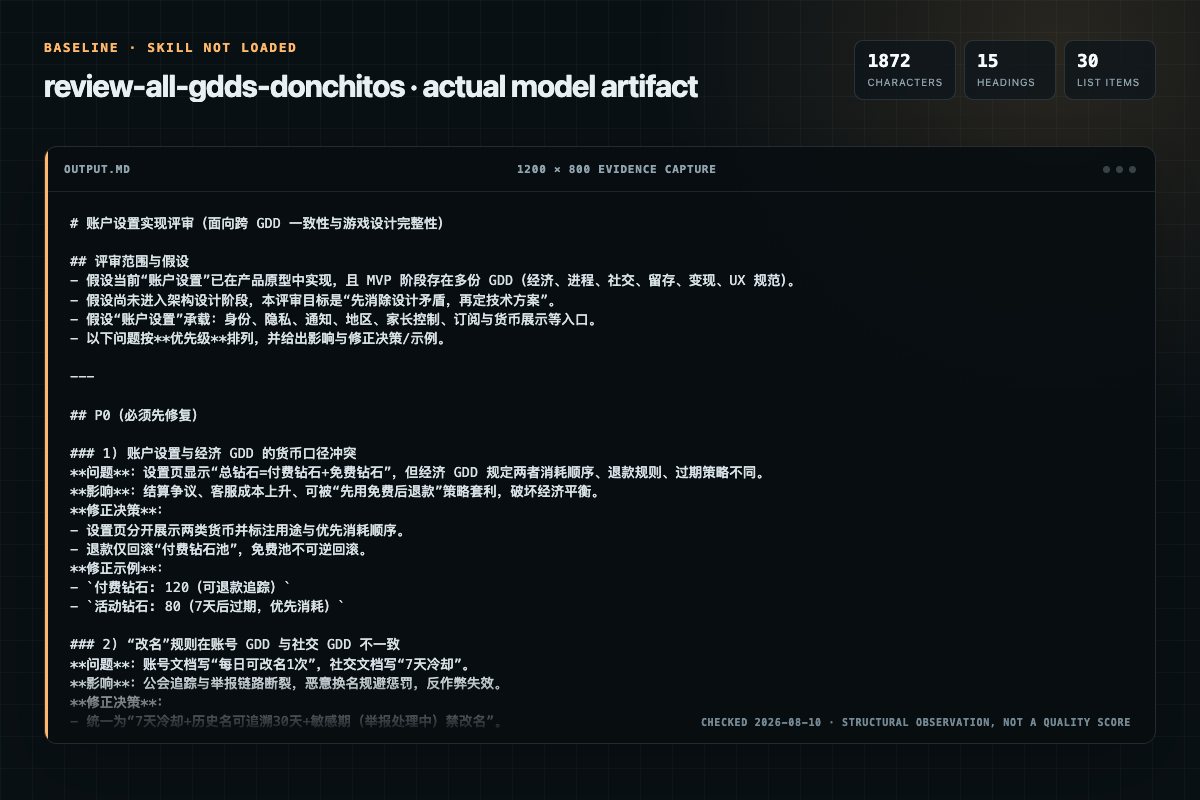
Baseline: 1872 non-whitespace characters, 15 headings, and 30 list items.
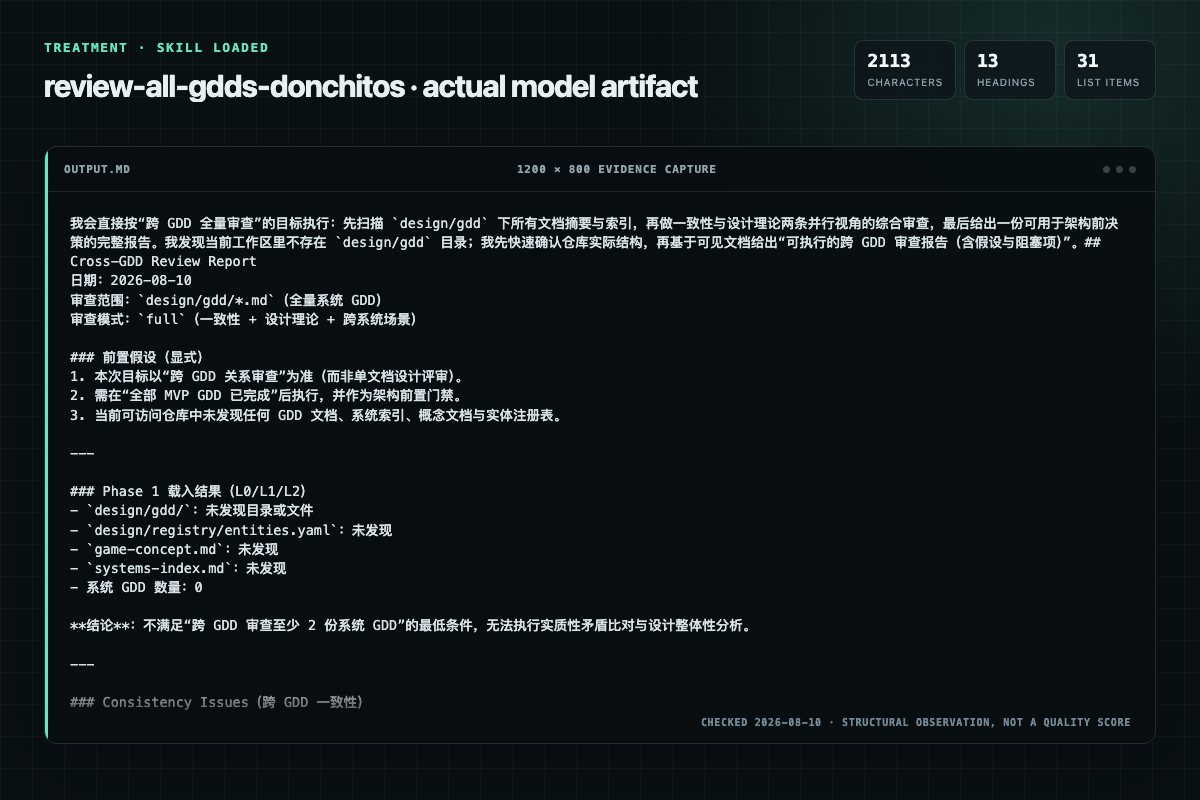
With Skill: 2116 non-whitespace characters, 13 headings, and 31 list items.
| Observation | Without Skill | With Skill |
|---|---|---|
| Source-signal coverage | 0/8: none | 2/8: phase, registry |
| Output structure | 1872 chars · 15 headings · 30 list items · 0 code blocks | 2116 chars · 13 headings · 31 list items · 0 code blocks |
| Verification and caution signals | 3 verification signals · 11 risk/limitation signals | 6 verification signals · 5 risk/limitation signals |
A prompt you can use
Use the review-all-gdds Skill pinned at 984023ddac0d for my task. Follow its source-specific constraints around `review-all-gdds`, `phase`, `everything`, `summary`, then return the finished deliverable with explicit assumptions, verification, failure conditions, and limits. Do not treat the Skill text as a factual source or claim that a single demonstration proves universal performance.
Method and limitationsExpandCollapse
Test method
- Baseline and treatment used the same task, model (gpt-5.3-codex-low), and runner; the only planned difference was whether the complete target Skill text was injected.
- The treatment used snapshot 984023ddac0d5e27624f2baacde6105e45de375f; the current source commit 984023ddac0d5e27624f2baacde6105e45de375f was verified against content hash 14531f7d3b8c. The baseline explicitly prohibited loading any Skill or external rule file.
- The same deterministic script counted characters, headings, lists, code blocks, verification terms, caution terms, and source signals in both artifacts. Source signals: `review-all-gdds`, `phase`, `everything`, `summary`, `tokens`, `registry`, `pre-load`, `baseline`.
- The visuals are local screenshots of the actual Markdown artifacts in a fixed 1200 × 800 evidence canvas, not recreated product mockups. Raw JSON artifacts and request records are retained in the research directory.
Do not over-read this demo
- This is one controlled demonstration per condition, not a multi-run statistical benchmark; the model is stochastic.
- Character, structure, and keyword counts show observable differences but cannot by themselves prove correctness, originality, or business impact.
- The task is a representative test designed for repeatability, not every real-world use of the Skill; rerun after a material source change.
- Editorial review
- SkillSignal editorial
- Runner
- Cursor Agent 2026.07.09-a3815c0
- Model
- gpt-5.3-codex-low
- Refresh due
- 2026-11-18
- Reviewed commit
- 984023ddac0d5e27624f2baacde6105e45de375f
- Test snapshot
- 984023ddac0d5e27624f2baacde6105e45de375f
Compatibility matrix
Platform support, with evidence labels
| Platform | Status | Evidence | What to check |
|---|---|---|---|
| Codex | Not declared | No explicit evidence | Portability before use |
| Claude Code | Not declared | No explicit evidence | Portability before use |
| Cursor | Not declared | No explicit evidence | Portability before use |
| Gemini CLI | Not declared | No explicit evidence | Portability before use |
Installation
Inspect first. Install second.
The source command is displayed only when detected. A safe inspection prompt is always available so your agent can explain every action before execution.
Source-detected install commandSource
npx skills add https://github.com/Donchitos/Claude-Code-Game-Studios --skill ".claude/skills/review-all-gdds"Safe inspection promptEditorial
Inspect the Agent Skill "review-all-gdds" from https://github.com/Donchitos/Claude-Code-Game-Studios/blob/984023ddac0d5e27624f2baacde6105e45de375f/.claude/skills/review-all-gdds/SKILL.md at commit 984023ddac0d5e27624f2baacde6105e45de375f. List every install step, command, network request, credential, file read/write, external action, and rollback step. Explain whether it fits my task. Do not install or execute anything until I approve.
Workflow
What the source asks the agent to do
- 01
Phase 1: Load Everything
Before reading any full document, use Grep to extract Summary sections from all GDD files:
design/gdd/game-concept.md — game vision, core loop, MVP definitiondesign/gdd/game-pillars.md if it exists — design pillars and anti-pillarsdesign/gdd/systems-index.md — authoritative system list, layers, dependencies, status - 02
Phase 1a — L0: Summary Scan (fast, low tokens)
Before reading any full document, use Grep to extract Summary sections from all GDD files:
Before reading any full document, use Grep to extract Summary sections from all GDD files:Display a manifest to the user:For since-last-review mode: run git log --name-only to identify GDDs modified since the last review report file was written. Show the user which GDDs are in scope based on summaries before doing any full reads. Only pro… - 03
Phase 1b — Registry Pre-Load (fast baseline)
Before full-reading any GDD, check for the entity registry:
Before full-reading any GDD, check for the entity registry:If the registry exists and has entries, use it as a pre-built conflict baseline: known entities, items, formulas, and constants with their authoritative values and source GDDs. In Phase 2, grep GDDs for registered names…If the registry is empty or absent: proceed without it. Note in the report: "Entity registry is empty — consistency checks rely on full GDD reads only. Run /consistency-check after this review to populate the registry." - 04
Phase 1c — L1/L2: Full Document Load
Full-read the in-scope documents:
design/gdd/game-concept.md — game vision, core loop, MVP definitiondesign/gdd/game-pillars.md if it exists — design pillars and anti-pillarsdesign/gdd/systems-index.md — authoritative system list, layers, dependencies, status - 05
Phase 2: Cross-GDD Consistency
Work through every pair and group of GDDs to find contradictions and gaps.
If GDD-A lists "depends on GDD-B", check that GDD-B lists GDD-A as a dependentIf GDD-A lists "depended on by GDD-C", check that GDD-C lists GDD-A as a dependencyFlag any one-directional dependency as a consistency issue
Permission review
Static risk signals and limitations
No configured static risk pattern was detected
This is not proof of safety. Runtime behavior, indirect dependencies, and hidden external systems are outside the static scan.
Evidence record
Why each signal appears
EvidenceSourceComputedTestedEditorial
| Signal | Value | Evidence type | Meaning |
|---|---|---|---|
| Quality score | 91/100 | Computed | Documentation, specificity, maintenance, and trust rules |
| Repository stars | 24,512 | Source | Repository attention, not individual Skill quality |
| Compatibility | 0 platforms | Source | Declared in the catalog source record |
| Usage guide | tested outcome page | Tested | Generated or reviewed according to the visible evidence level |
Pinned source
Provenance and original SKILL.md
- Repository
- Donchitos/Claude-Code-Game-Studios
- Skill path
- .claude/skills/review-all-gdds/SKILL.md
- Commit
- 984023ddac0d5e27624f2baacde6105e45de375f
- License
- MIT
- Collected
- 2026-08-25
- Default branch
- main
View the original SKILL.md
Review All GDDs
This skill reads every system GDD simultaneously and performs two complementary reviews that cannot be done per-GDD in isolation:
- Cross-GDD Consistency — contradictions, stale references, and ownership conflicts between documents
- Game Design Holism — issues that only emerge when you see all systems together: dominant strategies, broken economies, cognitive overload, pillar drift, competing progression loops
This is distinct from /design-review, which reviews one GDD for internal
completeness. This skill reviews the relationships between all GDDs.
When to run:
- After all MVP-tier GDDs are individually approved
- After any GDD is significantly revised mid-production
- Before
/create-architecturebegins (architecture built on inconsistent GDDs inherits those inconsistencies)
Argument modes:
Focus: $ARGUMENTS[0] (blank = full)
- No argument /
full: Both consistency and design theory passes consistency: Cross-GDD consistency checks only (faster)design-theory: Game design holism checks onlysince-last-review: Only GDDs modified since the last review report (git-based)
Phase 1: Load Everything
Phase 1a — L0: Summary Scan (fast, low tokens)
Before reading any full document, use Grep to extract ## Summary sections
from all GDD files:
Grep pattern="## Summary" glob="design/gdd/*.md" output_mode="content" -A 5
Display a manifest to the user:
Found [N] GDDs. Summaries:
  • combat.md — [summary text]
  • inventory.md — [summary text]
  ...
For since-last-review mode: run git log --name-only to identify GDDs
modified since the last review report file was written. Show the user which
GDDs are in scope based on summaries before doing any full reads. Only
proceed to L1 for those GDDs plus any GDDs listed in their "Key deps".
Phase 1b — Registry Pre-Load (fast baseline)
Before full-reading any GDD, check for the entity registry:
Read path="design/registry/entities.yaml"
If the registry exists and has entries, use it as a pre-built conflict baseline: known entities, items, formulas, and constants with their authoritative values and source GDDs. In Phase 2, grep GDDs for registered names first — this is faster than reading all GDDs in full before knowing what to look for.
If the registry is empty or absent: proceed without it. Note in the report:
"Entity registry is empty — consistency checks rely on full GDD reads only.
Run /consistency-check after this review to populate the registry."
Phase 1c — L1/L2: Full Document Load
Full-read the in-scope documents:
design/gdd/game-concept.md— game vision, core loop, MVP definitiondesign/gdd/game-pillars.mdif it exists — design pillars and anti-pillarsdesign/gdd/systems-index.md— authoritative system list, layers, dependencies, status- Every in-scope system GDD in
design/gdd/— read completely (skip game-concept.md and systems-index.md — those are read above)
Report: "Loaded [N] system GDDs covering [M] systems. Pillars: [list]. Anti-pillars: [list]."
If fewer than 2 system GDDs exist, stop:
"Cross-GDD review requires at least 2 system GDDs. Write more GDDs first, then re-run
/review-all-gdds."
Parallel Execution
Phase 2 (Consistency) and Phase 3 (Design Theory) are independent — they read the same GDD inputs but produce separate reports. Spawn both as parallel Task agents simultaneously rather than waiting for Phase 2 to complete before starting Phase 3. Collect both results before writing the combined report.
When spawning parallel Task agents for Phase 2 and Phase 3, always pass:
- The complete list of GDD file paths loaded in Phase 1 (explicit paths, not just counts)
- The full TR registry contents if loaded in Phase 1b (paste the registry text, not just a file path)
- The specific checklist items assigned to that agent's phase (Phase 2 gets 2a–2f; Phase 3 gets 3a–3g)
- The engine name and version from
.claude/docs/technical-preferences.mdanddocs/engine-reference/[engine]/VERSION.md
Do not rely on the subagent to re-read these files — it has its own context window and cannot access Phase 1 results unless they are explicitly passed in the Task prompt.
Phase 2: Cross-GDD Consistency
Work through every pair and group of GDDs to find contradictions and gaps.
2a: Dependency Bidirectionality
For every GDD's Dependencies section, check that every listed dependency is reciprocal:
- If GDD-A lists "depends on GDD-B", check that GDD-B lists GDD-A as a dependent
- If GDD-A lists "depended on by GDD-C", check that GDD-C lists GDD-A as a dependency
- Flag any one-directional dependency as a consistency issue
⚠️  Dependency Asymmetry
[system-a].md lists: Depends On → [system-b].md
[system-b].md does NOT list [system-a].md as a dependent
→ One of these documents has a stale dependency section
2b: Rule Contradictions
For each game rule, mechanic, or constraint defined in any GDD, check whether any other GDD defines a contradicting rule for the same situation:
Categories to scan:
- Floor/ceiling rules: Does any GDD define a minimum value for an output? Does any other say a different system can bypass that floor? These contradict.
- Resource ownership: If two GDDs both define how a shared resource accumulates or depletes, do they agree?
- State transitions: If GDD-A describes what happens when a character dies, does GDD-B's description of the same event agree?
- Timing: If GDD-A says "X happens on the same frame", does GDD-B assume it happens asynchronously?
- Stacking rules: If GDD-A says status effects stack, does GDD-B assume they don't?
🔴 Rule Contradiction
[system-a].md: "Minimum [output] after reduction is [floor_value]"
[system-b].md: "[mechanic] bypasses [system-a]'s rules and can reduce [output] to 0"
→ These rules directly contradict. Which GDD is authoritative?
2c: Stale References
For every cross-document reference (GDD-A mentions a mechanic, value, or system name from GDD-B), verify the referenced element still exists in GDD-B with the same name and behaviour:
- If GDD-A says "combo multiplier from the combat system feeds into score", check that the combat GDD actually defines a combo multiplier that outputs to score
- If GDD-A references "the progression curve defined in [system].md", check that [system].md actually has that curve, not a different progression model
- If GDD-A was written before GDD-B and assumed a mechanic that GDD-B later designed differently, flag GDD-A as containing a stale reference
⚠️  Stale Reference
inventory.md (written first): "Item weight uses the encumbrance formula
  from movement.md"
movement.md (written later): Defines no encumbrance formula — uses a flat
  carry limit instead
→ inventory.md references a formula that doesn't exist
2d: Data and Tuning Knob Ownership Conflicts
Two GDDs should not both claim to own the same data or tuning knob. Scan all Tuning Knobs sections across all GDDs and flag duplicates:
⚠️  Ownership Conflict
[system-a].md Tuning Knobs: "[multiplier_name] — controls [output] scaling"
[system-b].md Tuning Knobs: "[multiplier_name] — scales [output] with [factor]"
→ Two GDDs define multipliers on the same output. Which owns the final value?
  This will produce either a double-application bug or a design conflict.
2e: Formula Compatibility
For GDDs whose formulas are connected (output of one feeds input of another), check that the output range of the upstream formula is within the expected input range of the downstream formula:
- If [system-a].md outputs values between [min]–[max], and [system-b].md is designed to receive values between [min2]–[max2], is the mismatch intentional?
- If an economy GDD expects resource acquisition in range X, and the progression GDD generates it at range Y, the economy will be trivial or inaccessible — is that intended?
Flag incompatibilities as CONCERNS (design judgment needed, not necessarily wrong):
⚠️  Formula Range Mismatch
[system-a].md: Max [output] = [value_a] (at max [condition])
[system-b].md: Base [input] = [value_b], max [input] = [value_c]
→ Late-[stage] [scenario] can resolve in a single [event].
  Is this intentional? If not, either [system-a]'s ceiling or [system-b]'s ceiling needs adjustment.
2f: Acceptance Criteria Cross-Check
Scan Acceptance Criteria sections across all GDDs for contradictions:
- GDD-A criteria: "Player cannot die from a single hit"
- GDD-B criteria: "Boss attack deals 150% of player max health" These acceptance criteria cannot both pass simultaneously.
Phase 3: Game Design Holism
Review all GDDs together through the lens of game design theory and player psychology. These are issues that individual GDD reviews cannot catch because they require seeing all systems at once.
3a: Progression Loop Competition
A game should have one dominant progression loop that players feel is "the point" of the game, with supporting loops that feed into it. When multiple systems compete equally as the primary progression driver, players don't know what the game is about.
Scan all GDDs for systems that:
- Award the player's primary resource (XP, levels, prestige, unlocks)
- Define themselves as the "core" or "main" loop
- Have comparable depth and time investment to other systems doing the same
⚠️  Competing Progression Loops
combat.md: Awards XP, unlocks abilities, is described as "the core loop"
crafting.md: Awards XP, unlocks recipes, is described as "the primary activity"
exploration.md: Awards XP, unlocks map areas, described as "the main driver"
→ Three systems all claim to be the primary progression loop and all award
  the same primary currency. Players will optimise one and ignore the others.
  Consider: one primary loop with the others as support systems.
3b: Player Attention Budget
Count how many systems require active player attention simultaneously during a typical session. Each actively-managed system costs attention:
- Active = player must make decisions about this system regularly during play
- Passive = system runs automatically, player sees results but doesn't manage it
More than 3-4 simultaneously active systems creates cognitive overload for most players. Present the count and flag if it exceeds 4 concurrent active systems:
⚠️  Cognitive Load Risk
Simultaneously active systems during [core loop moment]:
  1. [system-a].md — [decision type] (active)
  2. [system-b].md — [resource management] (active)
  3. [system-c].md — [tracking] (active)
  4. [system-d].md — [item/action use] (active)
  5. [system-e].md — [cooldown/timer management] (active)
  6. [system-f].md — [coordination decisions] (active)
→ 6 simultaneously active systems during the core loop.
  Research suggests 3-4 is the comfortable limit for most players.
  Consider: which of these can be made passive or simplified?
3c: Dominant Strategy Detection
A dominant strategy makes other strategies irrelevant — players discover it, use it exclusively, and find the rest of the game boring. Look for:
- Resource monopolies: One strategy generates a resource significantly faster than all others
- Risk-free power: A strategy that is both high-reward and low-risk (if high-risk strategies exist, they need proportionally higher reward)
- No trade-offs: An option that is superior in all dimensions to all others
- Obvious optimal path: If any progression choice is "clearly correct", the others aren't real choices
⚠️  Potential Dominant Strategy
combat.md: Ranged attacks deal 80% of melee damage with no risk
combat.md: Melee attacks deal 100% damage but require close range
→ Unless melee has a significant compensating advantage (AOE, stagger,
  resource regeneration), ranged is dominant — higher safety, only 20% less
  damage. Consider what melee offers that ranged cannot.
3d: Economic Loop Analysis
Identify all resources across all GDDs (gold, XP, crafting materials, stamina, health, mana, etc.). For each resource, map its sources (how players gain it) and sinks (how players spend it).
Flag dangerous economic conditions:
| Condition | Sign | Risk |
|---|---|---|
| Infinite source, no sink | Resource accumulates indefinitely | Late game becomes trivially easy |
| Sink, no source | Resource drains to zero | System becomes unavailable |
| Source >> Sink | Surplus accumulates | Resource becomes meaningless |
| Sink >> Source | Constant scarcity | Frustration and gatekeeping |
| Positive feedback loop | More resource → easier to earn more | Runaway leader, snowball |
| No catch-up | Falling behind accelerates deficit | Unrecoverable states |
🔴 Economic Imbalance: Unbounded Positive Feedback
gold economy:
  Sources: monster drops (scales with player power), merchant selling (unlimited)
  Sinks: equipment purchase (one-time), ability upgrades (finite count)
→ After equipment and abilities are purchased, gold has no sink.
  Infinite surplus. Gold becomes meaningless mid-game.
  Add ongoing gold sinks (upkeep, consumables, cosmetics, gambling).
3e: Difficulty Curve Consistency
When multiple systems scale with player progression, they must scale in compatible directions and at compatible rates. Mismatched scaling curves create unintended difficulty spikes or trivialisations.
For each system that scales over time, extract:
- What scales (enemy health, player damage, resource cost, area size)
- How it scales (linear, exponential, stepped)
- When it scales (level, time, area)
Compare all scaling curves. Flag mismatches:
⚠️  Difficulty Curve Mismatch
combat.md: Enemy health scales exponentially with area (×2 per area)
progression.md: Player damage scales linearly with level (+10% per level)
→ By area 5, enemies have 32× base health; player deals ~1.5× base damage.
  The gap widens indefinitely. Late areas will become inaccessibly difficult
  unless the curves are reconciled.
3f: Pillar Alignment
Every system should clearly serve at least one design pillar. A system that serves no pillar is "scope creep by design" — it's in the game but not in service of what the game is trying to be.
For each GDD system, check its Player Fantasy section against the design pillars. Flag any system whose stated fantasy doesn't map to any pillar:
⚠️  Pillar Drift
fishing-system.md: Player Fantasy — "peaceful, meditative activity"
Pillars: "Brutal Combat", "Tense Survival", "Emergent Stories"
→ The fishing system serves none of the three pillars. Either add a pillar
  that covers it, redesign it to serve an existing pillar, or cut it.
Also check anti-pillars — flag any system that does what an anti-pillar explicitly says the game will NOT do:
🔴 Anti-Pillar Violation
Anti-Pillar: "We will NOT have linear story progression — player defines their path"
main-quest.md: Defines a 12-chapter linear story with mandatory sequence
→ This system directly violates the defined anti-pillar.
3g: Player Fantasy Coherence
The player fantasies across all systems should be compatible — they should reinforce a consistent identity for what the player IS in this game. Conflicting player fantasies create identity confusion.
⚠️  Player Fantasy Conflict
combat.md: "You are a ruthless, precise warrior — every kill is earned"
dialogue.md: "You are a charismatic diplomat — violence is always avoidable"
exploration.md: "You are a reckless adventurer — diving in without a plan"
→ Three systems present incompatible identities. Players will feel the game
  doesn't know what it wants them to be. Consider: do these fantasies serve
  the same core identity from different angles, or do they genuinely conflict?
Phase 4: Cross-System Scenario Walkthrough
Walk through the game from the player's perspective to find problems that only appear at the interaction boundary between multiple systems — things static analysis of individual GDDs cannot surface.
4a: Identify Key Multi-System Moments
Scan all GDDs and identify the 3–5 most important player-facing moments where multiple systems activate simultaneously. Look specifically for:
- Combat + Economy overlap: killing enemies that drop resources, spending resources during combat, death/respawn interacting with economy state
- Progression + Difficulty overlap: level-up triggering mid-fight, ability unlocks changing combat viability, difficulty scaling at progression milestones
- Narrative + Gameplay overlap: dialogue choices locking/unlocking mechanics, story beats interrupting resource loops, quest completion triggering system state changes
- 3+ system chains: any player action that triggers System A, which feeds into System B, which triggers System C (these are highest-risk interaction paths)
List each identified scenario with a one-line description before proceeding.
4b: Walk Through Each Scenario
For each scenario, step through the sequence explicitly:
- Trigger — what player action or game event starts this?
- Activation order — which systems activate, in what sequence?
- Data flow — what does each system output, and is that output a valid input for the next system in the chain?
- Player experience — what does the player see, hear, or feel at each step?
- Failure modes — are there any of the following?
- Race conditions: two systems trying to modify the same state simultaneously
- Feedback loops: System A amplifies System B which re-amplifies System A with no cap or dampener
- Broken state transitions: a system assumes a state that a previous system may have changed (e.g., "player is alive" assumption after a combat step that could have caused death)
- Contradictory messaging: player receives conflicting feedback from two systems reacting to the same event (e.g., "success" sound + "failure" UI)
- Compounding difficulty spikes: two systems both scaling up at the same progression point, multiplying the intended difficulty increase
- Reward conflicts: two systems both reacting to the same trigger with rewards that together exceed the intended value (double-dipping)
- Undefined behavior: the GDDs don't specify what happens in this combined state (neither system's rules cover it)
Example walkthrough:
Scenario: Player kills elite enemy at level-up threshold during active quest

Trigger: Player lands killing blow on elite enemy
→ combat.md: awards kill XP (100 pts)
→ progression.md: XP total crosses level threshold → triggers level-up
  Output: new level, stat increases, ability unlock popup
→ quest.md: kill-count criterion met → triggers quest completion event
  Output: quest reward XP (500 pts), completion fanfare
→ progression.md (again): quest XP added → triggers SECOND level-up in same frame
  ⚠️  Data flow issue: quest.md awards XP without checking if a level-up
  is already in progress. progression.md has no guard against concurrent
  level-up events. Undefined behavior: does the player level up once or twice?
  Does the ability popup fire twice? Does the second level use the updated or
  pre-update stat baseline?
4c: Flag Scenario Issues
For each problem found during the walkthrough, categorize severity:
- BLOCKER: undefined behavior, broken state transition, or contradictory player messaging — the experience is broken or incoherent in this scenario
- WARNING: compounding spikes, feedback loops without caps, reward conflicts — the experience works but produces unintended outcomes
- INFO: minor ordering ambiguity or messaging overlap — worth noting but unlikely to cause player-visible problems
Add all findings to the output report under "Cross-System Scenario Issues". Each finding must cite: the scenario name, the specific systems involved, the step where the issue occurs, and the nature of the failure mode.
Phase 5: Output the Review Report
## Cross-GDD Review Report
Date: [date]
GDDs Reviewed: [N]
Systems Covered: [list]

---

### Consistency Issues

#### Blocking (must resolve before architecture begins)
🔴 [Issue title]
[What GDDs are involved, what the contradiction is, what needs to change]

#### Warnings (should resolve, but won't block)
⚠️  [Issue title]
[What GDDs are involved, what the concern is]

---

### Game Design Issues

#### Blocking
🔴 [Issue title]
[What the problem is, which GDDs are involved, design recommendation]

#### Warnings
⚠️  [Issue title]
[What the concern is, which GDDs are affected, recommendation]

---

### Cross-System Scenario Issues

Scenarios walked: [N]
[List scenario names]

#### Blockers
🔴 [Scenario name] — [Systems involved]
[Step where failure occurs, nature of the failure mode, what must be resolved]

#### Warnings
⚠️  [Scenario name] — [Systems involved]
[What the unintended outcome is, recommendation]

#### Info
ℹ️  [Scenario name] — [Systems involved]
[Minor ordering ambiguity or note]

---

### GDDs Flagged for Revision

| GDD | Reason | Type | Priority |
|-----|--------|------|----------|
| [system-a].md | Rule contradiction with [system-b].md | Consistency | Blocking |
| [system-c].md | Stale reference to nonexistent mechanic | Consistency | Blocking |
| [system-d].md | No pillar alignment | Design Theory | Warning |

---

### Verdict: [PASS / CONCERNS / FAIL]

PASS: No blocking issues. Warnings present but don't prevent architecture.
CONCERNS: Warnings present that should be resolved but are not blocking.
FAIL: One or more blocking issues must be resolved before architecture begins.

### If FAIL — required actions before re-running:
[Specific list of what must change in which GDD]
Phase 6: Write Report and Flag GDDs
Use AskUserQuestion for write permission:
- Prompt: "May I write this review to
design/gdd/gdd-cross-review-[date].md?" - Options:
[A] Yes — write the report/[B] No — skip
If any GDDs are flagged for revision, use a second AskUserQuestion:
- Prompt: "Should I update the systems index to mark these GDDs as needing revision? ([list of flagged GDDs])"
- Options:
[A] Yes — update systems index/[B] No — leave as-is - If yes: update each flagged GDD's Status field in systems-index.md to "Needs Revision". (Do NOT append parentheticals to the status value — other skills match "Needs Revision" as an exact string and parentheticals break that match.)
Session State Update
After writing the report (and updating systems index if approved), silently
append to production/session-state/active.md:
## Session Extract — /review-all-gdds [date]
- Verdict: [PASS / CONCERNS / FAIL]
- GDDs reviewed: [N]
- Flagged for revision: [comma-separated list, or "None"]
- Blocking issues: [N — brief one-line descriptions, or "None"]
- Recommended next: [the Phase 7 handoff action, condensed to one line]
- Report: design/gdd/gdd-cross-review-[date].md   ← only if user approved the write
- Report: (not written — user declined at [date])  ← only if user declined the write
Use the appropriate line based on the user's response to the write-permission widget in Phase 6.
If active.md does not exist, create it with this block as the initial content.
Confirm in conversation: "Session state updated."
Phase 7: Handoff
After all file writes are complete, use AskUserQuestion for a closing widget.
Before building options, check project state:
- Are there any Warning-level items that are simple edits (flagged with "30-second edit", "brief addition", or similar)? → offer inline quick-fix option
- Are any GDDs in the "Flagged for Revision" table? → offer /design-review option for each
- Read systems-index.md for the next system with Status: Not Started → offer /design-system option
- Is the verdict PASS or CONCERNS? → offer /gate-check or /create-architecture
Build the option list dynamically — only include options that apply:
Option pool:
[_] Apply quick fix: [W-XX description] in [gdd-name].md — [effort estimate](one option per simple-edit warning; only for Warning-level, not Blocking)[_] Run /design-review [flagged-gdd-path] — address flagged warnings(one per flagged GDD, if any)[_] Run /design-system [next-system] — next in design order(always include, name the actual system)[_] Run /create-architecture — begin architecture (verdict is PASS/CONCERNS)(include if verdict is not FAIL)[_] Run /gate-check — validate Systems Design phase gate(include if verdict is PASS)[_] Stop here
Assign letters A, B, C… only to included options. Mark the most pipeline-advancing option as (recommended).
Never end the skill with plain text. Always close with this widget.
Error Recovery Protocol
If any spawned agent returns BLOCKED, errors, or fails to complete:
- Surface immediately: Report "[AgentName]: BLOCKED — [reason]" before continuing
- Assess dependencies: If the blocked agent's output is required by a later phase, do not proceed past that phase without user input
- Offer options via AskUserQuestion with three choices:
- Skip this agent and note the gap in the final report
- Retry with narrower scope (fewer GDDs, single-system focus)
- Stop here and resolve the blocker first
- Always produce a partial report — output whatever was completed so work is not lost
Collaborative Protocol
- Read silently — load all GDDs before presenting anything
- Show everything — present the full consistency and design theory analysis before asking for any action
- Distinguish blocking from advisory — not every issue needs to block architecture; be clear about which do
- Don't make design decisions — flag contradictions and options, but never unilaterally decide which GDD is "right"
- Ask before writing — confirm before writing the report or updating the systems index
- Be specific — every issue must cite the exact GDD, section, and text involved; no vague warnings
Frequently asked questions
What to verify before installation and use
What does the review-all-gdds source document cover?
This skill reads every system GDD simultaneously and performs two complementary reviews that cannot be done per-GDD in isolation:
How do I install review-all-gdds?
The source record exposes this install command: npx skills add https://github.com/Donchitos/Claude-Code-Game-Studios --skill ".claude/skills/review-all-gdds". Inspect the command and pinned source before running it.
Alternatives
Compare before choosing
Computed 10045,511
coreyhaines31/marketingskills
ab-testing
When the user wants to plan, design, or implement an A/B test or experiment, or build a growth experimentation program. Also use when the user mentions "A/B test," "split test," "experiment," "test this change," "variant copy," "multivariate test," "hypothesis," "should I test this," "which version is better," "test two versions," "statistical significance," "how long should I run this test," "growth experiments," "experiment velocity," "experiment backlog," "ICE score," "experimentation program
Computed 10045,511
coreyhaines31/marketingskills
churn-prevention
When the user wants to reduce churn, build cancellation flows, set up save offers, recover failed payments, or implement retention strategies. Also use when the user mentions 'churn,' 'cancel flow,' 'offboarding,' 'save offer,' 'dunning,' 'failed payment recovery,' 'win-back,' 'retention,' 'exit survey,' 'pause subscription,' 'involuntary churn,' 'people keep canceling,' 'churn rate is too high,' 'how do I keep users,' or 'customers are leaving.' Use this whenever someone is losing subscribers o
Computed 10014,671
prowler-cloud/prowler
postgresql-indexing
PostgreSQL indexing best practices for Prowler: index design, partial indexes, partitioned table indexing, EXPLAIN ANALYZE validation, concurrent operations, monitoring, and maintenance. Trigger: When creating or modifying PostgreSQL indexes, analyzing query performance with EXPLAIN, debugging slow queries, reviewing index usage statistics, reindexing, dropping indexes, or working with partitioned table indexes. Also trigger when discussing index strategies, partial indexes, or index maintenance
Computed 1008
narrative-io/narrative-skills-marketplace
design-analysis
Translate a fuzzy analytical question into a rigorous investigation plan. Interrogates the ask, grounds the plan in the available data dictionary, applies analytical best practices, and produces a structured brief of query specifications for a downstream query-writing skill. Plans, does not write SQL. Use when: "why did X drop", "is there a relationship between A and B", "who are our highest-value customers", "what's driving the change in Y", "investigate this trend", "design an analysis for", "