
Best for
- Use when the user mentions "module design", "API too complex", "shallow class", "complexity budget", "strategic vs tactical", "deep module", "information leakage", "pass-through method", "this code is over-engineered",…
wondelai/skills/software-design-philosophy/SKILL.md
Manage software complexity through deep modules, information hiding, and strategic programming. Use when the user mentions "module design", "API too complex", "shallow class", "complexity budget", "strategic vs tactical", "deep module", "information leakage", "pass-through method", "this code is over-engineered", or "simplify this design". Also trigger when reviewing an interface for simplicity, evaluating whether an abstraction is pulling its weight, deciding whether a comment is worth writing,
Decision brief
A practical framework for managing the fundamental challenge of software engineering: complexity. Apply these principles when designing modules, reviewing APIs, refactoring code, or advising on architecture decisions.
In this controlled same-task single run, enabling software-design-philosophy changed the output from 2516 non-whitespace characters and 17 headings to 2795 characters and 19 headings. Matches among 8 signals extracted from the pinned source changed from 2 to 2. Both actual outputs are shown; this is a structural observation, not a quality score or a universal performance claim.
Create an implementation guide for adding a webhook retry queue to a TypeScript service. Include prerequisites, steps, verification, and common mistakes. The deliverable must specifically reflect this user intent: Manage software complexity through deep modules, information hiding, and strategic programming. Use when the user mentions "module design", "API too complex", "shallow class", "complexity budget", "strategic vs tactical", "deep module", "information leakage", "pass-through method", "this code is over-engineered", or "simplify this design". Also trigger when reviewing an interface for simplicity, evaluating whether an abstraction is pulling its weight, deciding whether a comment is worth writing,
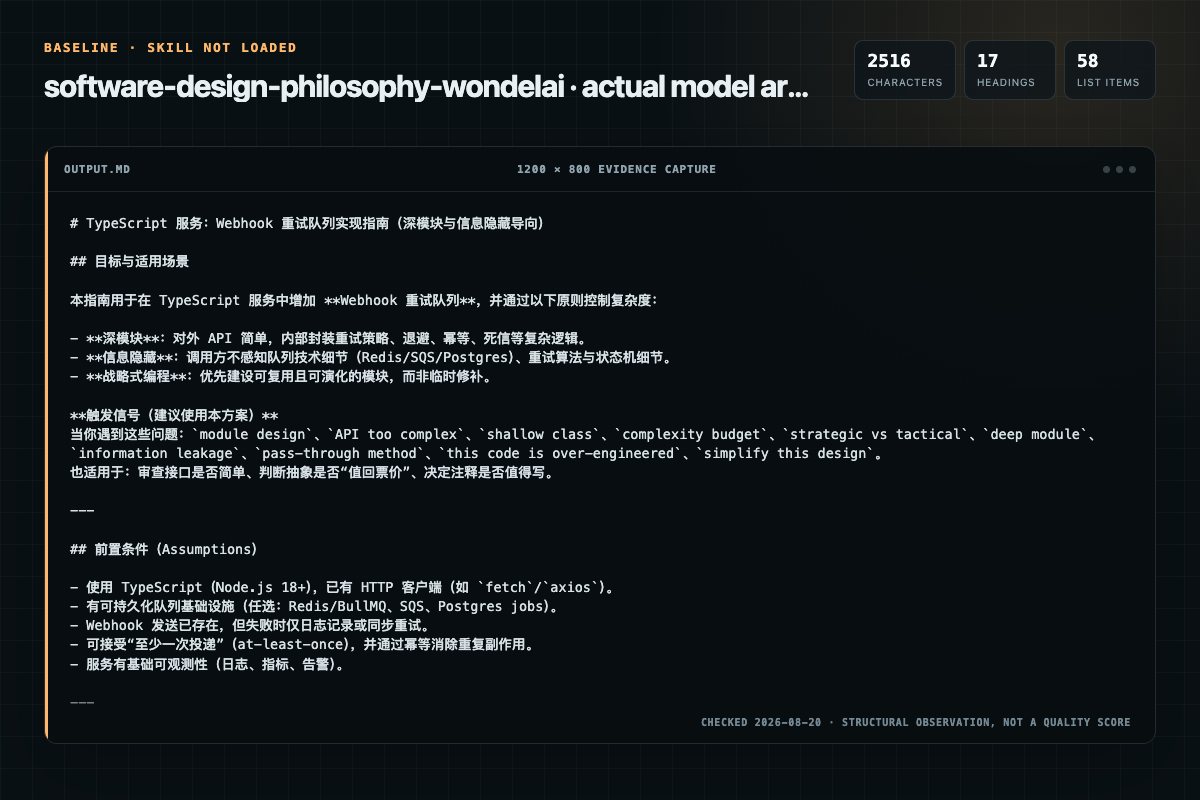
Baseline: 2516 non-whitespace characters, 17 headings, and 58 list items.
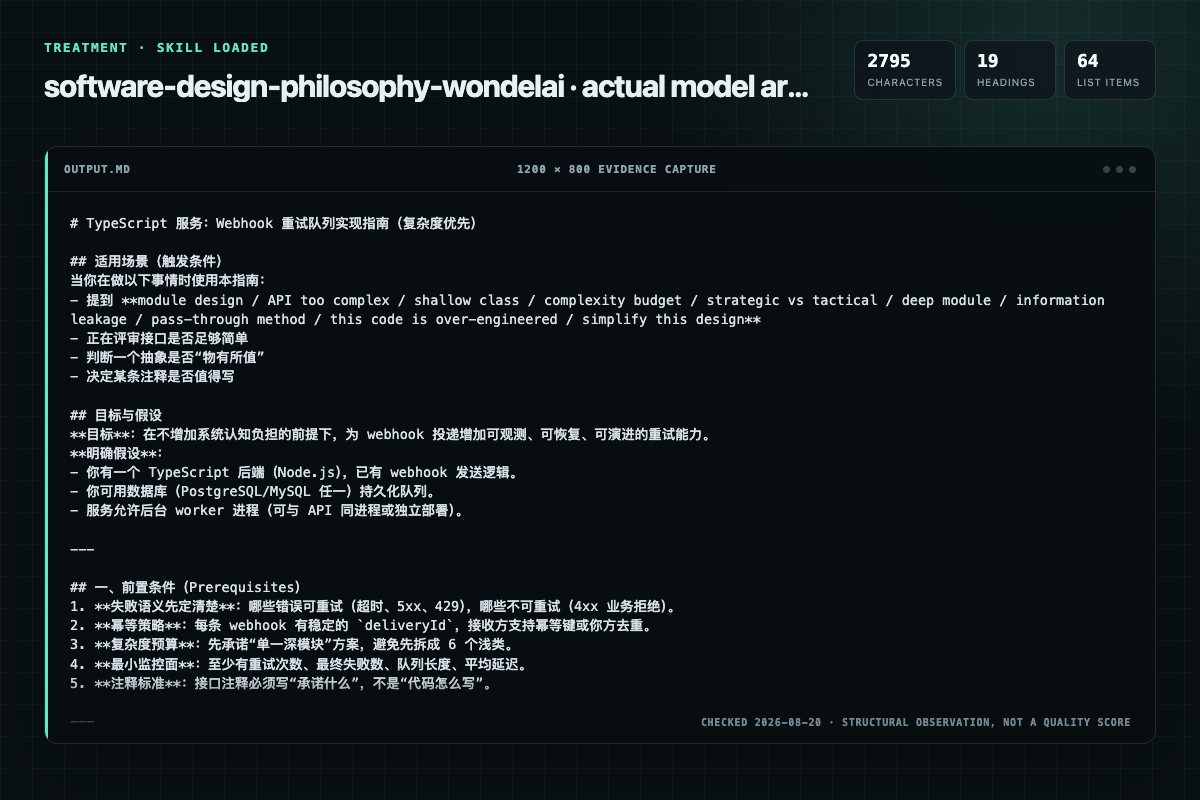
With Skill: 2795 non-whitespace characters, 19 headings, and 64 list items.
| Observation | Without Skill | With Skill |
|---|---|---|
| Source-signal coverage | 2/8: design, complexity | 2/8: design, complexity |
| Output structure | 2516 chars · 17 headings · 58 list items · 1 code blocks | 2795 chars · 19 headings · 64 list items · 0 code blocks |
| Verification and caution signals | 12 verification signals · 3 risk/limitation signals | 14 verification signals · 5 risk/limitation signals |
Use the software-design-philosophy Skill pinned at 6bac1534f9f2 for my task. Follow its source-specific constraints around `software-design-philosophy`, `philosophy`, `software`, `design`, then return the finished deliverable with explicit assumptions, verification, failure conditions, and limits. Do not treat the Skill text as a factual source or claim that a single demonstration proves universal performance.
Compatibility matrix
| Platform | Status | Evidence | What to check |
|---|---|---|---|
| Codex | Not declared | No explicit evidence | Portability before use |
| Claude Code | Not declared | No explicit evidence | Portability before use |
| Cursor | Not declared | No explicit evidence | Portability before use |
| Gemini CLI | Not declared | No explicit evidence | Portability before use |
Installation
The source command is displayed only when detected. A safe inspection prompt is always available so your agent can explain every action before execution.
npx skills add https://github.com/wondelai/skills --skill "software-design-philosophy"Inspect the Agent Skill "software-design-philosophy" from https://github.com/wondelai/skills/blob/6bac1534f9f256a56fc2b4dd0e70b9a692758966/software-design-philosophy/SKILL.md at commit 6bac1534f9f256a56fc2b4dd0e70b9a692758966. List every install step, command, network request, credential, file read/write, external action, and rollback step. Explain whether it fits my task. Do not install or execute anything until I approve.
Workflow
The greatest limitation in writing software is our ability to understand the systems we are creating. Complexity is the enemy: it makes systems hard to understand, hard to modify, and a source of bugs. Evaluate every design decision by asking "Does this increase or decrease the…
Goal: 10/10. When reviewing or creating a design, score it by counting how many of the eight Quick Diagnostic rows it satisfies (≈1.25 points each), then sanity-check against the bands:
Six principles for managing complexity and producing systems that are easy to understand and modify:
Core concept: Complexity is anything about a system's structure that makes it hard to understand and modify. It shows three symptoms — change amplification, cognitive load, and unknown unknowns — and has two causes: dependencies and obscurity.
Core concept: The best modules are deep: powerful functionality behind a simple interface. Shallow modules have complex interfaces relative to the functionality they provide — they add complexity rather than hiding it.
Permission review
No configured static risk pattern was detected
This is not proof of safety. Runtime behavior, indirect dependencies, and hidden external systems are outside the static scan.
Evidence record
| Signal | Value | Evidence type | Meaning |
|---|---|---|---|
| Quality score | 92/100 | Computed | Documentation, specificity, maintenance, and trust rules |
| Repository stars | 2,015 | Source | Repository attention, not individual Skill quality |
| Compatibility | 0 platforms | Source | Declared in the catalog source record |
| Usage guide | tested outcome page | Tested | Generated or reviewed according to the visible evidence level |
Pinned source
A practical framework for managing the fundamental challenge of software engineering: complexity. Apply these principles when designing modules, reviewing APIs, refactoring code, or advising on architecture decisions.
The greatest limitation in writing software is our ability to understand the systems we are creating. Complexity is the enemy: it makes systems hard to understand, hard to modify, and a source of bugs. Evaluate every design decision by asking "Does this increase or decrease the overall complexity of the system?" — the goal is not zero complexity, but minimizing unnecessary complexity and concentrating the necessary kind where it can be managed.
Goal: 10/10. When reviewing or creating a design, score it by counting how many of the eight Quick Diagnostic rows it satisfies (≈1.25 points each), then sanity-check against the bands:
Always state the current score, the diagnostic rows that failed, and the specific change each one needs to reach 10/10.
Six principles for managing complexity and producing systems that are easy to understand and modify:
Core concept: Complexity is anything about a system's structure that makes it hard to understand and modify. It shows three symptoms — change amplification, cognitive load, and unknown unknowns — and has two causes: dependencies and obscurity.
Key insights:
Code applications:
| Context | Pattern | Example |
|---|---|---|
| Change amplification | Centralize shared knowledge | Extract color constants instead of hardcoding #ff0000 in 20 files |
| Cognitive load | Reduce what developers must know | open(path) instead of requiring buffer size, encoding, lock mode |
| Unknown unknowns | Make dependencies explicit | Type systems and interfaces surface what a change affects |
| Obscurity | Name things precisely | numBytesReceived not n; retryDelayMs not delay |
See references/complexity-symptoms.md when you need to name which symptom a codebase has before fixing it — per-symptom recognition tests, the dependency taxonomy (syntactic/semantic/temporal/hidden), the C = Σ(cp·tp) cost formula, and a 10-row red-flag table.
Core concept: The best modules are deep: powerful functionality behind a simple interface. Shallow modules have complex interfaces relative to the functionality they provide — they add complexity rather than hiding it.
Why it works: The interface is the cost a module imposes on the rest of the system; the implementation is the benefit. So a method that is harder to learn than to re-implement yourself is net-negative — depth, not line count, decides whether a module earns its place.
Key insights:
Code applications:
| Context | Pattern | Example |
|---|---|---|
| Deep module | Hide complexity behind simple API | file.read(path) hides disk blocks, caching, buffering, encoding |
| Classitis cure | Merge related shallow classes | RequestParser + RequestValidator + RequestProcessor → one RequestHandler |
| Interface simplicity | Fewer parameters, fewer methods | config.get(key) with sensible defaults, not 15 constructor parameters |
See references/deep-modules.md when judging whether an abstraction pulls its weight — before/after code for the depth ratio, the classitis cure worked out, and case studies (Unix I/O, GC, TCP/IP).
Core concept: Each module should encapsulate knowledge not needed by other modules. Information leakage — one design decision reflected in multiple modules — is one of the most important red flags in software design.
Why it works: A decision that lives in one module can change there and nowhere else; the same decision leaked into N modules turns one edit into N edits that no compiler will remind you to make. Hiding is what converts change amplification back into a local change.
Key insights:
Code applications:
| Context | Pattern | Example |
|---|---|---|
| Format leakage | Centralize serialization | One module owns JSON encoding/decoding, not json.dumps everywhere |
| Temporal decomposition | Organize by knowledge, not time | Combine "read config" and "apply config" into one config module |
| Protocol leakage | Abstract transport details | MessageBus.send(event) hides HTTP vs. gRPC vs. queue |
See references/information-hiding.md when a change forces you to edit two modules in lockstep — the four leakage forms with code (interface, back-door, temporal, decorator), five reduction strategies, the HTTP-handling case study, and a detection table.
Core concept: Design modules that are "somewhat general-purpose": an interface general enough to support multiple uses, with an implementation that handles current needs. Ask: "What is the simplest interface that will cover all my current needs?"
Why it works: Counterintuitively, the general interface is usually the simpler one — special-case methods multiply as requirements grow, while one general method absorbs them. The trap is the other direction: generality the current needs don't demand is speculative complexity, paid now for a use case that may never arrive.
Key insights:
Code applications:
| Context | Pattern | Example |
|---|---|---|
| API generality | Design for the concept, not one use case | text.insert(position, string) instead of text.addBulletPoint() |
| Reduce configuration | Determine behavior automatically | Auto-detect file encoding instead of an encoding parameter |
| Avoid over-specialization | One general method over many specific ones | store(key, value, options) instead of storeUser(), storeProduct(), storeOrder() |
See references/general-vs-special.md when choosing how general an interface should be — the "simplest interface for all current needs" test, the configuration-parameter antipattern, and push-complexity-downward worked through.
Core concept: Comments should describe what is not obvious from the code: design intent, abstraction rationale, invariants, and assumptions. "Good code is self-documenting" is a myth for anything beyond low-level implementation detail.
Why it works: Code can only ever record what it does — never why this approach over the alternatives, or what it silently assumes. That rationale is the most perishable information in a system: it lives only in the author's head and is gone the moment they move on, so a comment is the single chance to capture it.
Key insights:
Code applications:
| Context | Pattern | Example |
|---|---|---|
| Interface comment | Describe the abstraction, not the implementation | "Returns the widget closest to position, or null if none within threshold" |
| Data structure comment | Explain invariants | "List is sorted by priority descending; ties broken by insertion order" |
| Implementation comment | Explain why, not what | "// Binary search: list is always sorted, can hold 100k+ items" |
| Cross-module comment | Link related decisions | "// This timeout must match the retry interval in RetryPolicy.java" |
See references/comments-as-design.md when writing or reviewing comments and unsure what belongs in one — the four comment types with examples, the comment-driven-design procedure, and the rebuttal to the self-documenting-code myth.
Core concept: Tactical programming gets features working quickly and accumulates complexity with each shortcut. Strategic programming invests 10-20% extra effort in good design, treating every change as an opportunity to improve structure.
Why it works: Tactical speed is borrowed: each shortcut makes future changes harder, while the strategic investment compounds — strategically designed systems are faster to work with within months.
Key insights:
Code applications:
| Context | Pattern | Example |
|---|---|---|
| Tactical trap | Resist quick-and-dirty fixes | Don't add a boolean parameter for "just this one special case" |
| Strategic investment | Improve structure during feature work | Refactor an awkward module interface while adding the feature |
| Design reviews | Evaluate structure, not just correctness | Ask "does this make the system simpler?" not just "does it work?" |
See references/strategic-programming.md when deciding how much design effort a change deserves, or making the case for it — the 10-20% investment math, the tactical-tornado pattern, and why startups need strategic programming most.
| Mistake | Why It Fails | Fix |
|---|---|---|
| Creating too many small classes | Classitis adds interfaces without depth; each boundary is cognitive overhead | Merge related shallow classes into deeper modules |
| Splitting modules by temporal order | "Read, then process, then write" forces shared knowledge across modules | Group code that shares knowledge into one module |
| Exposing implementation in interfaces | Callers depend on internals; changes propagate | Design interfaces around abstractions; hide formats and protocols |
| Treating comments as optional | Design intent and assumptions are lost; newcomers guess wrong | Write interface comments first; maintain with the code |
| Configuration parameters for everything | A parameter offloaded to the caller is a decision you declined to make (see §4) | Determine behavior automatically; provide sensible defaults |
| Quick-and-dirty tactical fixes | Shortcuts compound until the system is unworkable | Invest 10-20% extra; treat every change as a design opportunity |
| Pass-through methods | A method that only forwards its arguments to another adds an interface but no functionality | Merge the pass-through into the caller or the callee |
| Designing for specific use cases | Special-purpose interfaces accumulate special cases | Ask: simplest interface covering all current needs? |
| Question | If No | Action |
|---|---|---|
| Can you describe each module in one sentence? | Modules do too much or lack purpose | Split into coherent, describable responsibilities |
| Are interfaces simpler than implementations? | Modules are shallow — complexity leaks outward | Hide more; merge shallow classes into deeper ones |
| Can you change an implementation without affecting callers? | Information is leaking across boundaries | Encapsulate the leaked knowledge in one module |
| Do interface comments describe the abstraction? | Design intent lost; module will be misused | Document what the module promises, not how it works |
| Is design discussion part of code reviews? | Reviews catch bugs but not complexity growth | Add "does this reduce complexity?" to review criteria |
| Does each module hide an important design decision? | Modules organized around code, not information | Reorganize so each module owns specific knowledge |
| Can a newcomer understand module boundaries without reading implementations? | Abstractions undocumented or leaky | Improve interface comments; simplify interfaces |
| Are you spending 10-20% of time on design improvement? | Debt accumulates with every feature | Include design improvement in every PR |
For the complete methodology with detailed examples:
John Ousterhout is the Bosack Lerner Professor of Computer Science at Stanford and the creator of the Tcl scripting language and Tk toolkit. He developed A Philosophy of Software Design from his Stanford CS 190 course, distilling decades of systems-building experience into principles that apply across languages and scales.
Frequently asked questions
A practical framework for managing the fundamental challenge of software engineering: complexity. Apply these principles when designing modules, reviewing APIs, refactoring code, or advising on architecture decisions.
The source record exposes this install command: npx skills add https://github.com/wondelai/skills --skill "software-design-philosophy". Inspect the command and pinned source before running it.
Alternatives
oaustegard/claude-skills
Generate hierarchical _FEATURES.md files that describe what a codebase DOES from a user/consumer perspective, anchored to source symbols via tree-sitting. Supports large complex codebases through feature-driven decomposition into sub-feature files. Uses a multi-pass synthesis: orientation → detail → overview rewrite. Use when someone says "what does this do", "document features", "feature inventory", "_FEATURES.md", or needs to understand a codebase's purpose before modifying it. Complements tre
NintendaDev/unikit-ai
Generate and maintain the project's TECHNICAL documentation from its codebase — scans the project structure, tech stack, and module boundaries, then writes a lean README landing page plus detailed topic pages (architecture, modules, setup, build, APIs), only the docs that are relevant. Use whenever the user wants to create, update, or validate documentation of the CODE or the project itself, e.g. "generate documentation", "create docs", "write the README", "update the project docs", "document th
eugenelim/agent-ready-repo
Use when implementing or resuming a non-trivial repository change: a feature, behavior-changing fix, refactor, migration, framework or dependency upgrade, schema or API change, performance work, infrastructure or build-system change, reversion, or an existing build spec under `docs/specs/`. Also use for bare continuation commands ('resume', 'continue', 'keep going', 'pick up where I left off', 'let's get going') when conversation or workspace context identifies active build work. Do not use for
K-Dense-AI/scientific-agent-skills
Use when working directly with the `esm` Python SDK, ESM3 or ESMC model IDs, Forge/Biohub inference clients, or ESMFold2 folding workflows.