
Tested demoQuality 99/100
artokun/comfyui-mcp/plugin/skills/wan-flf-video/SKILL.md
wan-flf-video
Build WAN 2.2 First-Last-Frame video workflows — native dual hi-lo (required), and WanVideoWrapper VACE approaches
- Source repository stars
- 671
- Declared platforms
- 0
- Static risk flags
- 0
- Last source update
- 2026-08-25
- Source checked
- 2026-08-25
Decision brief
What it does: where it fits
Build WAN 2. 2 First-Last-Frame video workflows — native dual hi-lo (required), and WanVideoWrapper VACE approaches
Not for
- Tasks that require unconfirmed production actions or broad system permissions.
- Environments where the pinned source and install steps cannot be inspected.
Controlled single-run demoChecked 2026-08-20
What changed when the Skill was used
In this controlled same-task single run, enabling wan-flf-video changed the output from 2618 non-whitespace characters and 16 headings to 2973 characters and 19 headings. Matches among 8 signals extracted from the pinned source changed from 4 to 2. Both actual outputs are shown; this is a structural observation, not a quality score or a universal performance claim.
Same test task
Create a practical, self-contained deliverable for a small SaaS team. Include assumptions, the finished work, and a verification section. The deliverable must specifically reflect this user intent: Build WAN 2.2 First-Last-Frame video workflows — native dual hi-lo (required), and WanVideoWrapper VACE approaches
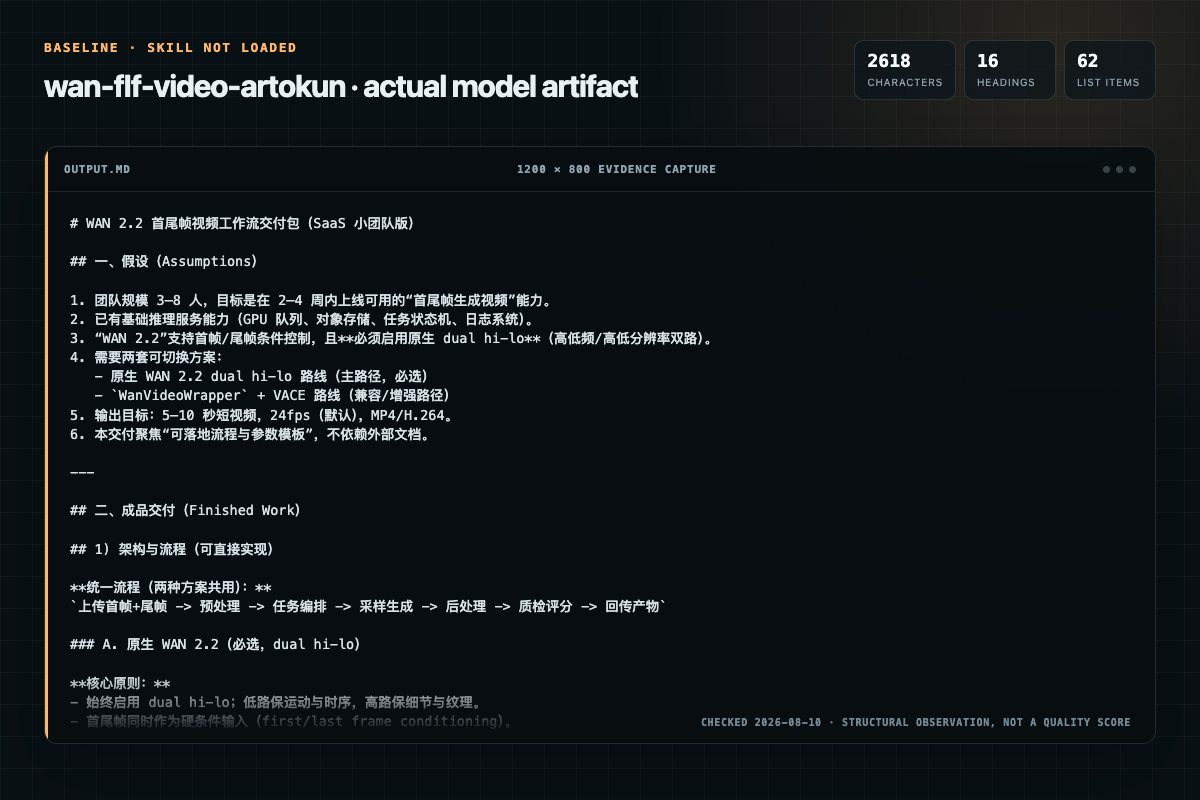
Baseline: 2618 non-whitespace characters, 16 headings, and 62 list items.
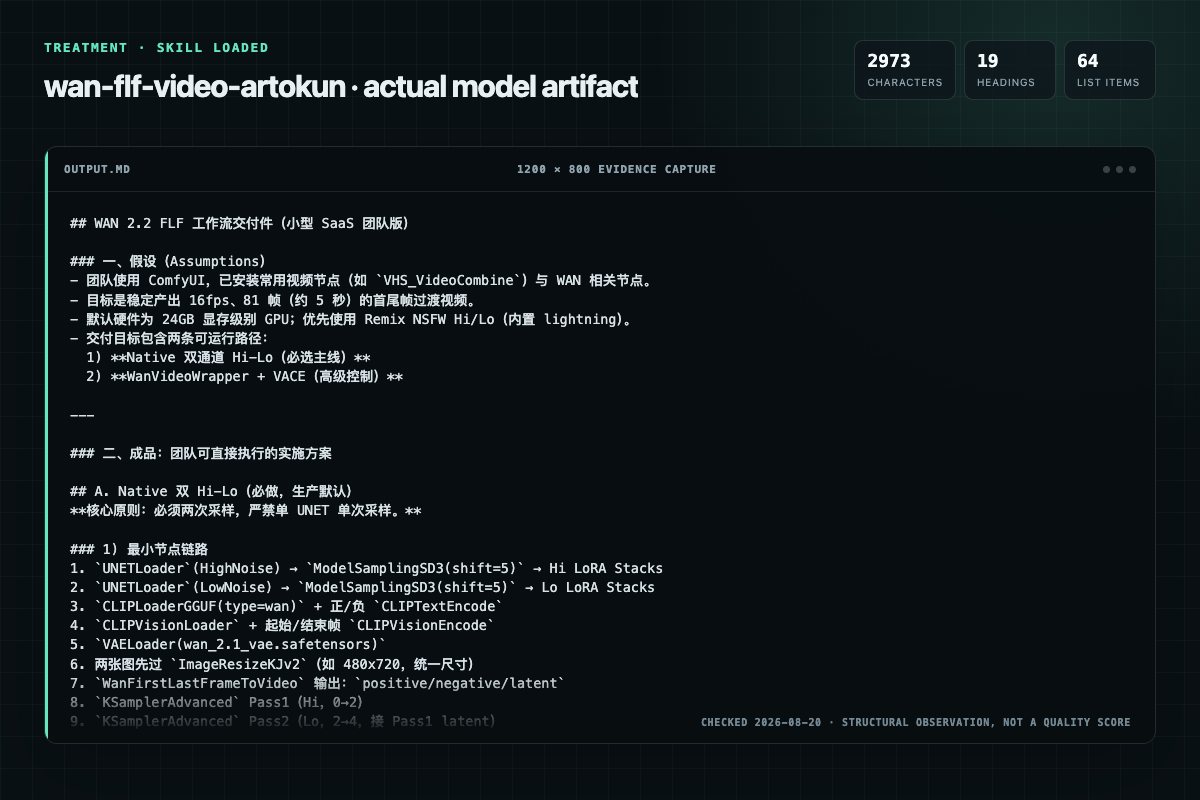
With Skill: 2973 non-whitespace characters, 19 headings, and 64 list items.
| Observation | Without Skill | With Skill |
|---|---|---|
| Source-signal coverage | 4/8: first-last-frame, video, hi-lo, required | 2/8: video, hi-lo |
| Output structure | 2618 chars · 16 headings · 62 list items · 1 code blocks | 2973 chars · 19 headings · 64 list items · 0 code blocks |
| Verification and caution signals | 7 verification signals · 3 risk/limitation signals | 8 verification signals · 3 risk/limitation signals |
A prompt you can use
Use the wan-flf-video Skill pinned at a1349440fe6a for my task. Follow its source-specific constraints around `wan-flf-video`, `first-last-frame`, `video`, `workflows`, then return the finished deliverable with explicit assumptions, verification, failure conditions, and limits. Do not treat the Skill text as a factual source or claim that a single demonstration proves universal performance.
Method and limitationsExpandCollapse
Test method
- Baseline and treatment used the same task, model (gpt-5.3-codex-low), and runner; the only planned difference was whether the complete target Skill text was injected.
- The treatment used snapshot a1349440fe6aec58938d45eae4bd812266c98a88; the current source commit a1349440fe6aec58938d45eae4bd812266c98a88 was verified against content hash e61d0db34c6b. The baseline explicitly prohibited loading any Skill or external rule file.
- The same deterministic script counted characters, headings, lists, code blocks, verification terms, caution terms, and source signals in both artifacts. Source signals: `wan-flf-video`, `first-last-frame`, `video`, `workflows`, `critical`, `hi-lo`, `architecture`, `required`.
- The visuals are local screenshots of the actual Markdown artifacts in a fixed 1200 × 800 evidence canvas, not recreated product mockups. Raw JSON artifacts and request records are retained in the research directory.
Do not over-read this demo
- This is one controlled demonstration per condition, not a multi-run statistical benchmark; the model is stochastic.
- Character, structure, and keyword counts show observable differences but cannot by themselves prove correctness, originality, or business impact.
- The task is a representative test designed for repeatability, not every real-world use of the Skill; rerun after a material source change.
- Editorial review
- SkillSignal editorial
- Runner
- Cursor Agent 2026.08.11-e8db854
- Model
- gpt-5.3-codex-low
- Refresh due
- 2026-11-18
- Reviewed commit
- a1349440fe6aec58938d45eae4bd812266c98a88
- Test snapshot
- a1349440fe6aec58938d45eae4bd812266c98a88
Compatibility matrix
Platform support, with evidence labels
| Platform | Status | Evidence | What to check |
|---|---|---|---|
| Codex | Not declared | No explicit evidence | Portability before use |
| Claude Code | Not declared | No explicit evidence | Portability before use |
| Cursor | Not declared | No explicit evidence | Portability before use |
| Gemini CLI | Not declared | No explicit evidence | Portability before use |
Installation
Inspect first. Install second.
The source command is displayed only when detected. A safe inspection prompt is always available so your agent can explain every action before execution.
Source-detected install commandSource
npx skills add https://github.com/artokun/comfyui-mcp --skill "plugin/skills/wan-flf-video"Safe inspection promptEditorial
Inspect the Agent Skill "wan-flf-video" from https://github.com/artokun/comfyui-mcp/blob/afc0713cb058ac6bd5bed33f62d4377982abd1c7/plugin/skills/wan-flf-video/SKILL.md at commit afc0713cb058ac6bd5bed33f62d4377982abd1c7. List every install step, command, network request, credential, file read/write, external action, and rollback step. Explain whether it fits my task. Do not install or execute anything until I approve.
Workflow
What the source asks the agent to do
- 01
Complete workflow (API JSON)
The full Native FLF (Remix NSFW + Lightning) graph is in references/workflows.md.
The full Native FLF (Remix NSFW + Lightning) graph is in references/workflows.md. - 02
Multi-Step Pipeline Pattern
When the start and end frames have different subject sizes (e.g., small cat → tall person), generate the "anchor" frame first — the one with the most complex composition — then use Qwen Edit to create the other frame from it. This ensures: - Consistent background/scene between f…
Consistent background/scene between framesCorrect relative proportions (the edit inherits the scene scale)Better FLF results since both frames share the same visual context - 03
CRITICAL: Dual Hi-Lo Architecture (REQUIRED)
WAN 2.2 I2V uses a split-noise architecture. Unlike WAN 2.1, the 2.2 model was trained with separate HighNoise and LowNoise components that handle different denoising ranges. You MUST use both models in a two-pass KSamplerAdvanced setup. Using a single model produces low-quality…
HighNoise model (pass 1, steps 0→N/2): Establishes structure, motion, and compositionLowNoise model (pass 2, steps N/2→N): Refines details and ensures fidelity to input framesBoth passes share the same conditioning from WanFirstLastFrameToVideo - 04
Models
Remix NSFW (Recommended — built-in lightning, fp16): | Model | Loader | Notes | |-------|--------|-------| | Wan2.2RemixNSFWi2v14bhighlightingfp16v2.1.safetensors | UNETLoader | HighNoise, built-in lightning acceleration | | Wan2.2RemixNSFWi2v14blowlightingfp16v2.1.safetensors |…
Remix NSFW (Recommended — built-in lightning, fp16): | Model | Loader | Notes | |-------|--------|-------| | Wan2.2RemixNSFWi2v14bhighlightingfp16v2.1.safetensors | UNETLoader | HighNoise, built-in lightning acceleratio…GGUF Q8 (Alternative — needs external lightning LoRAs): | Model | Loader | Notes | |-------|--------|-------| | Wan2.2-I2V-A14B-HighNoise-Q80.gguf | UnetLoaderGGUF | HighNoise, quantized | | Wan2.2-I2V-A14B-LowNoise-Q80…Official fp8: | Model | Loader | Notes | |-------|--------|-------| | wan2.2i2vhighnoise14Bfp8scaled.safetensors | UNETLoader | HighNoise, needs lightning LoRA | | wan2.2i2vlownoise14Bfp8scaled.safetensors | UNETLoader… - 05
UNET Pairs (Always load BOTH Hi and Lo)
Remix NSFW (Recommended — built-in lightning, fp16): | Model | Loader | Notes | |-------|--------|-------| | Wan2.2RemixNSFWi2v14bhighlightingfp16v2.1.safetensors | UNETLoader | HighNoise, built-in lightning acceleration | | Wan2.2RemixNSFWi2v14blowlightingfp16v2.1.safetensors |…
Remix NSFW (Recommended — built-in lightning, fp16): | Model | Loader | Notes | |-------|--------|-------| | Wan2.2RemixNSFWi2v14bhighlightingfp16v2.1.safetensors | UNETLoader | HighNoise, built-in lightning acceleratio…GGUF Q8 (Alternative — needs external lightning LoRAs): | Model | Loader | Notes | |-------|--------|-------| | Wan2.2-I2V-A14B-HighNoise-Q80.gguf | UnetLoaderGGUF | HighNoise, quantized | | Wan2.2-I2V-A14B-LowNoise-Q80…Official fp8: | Model | Loader | Notes | |-------|--------|-------| | wan2.2i2vhighnoise14Bfp8scaled.safetensors | UNETLoader | HighNoise, needs lightning LoRA | | wan2.2i2vlownoise14Bfp8scaled.safetensors | UNETLoader…
Permission review
Static risk signals and limitations
No configured static risk pattern was detected
This is not proof of safety. Runtime behavior, indirect dependencies, and hidden external systems are outside the static scan.
Evidence record
Why each signal appears
EvidenceSourceComputedTestedEditorial
| Signal | Value | Evidence type | Meaning |
|---|---|---|---|
| Quality score | 99/100 | Computed | Documentation, specificity, maintenance, and trust rules |
| Repository stars | 671 | Source | Repository attention, not individual Skill quality |
| Compatibility | 0 platforms | Source | Declared in the catalog source record |
| Usage guide | tested outcome page | Tested | Generated or reviewed according to the visible evidence level |
Pinned source
Provenance and original SKILL.md
- Repository
- artokun/comfyui-mcp
- Skill path
- plugin/skills/wan-flf-video/SKILL.md
- Commit
- afc0713cb058ac6bd5bed33f62d4377982abd1c7
- License
- MIT
- Collected
- 2026-08-25
- Default branch
- main
View the original SKILL.md
WAN 2.2 First-Last-Frame (FLF) Video Workflows
Overview
First-Last-Frame (FLF) video generation takes a start image and an end image and generates a smooth video transition between them. WAN 2.2 I2V (Image-to-Video) 14B model excels at this.
CRITICAL: Dual Hi-Lo Architecture (REQUIRED)
WAN 2.2 I2V uses a split-noise architecture. Unlike WAN 2.1, the 2.2 model was trained with separate HighNoise and LowNoise components that handle different denoising ranges. You MUST use both models in a two-pass KSamplerAdvanced setup. Using a single model produces low-quality, broken output.
- HighNoise model (pass 1, steps 0→N/2): Establishes structure, motion, and composition
- LowNoise model (pass 2, steps N/2→N): Refines details and ensures fidelity to input frames
- Both passes share the same conditioning from
WanFirstLastFrameToVideo - Pass 1 returns noisy latent → Pass 2 continues from there
NEVER use a single KSampler with only one model for WAN 2.2 I2V.
Two native approaches are available:
- Native Dual Hi-Lo (Default) —
WanFirstLastFrameToVideo+ dualKSamplerAdvancedtwo-pass - WanVideoWrapper —
WanVideoVACEStartToEndFrame+WanVideoVACEEncode+WanVideoSampler(VACE, caching, context windows)
Models
UNET Pairs (Always load BOTH Hi and Lo)
Remix NSFW (Recommended — built-in lightning, fp16):
| Model | Loader | Notes |
|---|---|---|
Wan2.2_Remix_NSFW_i2v_14b_high_lighting_fp16_v2.1.safetensors | UNETLoader | HighNoise, built-in lightning acceleration |
Wan2.2_Remix_NSFW_i2v_14b_low_lighting_fp16_v2.1.safetensors | UNETLoader | LowNoise, built-in lightning acceleration |
GGUF Q8 (Alternative — needs external lightning LoRAs):
| Model | Loader | Notes |
|---|---|---|
Wan2.2-I2V-A14B-HighNoise-Q8_0.gguf | UnetLoaderGGUF | HighNoise, quantized |
Wan2.2-I2V-A14B-LowNoise-Q8_0.gguf | UnetLoaderGGUF | LowNoise, quantized |
Official fp8:
| Model | Loader | Notes |
|---|---|---|
wan2.2_i2v_high_noise_14B_fp8_scaled.safetensors | UNETLoader | HighNoise, needs lightning LoRA |
wan2.2_i2v_low_noise_14B_fp8_scaled.safetensors | UNETLoader | LowNoise, needs lightning LoRA |
Text Encoder
| Model | Node | Notes |
|---|---|---|
nsfw_wan_umt5-xxl_bf16_fixed.safetensors | CLIPLoaderGGUF (type=wan) | NSFW-tuned, pair with Remix models |
umt5_xxl_fp8_e4m3fn_scaled.safetensors | CLIPLoader (type=wan) | Standard UMT5-XXL fp8 |
CLIP Vision + VAE
| Component | Node | Model |
|---|---|---|
| CLIP Vision | CLIPVisionLoader | clip_vision_h.safetensors |
| VAE | VAELoader | wan_2.1_vae.safetensors |
ModelSamplingSD3 (REQUIRED)
WAN 2.2 uses flow matching and requires ModelSamplingSD3 applied to each UNET:
{"class_type": "ModelSamplingSD3", "inputs": {"model": ["<unet>", 0], "shift": 5}}
shift=5 for lightning/Remix models. shift=8 for standard (non-lightning) models.
Lightning LoRAs
Remix NSFW models have lightning baked in — no external LoRA needed.
For GGUF/fp8 models, use paired hi/lo lightning LoRAs:
wan2.2_i2v_lightx2v_4steps_lora_v1_high_noise.safetensors→ HighNoise UNETwan2.2_i2v_lightx2v_4steps_lora_v1_low_noise.safetensors→ LowNoise UNET
LoRA Stacks (rgthree)
Each model path has two stacked loaders (Common + Specific), each supporting 4 LoRA slots:
Hi path: UNETLoader(HN) → ModelSamplingSD3(shift=5) → Hi Common Stack → Hi Lora Stack → MODEL_HI
Lo path: UNETLoader(LN) → ModelSamplingSD3(shift=5) → Lo Common Stack → Lo Lora Stack → MODEL_LO
Common stacks hold shared LoRAs (quality/style). Specific stacks hold model-variant LoRAs. Set slots to "None" when unused. Even with no LoRAs, include the stacks — they pass CLIP through for text encoding.
Image Resizing (ImageResizeKJv2)
Input frames MUST be resized to the target video resolution before FLF and CLIPVisionEncode. The end frame inherits width/height from the start frame's resize to ensure matching dimensions.
{"class_type": "ImageResizeKJv2", "inputs": {
  "image": ["<load_image>", 0], "width": 480, "height": 720,
  "upscale_method": "nearest-exact", "keep_proportion": "crop",
  "pad_color": "0, 0, 0", "crop_position": "center", "divisible_by": 2
}}
KSamplerAdvanced Two-Pass Settings
| Parameter | Pass 1 (Hi) | Pass 2 (Lo) |
|---|---|---|
| model | Hi LoRA stack output | Lo LoRA stack output |
| add_noise | enable | disable |
| steps | 4 | 4 |
| cfg | 1 | 1 |
| sampler_name | uni_pc | uni_pc |
| scheduler | beta | beta |
| start_at_step | 0 | 2 |
| end_at_step | 2 | 4 |
| return_with_leftover_noise | enable | disable |
| latent_image | WanFLF output[2] | Pass 1 output[0] |
Both passes share the same positive/negative conditioning from WanFirstLastFrameToVideo outputs [0] and [1].
For standard (non-lightning) models: steps=20, split at step 10, cfg=4, sampler=euler, scheduler=simple, shift=8.
Negative Prompt (REQUIRED)
Always include a quality negative prompt:
The tones are vibrant, overexposed, static, details are unclear, subtitles, style, work, painting, image, still, overall grayish, worst quality, low quality, JPEG compression artifacts, ugly, incomplete, extra fingers, poorly drawn hands, poorly drawn faces, deformed, disfigured, distorted limbs, merged fingers, motionless image, cluttered background, three legs, many people in the background, walking backwards
Node: WanFirstLastFrameToVideo
Required Inputs:
  - positive: CONDITIONING (from CLIPTextEncode)
  - negative: CONDITIONING (from CLIPTextEncode with negative prompt)
  - vae: VAE
  - width: INT (from ImageResizeKJv2 end frame output[1])
  - height: INT (from ImageResizeKJv2 end frame output[2])
  - length: INT (default 81, step 4) — number of frames
  - batch_size: INT (default 1)

Optional Inputs:
  - clip_vision_start_image: CLIP_VISION_OUTPUT (from CLIPVisionEncode)
  - clip_vision_end_image: CLIP_VISION_OUTPUT (from CLIPVisionEncode)
  - start_image: IMAGE (resized start frame)
  - end_image: IMAGE (resized end frame)

Outputs:
  - [0] positive: CONDITIONING → feed to BOTH Hi and Lo KSamplerAdvanced
  - [1] negative: CONDITIONING → feed to BOTH Hi and Lo KSamplerAdvanced
  - [2] latent: LATENT → feed to Hi Pass only (Lo Pass gets Hi Pass output)
Pipeline Flow
UNETLoader (HighNoise) → ModelSamplingSD3 (shift=5) → Hi Common Stack → Hi Lora Stack → MODEL_HI
UNETLoader (LowNoise) → ModelSamplingSD3 (shift=5) → Lo Common Stack → Lo Lora Stack → MODEL_LO
CLIPLoaderGGUF (wan) → CLIP
  ├─ CLIPTextEncode (positive) → CONDITIONING
  └─ CLIPTextEncode (negative) → CONDITIONING
CLIPVisionLoader → CLIPVisionEncode (start) + CLIPVisionEncode (end)
VAELoader → VAE
LoadImage (start) → ImageResizeKJv2 (480x720) → resized start
LoadImage (end) → ImageResizeKJv2 (match dims) → resized end

WanFirstLastFrameToVideo (positive, negative, vae, clip_vision_start, clip_vision_end,
  start_image, end_image, width/height from resize)
  → modified positive [0], modified negative [1], latent [2]

KSamplerAdvanced (Hi: MODEL_HI, steps 0→2, add_noise=enable, return_leftover=enable)
  → noisy LATENT
KSamplerAdvanced (Lo: MODEL_LO, steps 2→4, add_noise=disable, return_leftover=disable)
  → final LATENT

VAEDecode → IMAGE → VHS_VideoCombine (raw output)
                   → VRAM_Debug → SeedVR2VideoUpscaler (1080p) → VHS_VideoCombine (upscaled)
Complete workflow (API JSON)
The full Native FLF (Remix NSFW + Lightning) graph is in references/workflows.md.
Optional: Video Upscaling with SeedVR2
Add after VAEDecode for AI-powered video upscaling to 1080p. Use VRAM_Debug to free VRAM between generation and upscaling:
{
  "25": { "class_type": "VRAM_Debug", "inputs": {
    "image_pass": ["23", 0], "empty_cache": true, "gc_collect": true, "unload_all_models": true
  }},
  "26": { "class_type": "SeedVR2LoadDiTModel", "inputs": {
    "model": "seedvr2_ema_3b_fp8_e4m3fn.safetensors", "device": "cuda:0",
    "blocks_to_swap": 0, "swap_io_components": false, "cache_model": false, "attention_mode": "sdpa"
  }},
  "27": { "class_type": "SeedVR2LoadVAEModel", "inputs": {
    "model": "ema_vae_fp16.safetensors", "device": "cuda:0",
    "encode_tiled": false, "decode_tiled": false, "cache_model": false
  }},
  "28": { "class_type": "SeedVR2VideoUpscaler", "inputs": {
    "image": ["25", 1], "dit": ["26", 0], "vae": ["27", 0],
    "seed": 0, "resolution": 1080, "max_resolution": 0,
    "batch_size": 5, "uniform_batch_size": false, "color_correction": "lab"
  }},
  "29": { "class_type": "VHS_VideoCombine", "inputs": {
    "images": ["28", 0], "frame_rate": 16, "loop_count": 0,
    "filename_prefix": "wan_flf_upscaled", "format": "video/h264-mp4",
    "pingpong": false, "save_output": true,
    "pix_fmt": "yuv420p", "crf": 19, "save_metadata": true, "trim_to_audio": false
  }}
}
Alternative: GGUF Models with Lightning LoRAs
When using GGUF Q8 models instead of Remix, add paired lightning LoRAs:
Hi path: UnetLoaderGGUF(HN Q8) → ModelSamplingSD3(shift=5) → LoraLoaderModelOnly(hi_noise_lightning) → Hi Common Stack → Hi Lora Stack
Lo path: UnetLoaderGGUF(LN Q8) → ModelSamplingSD3(shift=5) → LoraLoaderModelOnly(lo_noise_lightning) → Lo Common Stack → Lo Lora Stack
LoRA files:
Unknown\no tags\wan2.2_i2v_lightx2v_4steps_lora_v1_high_noise.safetensorsUnknown\no tags\wan2.2_i2v_lightx2v_4steps_lora_v1_low_noise.safetensors
Approach 2: WanVideoWrapper (Advanced Control)
Uses the WanVideoWrapper custom node pack for more control over conditioning, caching, context windows, and advanced features.
Key Differences from Native
- Uses
WANVIDEOMODELtype instead of genericMODEL - Uses
WANVIDIMAGE_EMBEDSfor conditioning instead ofCONDITIONING - Has own sampler (
WanVideoSampler) with shift parameter and scheduler options - Supports TeaCache, MagCache, EasyCache for speed optimization
- Supports context windows for longer videos
- VACE module provides more flexible frame conditioning
VACE-Based FLF Pipeline
WanVideoModelLoader → WANVIDEOMODEL
WanVideoVAELoader → WANVAE
WanVideoTextEncode → WANVIDEOTEXTEMBEDS
WanVideoClipVisionEncode (start + end images) → WANVIDIMAGE_CLIPEMBEDS

WanVideoVACEStartToEndFrame (start_image, end_image, num_frames=81)
  → images batch, masks

WanVideoVACEEncode (vae, input_frames, input_masks, width, height, num_frames)
  → WANVIDIMAGE_EMBEDS (vace_embeds)

WanVideoSampler (model, image_embeds, text_embeds, steps, cfg, shift, scheduler)
  → LATENT

WanVideoDecode (vae, samples) → IMAGE → VHS_VideoCombine → MP4
WanVideoSampler Settings
| Parameter | Standard | Lightning | Notes |
|---|---|---|---|
| steps | 30 | 4 | |
| cfg | 6.0 | 1.0 | |
| shift | 5.0 | 5.0 | Flow matching shift |
| scheduler | unipc | euler | WanVideoWrapper has own schedulers |
| force_offload | true | true | Move model to CPU after sampling |
When to Use WanVideoWrapper vs Native
| Feature | Native | WanVideoWrapper |
|---|---|---|
| Simplicity | Simpler | More complex |
| Dual Hi-Lo | Manual two-pass | May handle internally |
| LoRA loading | Lora Loader Stack (rgthree) | WanVideoLoraSelect → WanVideoModelLoader lora (see merge_loras caveat) |
| Caching (TeaCache) | Not available | Built-in |
| Context windows | Not available | WanVideoContextOptions |
| Block swap (VRAM) | Not available | WanVideoBlockSwap |
| VACE conditioning | Not available | Full VACE support |
| Long video (>81 frames) | Limited | InfiniteTalk / context windows |
Recommendation: Use Native dual hi-lo for standard FLF transitions. Use WanVideoWrapper when you need caching, context windows, VRAM management, or advanced conditioning.
⚠️ CRITICAL: merge_loras=false with fp8-scaled models
When loading a LoRA through WanVideoLoraSelect → WanVideoModelLoader's lora
input on an fp8-quantized model (quantization=fp8_e4m3fn_scaled, e.g. the
official wan2.2_i2v_high/low_noise_14B_fp8_scaled weights), you MUST set the
WanVideoLoraSelect widget merge_loras=false.
merge_loras=true(the node default) tries to bake the LoRA deltas into the already-quantized fp8 weights. That merge path hard-crashes ComfyUI during LoRA loading — the process dies with no Python traceback (sopanel_get_errors/ the frontend show nothing; only a process restart/OOM-style symptom). This is the #1 cause of a "crashed on lora loading" report with the wrapper.merge_loras=falseapplies the LoRA as a runtime patch during the forward pass instead of merging — fully fp8-safe, negligible speed cost. This is the correct setting for thelightx2v4-step lightning LoRAs (hi + lo) on the fp8 hi/lo I2V models.- It also pairs cleanly with block swap:
WanVideoBlockSwap(e.g. 20–30 of 40 blocks → RAM) +merge_loras=falseis the verified combo for fp8 14B I2V at 720p/81f on a 24GB card. (If you instead use a non-quantized bf16/fp16 model,merge_loras=trueis fine.)
Separately, at 720p/81f enable enable_vae_tiling=true on WanVideoDecode —
the full-frame decode is the other common uncaught-OOM crash point.
Resolution & Frame Count
Standard Resolutions
| Aspect | Resolution | Megapixels |
|---|---|---|
| Portrait 2:3 | 480x720 | 0.35MP (recommended default) |
| Landscape 16:9 | 832x480 | 0.4MP |
| Portrait 9:16 | 480x832 | 0.4MP |
| Square | 640x640 | 0.4MP |
Width and height must be divisible by 16. Use ImageResizeKJv2 with divisible_by: 2 and keep_proportion: crop.
Frame Count
- 81 frames at 16fps = ~5 seconds (default, recommended)
- 49 frames at 16fps = ~3 seconds (faster, less motion)
- 121 frames at 16fps = ~7.5 seconds (longer, more VRAM)
- Frame count should be
4n + 1(1, 5, 9, ..., 49, 81, 121)
Frame Rate
Standard: 16 fps for WAN 2.2 output.
Video Output
VHS_VideoCombine
{
  "class_type": "VHS_VideoCombine",
  "inputs": {
    "images": ["<vae_decode>", 0],
    "frame_rate": 16,
    "loop_count": 0,
    "filename_prefix": "wan_flf",
    "format": "video/h264-mp4",
    "pingpong": false,
    "save_output": true,
    "pix_fmt": "yuv420p",
    "crf": 19,
    "save_metadata": true,
    "trim_to_audio": false
  }
}
VRAM Considerations
Dual Hi-Lo with Remix fp16
- Two UNETs loaded sequentially (ComfyUI offloads between passes): ~14GB each
- NSFW UMT5-XXL bf16: ~8GB (offloaded after text encoding)
- CLIP Vision H: ~1.5GB (offloaded after encoding)
- VAE: ~200MB
- Latent (81 frames at 480x720): ~1-2GB
ComfyUI manages VRAM by offloading models between passes. The Hi UNET is offloaded before the Lo UNET loads.
Tips
- Always
clear_vrambefore switching to WAN from another model family - Use
VRAM_Debugnode between generation and SeedVR2 upscaling to free all VRAM - For 24GB GPUs, 81 frames at 480x720 is the practical maximum
- Remix NSFW models have lightning baked in — no separate LoRA needed, 4 steps total
Morph LoRAs (Smooth Metamorphosis)
By default, FLF produces a transition/dissolve between frames. For true morphing (one shape seamlessly reshaping into another), use a morph LoRA on both Hi and Lo paths.
Magical Morph (Recommended)
| Variant | File | Strength | Notes |
|---|---|---|---|
| HighNoise | wan2.2_i2v_magical_morph_highnoise.safetensors | 0.7-1.0 | Apply to Hi Common stack |
| LowNoise | wan2.2_i2v_magical_morph_lownoise.safetensors | 0.7-1.0 | Apply to Lo Common stack |
- Source: NikolaSigmoid/wan2.2-i2v-loras-magical-morph
- No trigger word needed — the LoRA modifies the denoising behavior
- Strength 1.0 can add visual sparkle/particle effects. Reduce to 0.7-0.8 for cleaner morphs
- Works with Remix NSFW models (no conflict with built-in lightning)
SkinMorph Redmond (Alternative — Face/Body Focus)
For person-to-person morphs (identity, gender transforms):
- Trigger word:
Skin morph - Strength: 0.8-1.0
- Source: CivitAI
Prompt Tips
Describe the transition motion, not just the start/end states:
Good: "A small cat sitting on the ground smoothly transforms and grows into a woman standing tall, seamless transformation, cinematic"
Bad: "A cat and a girl"
IMPORTANT — Prompt language affects visuals:
- AVOID words like "magical", "enchanted", "mystical" — they cause literal sparkle/particle effects
- USE clean motion language: "smoothly transforms", "gradually reshapes", "seamlessly morphs", "transitions into"
- The morph LoRA handles the morphing effect — the prompt should describe motion and form change, not style
- Include scale/position cues when subjects differ in size: "grows into", "expands upward", "shrinks down"
Settings Quick Reference
| Config | Lightning (Remix) | Standard |
|---|---|---|
| Models | Remix NSFW Hi+Lo fp16 | Official Hi+Lo fp8 |
| CLIP | nsfw_wan_umt5-xxl_bf16_fixed | umt5_xxl_fp8_e4m3fn_scaled |
| ModelSamplingSD3 shift | 5 | 8 |
| Total steps | 4 | 20 |
| Hi pass end_at_step | 2 | 10 |
| CFG | 1 | 4 |
| Sampler | uni_pc | euler |
| Scheduler | beta | simple |
| External LoRA needed | No (built-in) | Yes (paired hi/lo) |
Multi-Step Pipeline Pattern
Anchor Frame Strategy (Proportions)
When the start and end frames have different subject sizes (e.g., small cat → tall person), generate the "anchor" frame first — the one with the most complex composition — then use Qwen Edit to create the other frame from it. This ensures:
- Consistent background/scene between frames
- Correct relative proportions (the edit inherits the scene scale)
- Better FLF results since both frames share the same visual context
Example — Cat-to-Girl Morph:
- Generate girl standing in front of barn with Z-Image (she fills the frame)
- Qwen Edit: "Replace the woman with a small cat sitting at the bottom of the image"
- FLF: cat (start) → girl (end) — proportions are correct because the barn establishes scale
Anti-pattern: Generating cat and girl independently produces mismatched scale.
Full Pipeline
- Generate anchor frame with Z-Image/SDXL/Flux (portrait orientation for standing subjects)
- Qwen Edit to create second frame — the edit preserves scene context
- Clear VRAM between model families
- Stage both frames as inputs. When the frames are ComfyUI OUTPUTS from a prior stage (the generated/edited frames above), use
upload_image (action:"stage")with each output's{ filename, subfolder?, type? }and feed the returned input filename into eachLoadImage. (For a frame already on local disk, useupload_image (action:"image").) NEVER copy the output file into, or guess, a filesysteminput/path — ComfyUI's input/output dirs may be CUSTOM (--input-directory/--output-directory), so a guessed path makesLoadImagereject the file (Invalid image file) and wastes the render.upload_image (action:"stage")routes through the server API (/view→/upload/image), which resolves the real dirs correctly. - Run dual hi-lo FLF with morph LoRA if morphing is desired
- Optionally upscale with SeedVR2 to 1080p
Proven timing on RTX 4090: Z-Image (35s) → Qwen Edit (78s) → WAN FLF 81 frames (139s) = ~4 minutes total.
Working with Saved Workflows
Use get_workflow (action:"analyze") to understand any saved WAN FLF workflow before modifying or executing it. It returns a structured summary with sections, node IDs, key settings, and virtual wire connections — no raw JSON needed.
get_workflow(action="analyze", filename="Wan FirstLastFrame Advanced.json")                # summary view (default)
get_workflow(action="analyze", filename="Wan FirstLastFrame Advanced.json", view="flat")   # mermaid diagram
Only use get_workflow when you need the raw JSON for enqueue_workflow or create_workflow (action:"modify").
Sources
- Official: none found.
- Empirical: sampler values, wiring, and prompt notes from working graphs in
packs/and observed renders; not a vendor prompting guide.
Frequently asked questions
What to verify before installation and use
What does the wan-flf-video source document cover?
Build WAN 2. 2 First-Last-Frame video workflows — native dual hi-lo (required), and WanVideoWrapper VACE approaches
How do I install wan-flf-video?
The source record exposes this install command: npx skills add https://github.com/artokun/comfyui-mcp --skill "plugin/skills/wan-flf-video". Inspect the command and pinned source before running it.